Hi, I’m Joshua, founder of Urban Street Defense. What you’re about to read is something personal.
I want to share with you my journey on how and why I started Urban Street Defense, and how my understanding of self-defense evolved over the years.
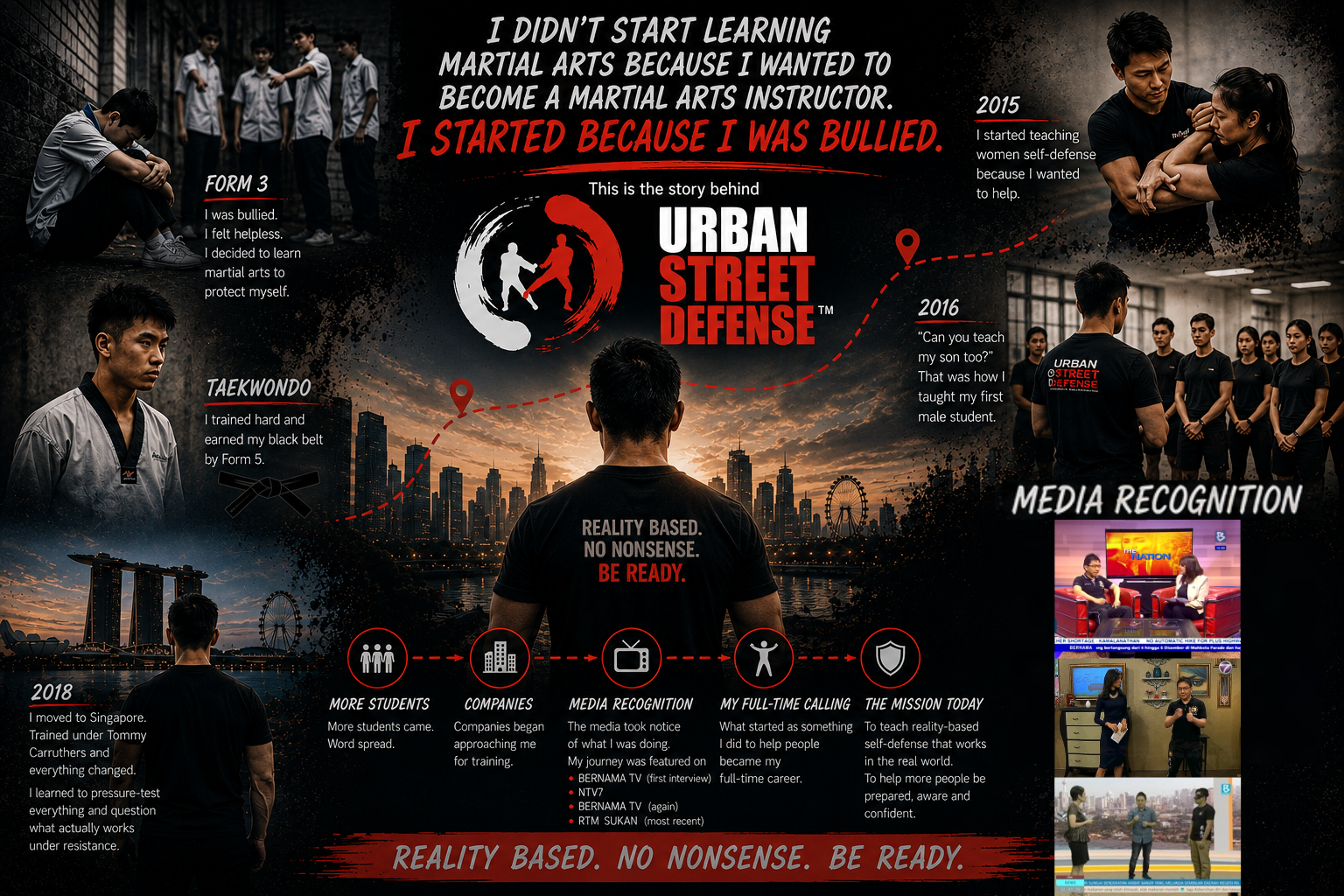
I didn’t start learning martial arts because I wanted to become a martial arts instructor. I started because I was bullied.
Urban Street Defense was created in 2015, but the story behind it started much earlier.
1999 — Where It All Started
When I was in Form 3, I experienced bullying at school. I knew what it felt like to feel vulnerable and not know how to protect myself. Towards the end of Form 3, I decided to start learning Taekwondo. I became deeply committed to training and eventually earned my black belt by Form 5. But even after earning my black belt, I felt that something was missing. I had learned techniques, forms after forms, controlled sparring. I had trained hard to achieved the rank I had worked towards.
Yet one question kept coming back to me:
“Would this actually work if someone really attacked me?”
I didn’t have the answer. So I kept searching.
2007–2014 — The Search for Something More
I went on to study different martial arts and trained under two different Wing Chun sifus. Eventually, my journey led me to Bruce Lee’s Jeet Kune Do. I trained with different instructors and eventually learned from two masters with very different areas of expertise. Every stage taught me something new. But more importantly, I began to understand that martial arts isn’t simply about collecting techniques or achieving the next rank. It is about constantly questioning what you think you already know.
The more I trained, the more I wanted to understand one thing:
“What actually works when someone doesn’t cooperate?”
2015 — Why I Started Teaching
In 2015, I started my own training school, Urban Street Defense. At the time, I was primarily teaching Jeet Kune Do, and my teaching approach was still very different from what I teach today.
And I didn’t start teaching because I wanted to make money. There was another reason. My aunt was involved with an NGO, and through her I became aware of many domestic violence cases involving women.
Those stories impacted me, and I kept thinking about how vulnerable these women must have felt and whether I could do something to help. So I decided to start teaching women’s self-defense.
In the beginning, I focused entirely on women.
Then, in 2016, one of the parents asked me:
“Can you teach my son too?”
That was how I ended up teaching my first male student. And from there, everything started to change.
More students came.Word spread.
Eventually, companies began approaching me for training. Then something I never expected started happening.
The Media Began Taking Notice
I was first interviewed on BERNAMA TV, followed by NTV7, then another feature on BERNAMA TV, and most recently, RTM Sukan.
What started as something I was doing simply because I wanted to help people gradually grew into something much bigger.
2016 — My First Training Centre
As the programme grew, I eventually rented my own training space at Sunway Mas Commercial Centre. It was a major milestone. Something that started with me simply wanting to help people had grown into a real business. But the journey wasn’t straightforward. In 2018, I made the decision to close the centre in Malaysia and move to Singapore for work. At the time, I didn’t realise that this would become one of the most important turning points in my martial arts journey.
2018 — Singapore Changed My Perspective
While I was in Singapore, I discovered another Jeet Kune Do school under Sifu Tommy Carruthers (IFO). What I experienced there fundamentally changed the way I looked at martial arts and self-defense. It wasn’t simply about learning more techniques. It was about questioning whether the things I had been practising for years actually held up when someone resisted, moved unpredictably and didn’t cooperate.
So I started pressure-testing. Things that looked good during controlled training didn’t always work the same way when the situation became chaotic.
That forced me to confront an uncomfortable question:
“If a technique only works when the attacker behaves exactly as expected, how useful is it in a real fight?”
That question changed everything.
2019–Present — From Martial Arts to Reality-Based Self-Defense
My focus gradually shifted. I became less interested in collecting techniques and more interested in finding what actually worked. I began looking at self-defense differently.
Real violence doesn’t come with a script.
You don’t know exactly what attack is coming.
You don’t know how the person will react.
You don’t know where you’ll be standing.
You don’t know whether there will be one attacker or more.
You don’t know whether a weapon will appear.
You don’t know whether you’ll freeze, panic or react differently from how you imagined during training.
There are simply too many variables. I started calling this the Infinite Variables of violence. And that became one of the foundations of what I teach today.
I began moving away from fixed scenarios, rehearsed responses and techniques that depended on a predictable attack.
Instead, I became increasingly focused on:
Simplicity. Adaptability. Pressure-testing. And the ability to respond when things don’t go according to plan.
The Journey Continues
Urban Street Defense has come a long way from where it began in 2015. From my original training location in Petaling Jaya, the school eventually expanded to Ipoh and continued to evolve along with my own understanding of self-defense.
After more than 20 years of training, teaching, questioning and pressure-testing, I’ve learned that I don’t have all the answers.
I also have deep respect for all martial arts. After all, martial arts is where my own journey began, and it has shaped who I am today.
But I believe in always asking one question:
“Does what we train actually prepare us for reality?”
That question started my journey. And it continues to drive me today.
From a bullied teenager who simply wanted to protect himself, to building a reality-based self-defense system designed to help others do the same.
A clean technique can look convincing when your partner stands still, waits their turn, and gives you space. Real violence does not work like that. It is sudden, loud, close, confusing, and often over before you have time to think. What is pressure testing? It is training that adds realistic stress so you can find out whether a self-defense response still works when your heart rate rises and your plan starts to fall apart.
Pressure testing is not about proving who is toughest in the room. It is about exposing gaps safely, building usable reactions, and learning to make better decisions when conditions are bad. No fancy moves. No rehearsed victory. Just action that holds up when pressure hits.
What Is Pressure Testing and Why Does It Matter?
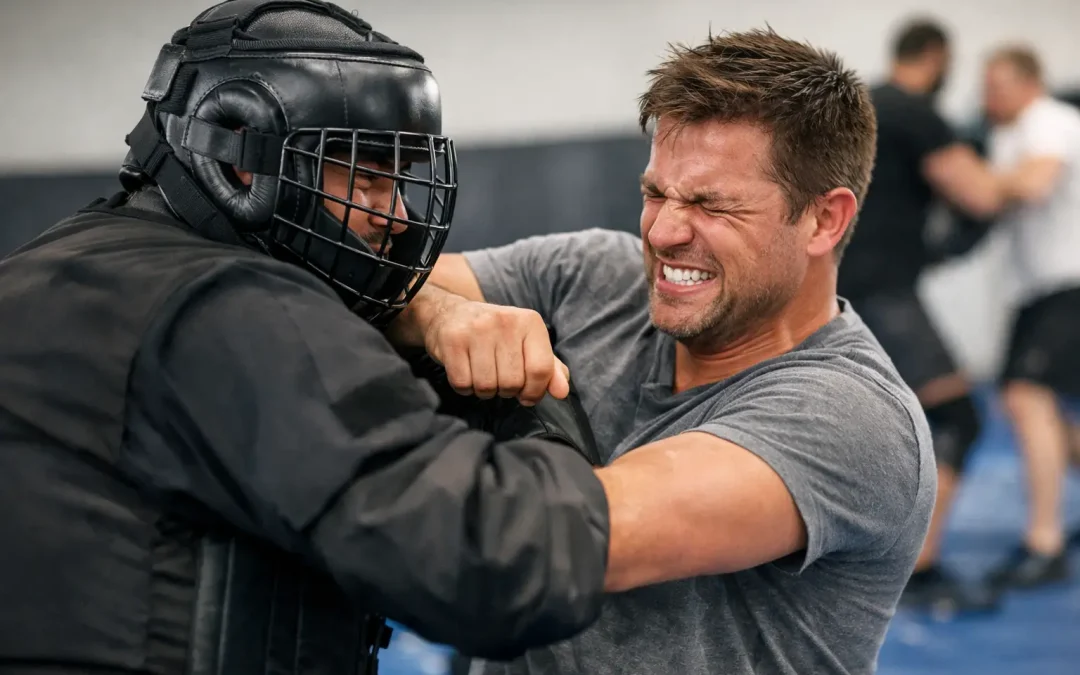
Pressure testing puts a technique, tactic, or decision under controlled resistance. Your training partner may move unpredictably, resist your escape, talk aggressively, crowd your space, or force you to react from an awkward position. The intensity is adjusted to your experience, fitness, and the goal of the drill.
The key word is controlled. Realistic training does not mean reckless training. It means creating enough uncertainty that you cannot simply perform a memorized sequence. You must recognize the problem, protect yourself, create space, act decisively, and leave.
This matters because stress changes behavior. Fine motor skills get worse. Your vision can narrow. You may freeze, rush, hesitate, or forget techniques you could perform perfectly five minutes earlier. A complicated response that needs ideal timing, perfect balance, and a cooperative opponent is a poor bet for personal safety.
Pressure testing helps strip your response down to what is simple, direct, and repeatable. It shows you whether your stance collapses when pushed, whether you can speak firmly under intimidation, whether you notice exits, and whether you can move after contact begins. Those are the questions that matter outside the gym.
Pressure Is More Than Hard Sparring
Many people hear the term and picture two people trading punches at full speed. Sparring can be useful, but pressure testing is broader than sparring. A real self-defense problem may start with someone blocking your path, grabbing your wrist, crowding you in an elevator, confronting you at your car, or escalating after an argument.
A good pressure-tested drill can include verbal boundary setting, awareness, movement, escape routes, physical contact, and the decision to disengage. It can also include scenarios where the correct answer is to leave early rather than fight.
For example, a beginner may start with a partner stepping into their space and using a loud, confrontational voice. The student practices setting a clear boundary, moving to a safer angle, and getting away. Later, the drill may add a grab, protective gear, resistance, and limited striking or escape options. The objective stays the same: get safe, not win points.
Sport training and self-defense training can overlap, but their priorities are not identical. A sport match has rules, a referee, a known start time, and usually one opponent. Street violence may have none of those. Pressure testing should reflect the actual problem you are preparing to handle.
What Good Pressure Testing Looks Like
Good pressure testing has purpose. It is not an excuse for instructors or advanced students to overwhelm beginners. Every drill should answer a practical question: Can you make space from a grab? Can you protect your head while moving? Can you get up safely? Can you recognize when talking is no longer working?
The pressure should also be progressive. Throwing an untrained person into a high-intensity scenario on day one can create panic without teaching useful skills. Start with simple movement and clear roles. Add resistance, speed, noise, surprise, and fatigue as the student develops control.
Equipment matters when contact increases. Gloves, mouthguards, head protection, pads, and appropriate rules help people train with enough intensity to learn without collecting unnecessary injuries. The aim is honest feedback, not damage.
A quality instructor watches closely and changes the drill when needed. Some students need more repetition before intensity. Others need to slow down and regain structure because they are relying on wild swings or tunnel vision. Pressure should reveal behavior, then training should improve it.
Resistance must be realistic
A partner who lets you complete every technique teaches you nothing about resistance. At the same time, a partner who turns every drill into a competition can stop learning entirely. Realistic resistance means the partner makes the task difficult in ways that fit the scenario.
If you are practicing an escape from a wrist grab, the partner should grip with intent, adjust when you move, and make you work for the exit. They should not transform the drill into a surprise takedown unless that is part of the agreed lesson. Clarity keeps training useful and safe.
Decision-making belongs in the drill
Physical skill is only one part of personal safety. Pressure testing should make you think about distance, obstacles, bystanders, exits, and whether you can leave before the situation turns physical.
Sometimes the strongest response is a loud command and immediate movement toward safety. Sometimes you need to use force to break contact long enough to escape. The circumstances matter. Training should build judgment, not a habit of fighting every problem.
Recovery is part of the lesson
You will make mistakes under pressure. Everyone does. You may lose balance, miss a strike, freeze for a second, or use the wrong response. The value is in what happens next.
Can you cover up, regain your position, keep moving, and continue toward escape? Can you review the drill without excuses and identify one correction for the next round? Pressure testing builds resilience when students learn to recover instead of treating every error as failure.
Common Myths About Pressure Testing
The first myth is that pressure testing means full-contact fighting every class. It does not. Intensity is a tool, not the entire program. A beginner can experience pressure through timing, verbal confrontation, limited space, and controlled resistance before heavy contact is appropriate.
The second myth is that pain proves realism. Pain can teach a lesson, but it is not the goal. A training environment that injures people, humiliates them, or ignores consent will eventually reduce attendance and damage learning. You need challenge with standards.
The third myth is that one successful drill proves a technique will always work. It does not. Size, strength, environment, surprise, weapons, multiple attackers, and your own stress level change the situation. Pressure testing does not offer guarantees. It helps you choose higher-percentage actions and recognize when a tactic is failing.
The final myth is that only experienced fighters need this training. Beginners may benefit most because they quickly learn the difference between knowing a move and being able to use it. The process should be scaled, coached, and repeated. Confidence should come from tested ability, not wishful thinking.
How Pressure Testing Builds Real Confidence
False confidence says, “I know what I would do.” Real confidence says, “I have faced resistance before, I know what stress feels like, and I can still take the next useful action.” That is a major difference.
Repeated exposure to manageable pressure helps reduce the shock of confrontation. You become more familiar with close range, loud voices, resistance, and physical effort. You learn that you can breathe, move, protect yourself, and make decisions even when the situation feels uncomfortable.
It also creates humility. You discover that distance disappears quickly, that balance is easy to lose, and that simple techniques need practice. That humility is valuable because it encourages awareness, avoidance, and early action. The best self-defense encounter is still the one you leave before violence begins.
At Urban Street Defense, pressure is introduced with purpose: to help students develop instinctive responses without pretending that real danger follows a script. The training is built around practical movement, direct action, and the ability to adapt when the first plan does not work.
A Better Standard for Self-Defense Training
When you assess a self-defense class, do not only ask what techniques are taught. Ask how those techniques are tested. Are students working against realistic resistance? Do drills include movement, stress, verbal boundaries, and escape? Is the training adjusted for beginners while still progressing toward honest intensity?
Also ask whether the class values safety and control. Effective training should challenge you, not feed someone else’s ego. You should leave with clearer lessons, better awareness, and skills you can build on.
Personal safety is not about collecting moves. It is about being able to act when your body wants to freeze and your environment gives you no perfect answer. Train simply. Train honestly. Then keep showing up until your response becomes harder to shake.
A safety briefing can fill a room, collect signatures, and still leave people frozen when a situation turns hostile. That is the hard truth behind corporate safety program results: attendance is not readiness. A program earns its value when employees can spot danger early, make sound decisions under stress, and take immediate action without waiting for perfect conditions.
For employers, this is not about turning staff into fighters or creating fear around the workplace. It is about giving people practical options when commuting, traveling, working late, meeting the public, or dealing with an escalating confrontation. The right training builds awareness first, confidence second, and physical response only where it is necessary.
What Corporate Safety Program Results Should Actually Show
The easiest numbers to report are completion rates, satisfaction scores, and the number of training hours delivered. They matter, but they do not tell the full story. A team can enjoy a workshop and still fail to apply a single skill when pressure arrives.
Strong results show up in behavior. Employees become more alert to their surroundings in parking areas, elevators, ride-share pickups, and unfamiliar venues. They know how to set boundaries clearly, move toward safer spaces, get attention from others, and report concerns earlier. Managers see more useful incident reporting because staff understand what to look for and believe their observations will be taken seriously.
The final measure is decision-making. Can a participant explain the difference between an awkward interaction and a developing threat? Can they create distance rather than argue? Can they leave without feeling that they must win a confrontation? These are practical outcomes that reduce exposure before a situation becomes physical.
Lagging indicators are not enough
Organizations often judge safety by what did not happen: no reported assaults, no lost-time injuries, no major incident. That can be reassuring, but it can also hide a problem. Threats may go unreported. Employees may change their routines quietly because they do not feel safe. A near miss may be treated as bad luck instead of useful information.
Use lagging indicators, but pair them with leading indicators. Track whether staff report hazards and suspicious behavior, whether managers respond consistently, and whether employees can recall the actions taught in training. Look for changes in confidence, but do not mistake confidence alone for capability.
Why Awareness-Only Training Falls Short
Awareness is the first layer of personal safety, not the whole system. Telling people to stay alert, trust their instincts, or avoid dark places gives broad advice. It does not prepare them for the moment someone blocks their path, invades their space, grabs an arm, or refuses to accept a clear no.
Under stress, people do not rise to the level of a polished presentation. They fall back on what they have practiced. If training has been entirely theoretical, the response is likely to be hesitation, confusion, or a technique too complicated to remember.
That is why realistic corporate training must stay simple. A participant should practice verbal boundary setting, body positioning, escape routes, and basic movement under controlled pressure. The goal is not choreography. The goal is an instinctive response that works while the heart rate rises and the mind is busy.
There is a trade-off. Training that feels more realistic can make some participants uncomfortable, especially if it is delivered without care or clear boundaries. The answer is not to remove all pressure. It is to scale it properly. Start with accessible drills, explain the purpose, allow opt-out choices where appropriate, and increase intensity only when participants are ready.
Measure the Skills That Matter
A useful evaluation begins before the session. Ask employees where they feel exposed: commuting after dark, handling angry customers, traveling alone, working off-site, or entering isolated parking areas. Risks differ between a customer-facing team, a sales force, and an office-based department. One generic lecture will not fit every group.
After training, assess whether people can apply core actions in short scenarios. Keep the test practical, respectful, and focused on safety rather than athletic ability. For example, participants may need to identify an exit, use a firm verbal command, maintain distance, and move toward help. In a more advanced session, they might practice safely breaking contact and leaving an immediate threat area.
Four measures give HR and learning teams a clearer view of progress:
Recall: Can employees name the key actions without prompts a few weeks later?
Recognition: Can they identify early warning signs in realistic workplace and travel scenarios?
Response: Can they use simple verbal and physical safety actions under manageable pressure?
Reporting: Do they know exactly who to contact and what information to provide after an incident or near miss?
These measures should not become a pass-or-fail obstacle course. Their purpose is to expose gaps while there is time to fix them. If most participants struggle with a scenario, the training design needs work. Blaming the employees misses the point.
Turn a One-Time Workshop Into Lasting Readiness
A single workshop can create momentum, especially for teams that have never received practical personal-safety instruction. It cannot carry the entire safety culture. Skills fade when they are not revisited, and policies disappear from memory when nobody talks about them.
The strongest programs use a short initial course followed by brief refreshers. A 15-minute scenario discussion during a team meeting can reinforce a major lesson. A quarterly practical session can revisit movement, verbal responses, and reporting procedures. New hires should receive the same foundation rather than relying on secondhand advice from colleagues.
Managers play a major role. If a manager dismisses a concern as overreacting, staff learn to stay quiet. If a manager responds quickly, documents the issue, and checks whether the employee needs support, the program becomes real. Corporate safety is not only a training-provider responsibility. It is a leadership behavior.
Clear procedures matter too. Employees need to know what happens after they raise a concern, who escorts someone to a vehicle when needed, how travel check-ins work, and when security or emergency services should be contacted. Physical skills are one part of the response. Communication and follow-through keep the system from breaking down.
Build Training Around Real Exposure
The most effective safety programs do not copy sport martial arts classes or rely on ceremonial forms. A corporate team does not need belts, complicated combinations, or impressive-looking moves. It needs actions that are easy to learn, easy to recall, and useful in tight spaces, work clothes, and everyday shoes.
At Urban Street Defense, corporate sessions are built around scenario-based learning and simple, direct responses. That approach suits beginners because it does not demand years of technical training before participants gain useful skills. It also gives experienced martial artists a reality check: what works in a controlled class may not be the best choice in a crowded lobby, a car park, or a tense customer interaction.
Context matters. A frontline retail team may need stronger skills for verbal de-escalation and calling for support. Employees who travel between sites may need more focus on situational awareness and vehicle approach safety. Women-focused groups may want to address boundary violations, unwanted contact, and escape from common grabs. Private instruction can help leaders or at-risk employees work through specific concerns discreetly.
The question is not whether every employee needs the same level of physical training. They do not. The question is whether every employee has a practical safety baseline and whether higher-risk roles receive training that matches their exposure.
The Result That Matters Most
Good corporate safety program results are not measured by how tough a team looks after a workshop. They are measured by whether people feel prepared to act early, leave safely, support one another, and speak up before a warning sign becomes an incident.
Give employees something they can use on the walk to their car, during a difficult conversation, and in the first seconds of an unexpected threat. No fancy moves – just clear thinking, direct action, and practice that holds up when it counts.
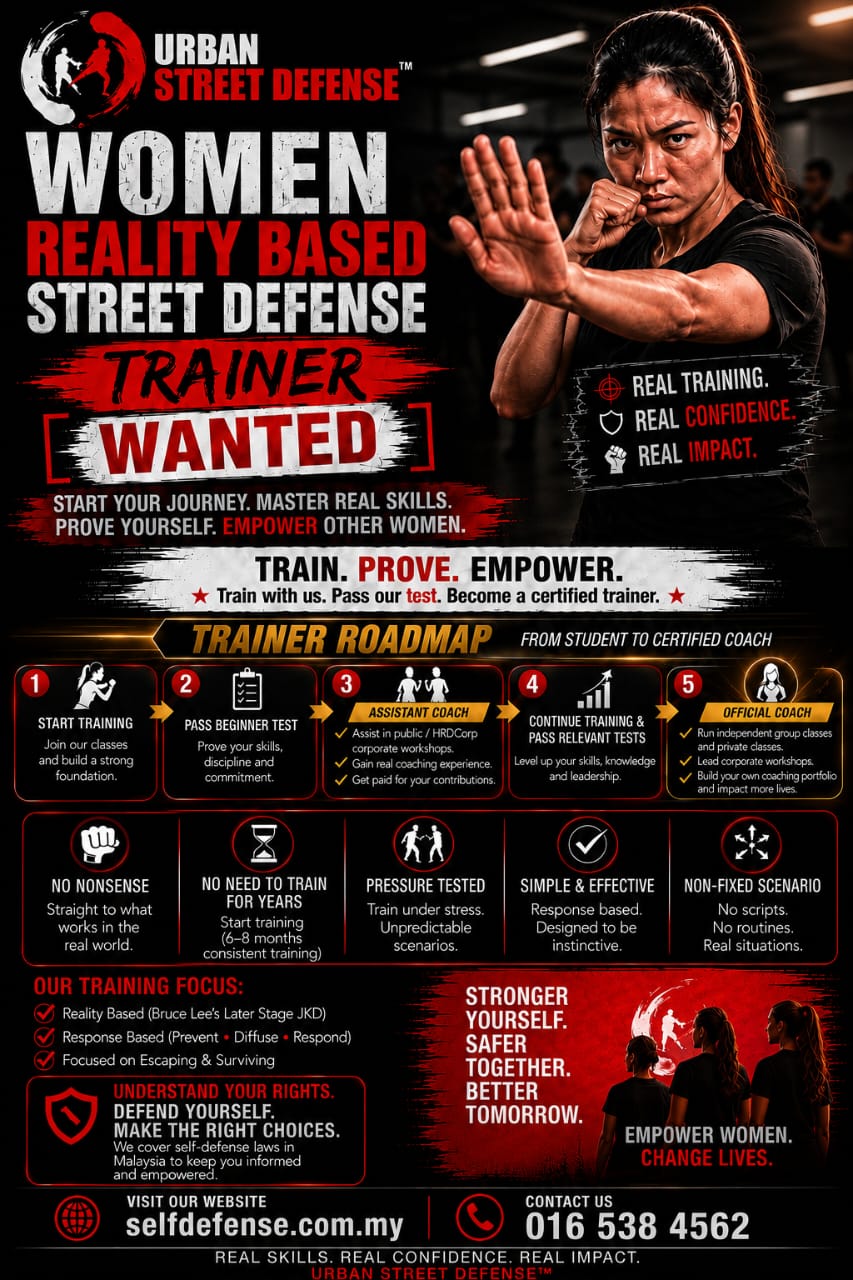
Turn your interest into real skills, confidence and a career opportunity in self-defense with Urban Street Defense.
Our Women’s Reality-Based Street Defense pathway is designed not only to build practical self-defense skills, but also to develop women into future self-defense trainers in Malaysia.
And no, you don’t need years and years of training to learn what you actually need for self-defense. We challenge the traditional perception that effective self-defense requires years of martial arts training. Instead, we focus on what is necessary, practical and effective for real-world safety, without wasting time on techniques you may never need.
Here’s a simple ROAD MAP to becoming an Urban Street Defense Coach: Start as a student → Complete 6–8 months of consistent training → Pass your Beginner Test → Become an Assistant Coach → Continue training & pass the relevant assessments → Become an Official Coach.
As you progress, you can gain real coaching experience, get paid for your contributions, assist in HRDCorp corporate self-defense workshops, conduct group or private classes, lead workshops and build your own coaching portfolio.
Your women’s self-defense training can become more than a personal skill, it can open the door to professional growth, a coaching career and additional income.
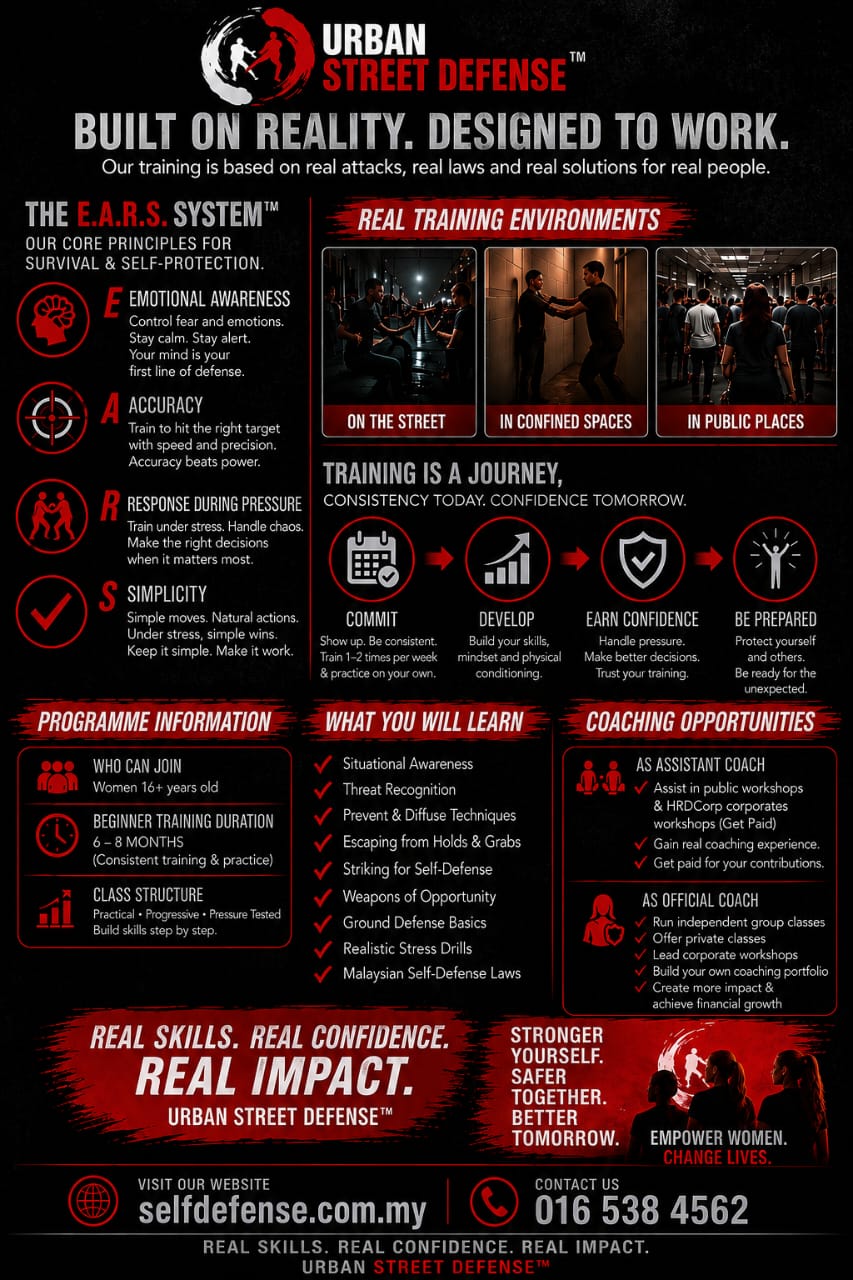
Our reality-based self-defense training in Malaysia focuses on practical skills, pressure-tested responses and real-world situations, guided by our E.A.R.S. System™ — Emotional Awareness, Accuracy, Response During Pressure and Simplicity.
TRAIN. PROVE. EMPOWER.
If you have the interest, commitment and motivation to learn and eventually empower other women, this could be your next step. Contact us at 016-5384562 to get more information.
A threat does not arrive with a warning bell, a referee, or time to remember a complicated sequence. It can happen beside your car, in a parking structure, on the walk home, at work, or during travel. That is why self defense classes Kuala Lumpur residents choose should train more than techniques. They should train awareness, decision-making, movement, and the ability to act when adrenaline hits.
Real self-defense is not about looking impressive. It is about creating a chance to get away safely. The right training makes your responses simpler, faster, and more reliable under pressure.
What Self Defense Classes in Kuala Lumpur Should Teach
A useful class starts with reality. Most people do not need a collection of ceremonial forms or a long list of moves designed for a cooperative partner. They need to recognize danger early, set boundaries clearly, move to a safer position, and respond decisively if physical contact becomes unavoidable.
That requires training against common urban situations: an aggressive approach, unwanted grabbing, being crowded against a wall, an attempted restraint, or an attack that begins at close range. Distance matters. Position matters. Your ability to keep moving matters. So does the judgment to leave before a situation becomes physical.
Good instruction also makes room for an uncomfortable truth: there is no guaranteed technique. Size, fitness, environment, surprise, multiple attackers, and weapons can change everything. A responsible program does not sell false certainty. It gives you practical options, builds better habits, and teaches you to prioritize escape over winning.
Look for classes that emphasize four essentials:
Awareness of surroundings, behavior, exits, and warning signs
Clear verbal boundaries and the confidence to use them
Simple physical responses that work from natural positions
Pressure-based practice that reveals what you can do under stress
The last point separates knowing a move from being able to use it. A technique practiced slowly with a willing partner can feel effective. Add speed, resistance, noise, surprise, and fatigue, and the experience changes. Training must eventually reflect that reality in a controlled, responsible way.
Why Reality-Based Training Matters
Street violence is messy. You may be carrying a work bag, wearing office clothes, dealing with poor lighting, protecting a friend, or trying to reach your vehicle. You may freeze for a moment. You may not have room to kick. You may be off balance before you even understand what is happening.
Reality-based self-defense training prepares for those imperfect conditions. It favors direct actions over complicated patterns and repeated practice over theory alone. The goal is not to memorize dozens of answers. It is to build a small set of dependable responses and the instinct to use them.
Jeet Kune Do-inspired training follows this mindset well: simplicity, directness, adaptability, and effectiveness. There is no need to force every problem into one style or one perfect technique. Use what fits the moment. If a response fails, adjust. If an exit opens, take it.
This approach is especially useful for beginners. You do not need years of martial arts experience before learning how to stand with better balance, protect your space, strike with purpose, break contact, and move away. Experience helps, but practical foundations can begin in the first session.
At Urban Street Defense, the focus is on functional action rather than choreography. Students work through situations that demand attention, movement, and decisive responses. The environment is supportive, but the purpose is serious: build skills you can access when you are stressed, tired, and surprised.
What to Expect From Your First Class
Your first class should not be an ego test. It should be a place to learn the basics safely and honestly. A capable instructor will explain the purpose of each drill, scale intensity to the group, and correct movements before pushing speed or resistance.
Expect to work on posture, distance, footwork, protective positioning, and simple striking mechanics. You may practice escaping common grips or handling an aggressive approach. The point is not to prove toughness on day one. It is to understand how your body reacts and begin replacing hesitation with usable action.
Wear comfortable clothes you can move in. Leave jewelry and anything loose at home. Bring water, arrive ready to pay attention, and tell the instructor about injuries or physical limitations. Training can be adapted, but instructors need accurate information to do that well.
You should also expect some discomfort. Not injury or reckless contact, but the mental discomfort of being challenged, pressured, and asked to react. That is part of the value. Confidence is not pretending danger cannot happen. Confidence is knowing you have practiced what to do next.
Group, Private, and Corporate Training: Which Fits?
The best format depends on your goal, schedule, and starting point. Group classes offer repetition, partner variety, and a community that keeps you accountable. They are a strong choice if you want ongoing development and regular pressure-based practice.
Private instruction gives you more flexibility and focused coaching. It can suit professionals with limited time, beginners who want extra confidence before joining a group, or people working toward a specific safety concern. Private-group sessions can also work well for families, friends, or small teams who want to train together.
For employers, corporate self-defense training addresses a different need. Staff may commute late, travel for work, meet clients off-site, or work in public-facing roles. A well-run workplace session should be practical, inclusive, and relevant to the actual environment. It should cover awareness, de-escalation, personal boundaries, and simple protective actions without turning the program into a fitness contest.
Women-focused crash courses can offer a direct entry point for people who want concentrated, practical instruction. They are not a replacement for continued practice, because skills improve through repetition. But a focused course can provide immediate tools, stronger awareness, and a clear plan for what to do when a situation feels wrong.
How to Judge a Self-Defense School Before You Commit
Ask direct questions. Does the school explain how drills connect to real situations? Is there controlled resistance, or do partners always cooperate? Are students taught to escape and de-escalate, or only to fight? Can beginners train safely? Are classes built around useful movement rather than rank, ritual, or performance?
Watch how instructors speak about violence. Be cautious of anyone promising that one move will stop every attacker or teaching students to chase confrontation. Effective training respects the risks. It teaches avoidance first, action when necessary, and escape whenever possible.
Class size matters too. In a crowded room, you may get less feedback and fewer opportunities to practice properly. Smaller groups often give instructors more room to correct technique, manage intensity, and make sure students are not merely going through motions.
Finally, choose a program you can attend consistently. One workshop can change how you think about safety. Regular training changes how you move, respond, and carry yourself. The best system is the one that is practical enough to use and structured enough to keep you coming back.
Build Readiness Without Living in Fear
Personal safety is not about becoming suspicious of everyone around you. It is about paying attention, trusting your judgment, and refusing to surrender your choices when pressure appears. Notice the exit. Keep your phone accessible without being distracted by it. Create distance when someone ignores a boundary. Leave early when your instincts tell you something is off.
Physical self-defense adds another layer. It gives you options when awareness and words are not enough. Train for reality, practice consistently, and measure progress by how clearly you can think and act under pressure. Better. Faster. Stronger.