by Founder of USDC | 4th September 2026 | General Safety Topics
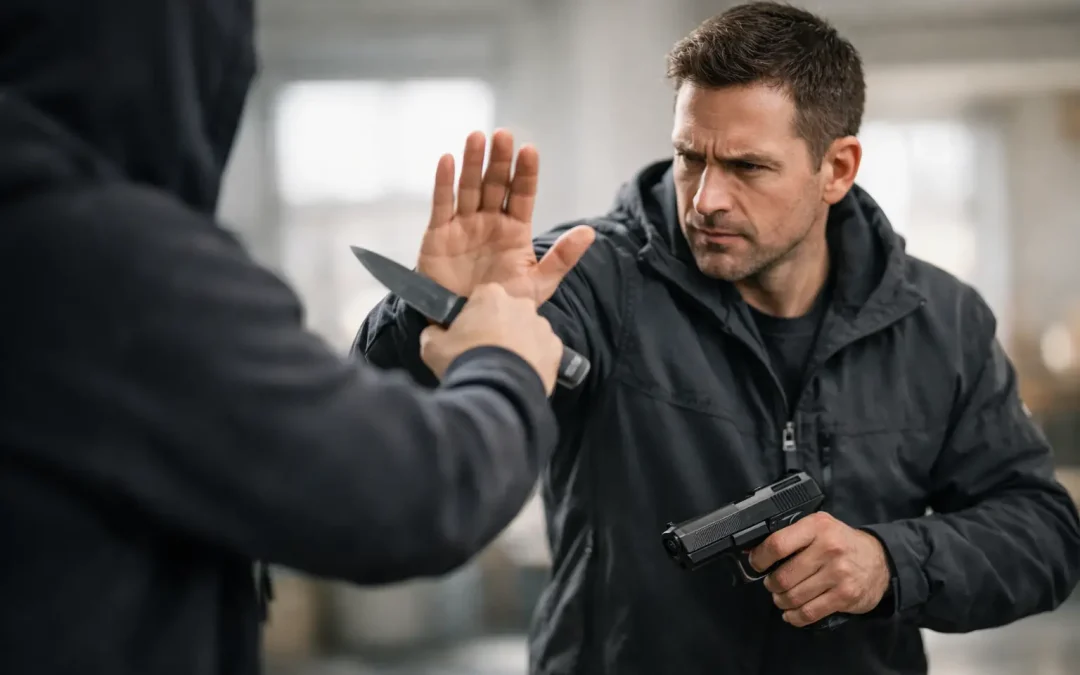
A stranger closes distance on the train platform. Their voice gets louder. Their hands are moving. You do not have time for a perfect speech or a complicated technique. Deescalation versus physical resistance is not an argument about which response is tougher. It is a fast safety decision: can you create space and leave, or is immediate physical action necessary to stop harm?
The goal is never to win a confrontation. The goal is to get home safe. That means recognizing danger early, refusing to let ego take control, and having a simple response when words no longer work.
The Decision Is Not About Winning
Most confrontations do not begin with punches. They begin with pressure: aggressive questions, unwanted attention, insults, someone blocking your path, or a person moving too close after you have asked for space. Many can be interrupted before they become physical. That is where deescalation matters.
But deescalation is not submission. It is not standing still and hoping an aggressive person suddenly becomes reasonable. It is an active process of reducing risk while positioning yourself to leave. You use your voice, your awareness, your movement, and the people around you to make yourself a harder target.
Physical resistance has a different job. It is for the moment an attacker is already using force, is about to use force, or will not allow you to escape. Its purpose is not to punish, prove a point, or control someone indefinitely. Its purpose is to break contact, create an opening, and get away.
That distinction matters because the wrong mindset creates bad decisions. Trying to “talk it out” with someone who has already committed to violence can cost precious seconds. Throwing hands when a clear exit exists can turn a verbal incident into a dangerous fight.
Deescalation Versus Physical Resistance: The Real Divide
The dividing line is not whether someone is rude, angry, drunk, or bigger than you. It is whether you still have a safe, realistic path to disengage.
Deescalation works best when the other person still has choices. They may be upset, embarrassed, intoxicated, or looking for attention, but they are responding to boundaries and have not trapped you. Your job is to keep your communication brief, non-provocative, and clear. Say what you need once: “I don’t want trouble.” “Please step back.” “I’m leaving.” Then move toward safety.
Do not debate. Do not trade insults. Do not explain yourself repeatedly. Long conversations create more opportunities for manipulation, distraction, and escalation. A calm voice can help, but calm does not mean passive. Keep your hands up naturally in front of your body, maintain distance, and angle your body toward an exit.
Physical resistance becomes more likely when the person ignores repeated boundaries and their behavior shows immediate intent or ability to harm you. A grab, choke, attempted forced movement, weapon threat, cornering, or assault changes the problem. At that point, verbal skill alone may not solve it.
Read the Threat, Not Your Ego
Real threats are messy. There is no alarm that announces when a situation has crossed the line. You need to notice behavior, environment, and access to escape.
Watch for four warning signs that demand immediate attention:
- The person is closing distance despite your attempts to move away.
- They are blocking doors, paths, or your access to other people.
- Their hands disappear from view, clench, reach for you, or move toward a waistband or bag.
- They make threats, attempt to isolate you, or start touching you without consent.
One sign does not always guarantee an attack. A crowded elevator, a noisy street, or an accidental bump can create confusion. Context matters. Still, you do not need courtroom-level proof before taking safety measures. Trust the pattern. If someone is making you feel trapped, create distance early.
This is also why awareness beats bravado. Looking at your phone with earbuds in while walking through an empty parking area reduces your reaction time. So does allowing a stranger to lead you to a quieter location to “talk.” Stay where people can see you. Move toward light, staff, security, or a populated business whenever possible.
When Talking Stops Being the Safer Option
There is no magic phrase that controls an attacker. Some people want money. Some want power. Some are under the influence. Some are looking for an easy victim. Your words may help, but they are not a force field.
If a person grabs you, tries to drag you somewhere, pins you, begins striking, or presents a credible immediate threat, your priority changes. Protect your head and balance. Attack vulnerable targets only as necessary to create a chance to escape. Move with urgency. Run when you can. Get to people. Call for help.
This is where fantasy techniques fail. Under adrenaline, fine motor skills drop. You may lose grip strength, timing, and memory. A response that depends on ten precise steps, perfect leverage, or an opponent cooperating is not a reliable plan for a parking lot, hallway, elevator, or moving train.
Simple actions hold up better: establish a protective position, strike or disrupt when necessary, break away from the hold, and leave. The exact response depends on the threat, your physical condition, the environment, and whether there are multiple attackers or weapons involved. There are no guarantees. But doing nothing because you are waiting for the “right” technique is rarely a strategy.
What Physical Resistance Should Actually Do
Effective self-defense is not about collecting moves. It is about creating a result under pressure. In a real encounter, physical resistance should do three things: protect you from immediate injury, disrupt the attacker’s ability to continue, and give you an exit.
That may mean using your forearms to shield your head while moving off line. It may mean breaking a grip and driving away. It may mean using your voice loudly enough to draw attention while you escape. The details change, but the objective does not.
Avoid getting locked into a fight after you have an opening. Many people make the mistake of continuing after they could leave because anger takes over. That is dangerous physically, legally, and tactically. The attacker may have friends nearby, retrieve a weapon, or recover faster than expected. Escape is the finish line.
Local laws differ, and any use of force can carry legal consequences. In general, the more clearly you can show that you acted to stop an immediate threat and get away, rather than to retaliate, the stronger your safety decision will be. Once you are safe, contact emergency services, seek medical attention, and document what happened while details are fresh.
Why Training Changes the Decision
Knowing that deescalation is preferable when possible is easy. Making that judgment while your heart is racing is harder. Stress narrows vision, makes time feel strange, and can freeze even strong, confident people.
That is why practical training must include more than techniques. You need scenario work. You need to practice verbal boundaries, movement, distance management, protective posture, escape decisions, and simple physical responses against realistic resistance. You need to feel pressure in a controlled setting before you face it unexpectedly outside.
At Urban Street Defense, the focus is not ceremonial forms or impressive choreography. It is building direct, adaptable responses that work when you are tired, startled, off balance, or afraid. Pressure-oriented practice teaches a crucial lesson: you may not perform perfectly, but you can still act effectively.
Training also helps people avoid unnecessary violence. When you have confidence in your ability to move, speak, and protect yourself, you are less likely to panic, posture, or let pride pull you into a fight. Real readiness makes you calmer because you have options.
Build Your Response Before You Need It
Start with a personal rule: create distance at the first sign that something feels wrong. You do not owe a stranger access to your space, your time, or your attention. Practice clear phrases out loud so they come naturally. “Stop.” “Back up.” “Don’t touch me.” Short words are easier to use under stress.
Next, look at your daily routes. Where do you park? When do you commute? Which areas are isolated? Where are the exits, security desks, brighter streets, and places where you can ask for help? This is not paranoia. It is preparation.
Then train your body and judgment together. A self-defense class should not merely show you what to do after someone grabs you. It should teach you how to recognize the setup, manage the space before contact, respond decisively if contact happens, and leave without hesitation.
The strongest response is not always verbal, and it is not always physical. It is the response that gives you the best chance to break the threat, keep control of your choices, and walk away. Better. Faster. Stronger.

by Founder of USDC | 2nd September 2026 | General Safety Topics
A stranger closes distance fast. Your exit is behind them. They ignore your clear command to stop. This is the moment people mean when they ask, when should you use force? Not when an interaction feels awkward. Not to prove a point. Force is for stopping an immediate threat and creating a safe way out.
Real self-defense is not about winning a fight. It is about recognizing danger early, making a decision under pressure, and doing what is necessary to escape. That distinction matters because the wrong response can make a bad situation worse. The right response can give you the seconds and space you need to get home.
When Should You Use Force in Self-Defense?
Use force only when you reasonably believe you face an immediate threat of unlawful physical harm and cannot safely avoid it. The purpose is defensive: stop the threat, break contact, and leave. It is never punishment, revenge, or a way to control someone after the danger has passed.
The key word is immediate. An insult, rude gesture, argument, or social-media threat may be upsetting, but none automatically justifies physical action. If a person is yelling from a distance and you can walk away, walking away is usually the stronger choice.
The situation changes when someone corners you, grabs you, attempts to strike you, tries to force you into a vehicle, or continues advancing after you have created distance and told them to stop. You do not need to wait passively to be hit if the threat is clearly imminent. But you do need to be able to explain why you believed harm was about to happen.
There is no perfect script for every encounter. Context decides a great deal: distance, size disparity, number of people involved, whether there is a visible weapon, available exits, the aggressor’s behavior, and whether someone vulnerable is with you. A person reaching into a bag after threatening you presents a different problem from a person shouting across a parking lot.
Your Goal Is Escape, Not Control
The cleanest self-defense decision is often made before contact. Trust warning signs. Move toward people, light, staff, security, or an open business. Keep an exit in view. Use your voice early and clearly: “Stop.” “Stay back.” “I do not want trouble.” A loud command can draw attention, set a boundary, and show that you tried to disengage.
If you can leave safely, leave. Do not stay to argue. Do not follow someone who walks away. Do not go back for the last word. An ego-driven return to the scene can turn a defensible situation into a dangerous one.
If escape is blocked and violence is imminent, act with a simple objective: create an opening and move. Under adrenaline, fine motor skills and complicated sequences fall apart. This is why reality-based training favors direct, natural responses practiced against pressure, not choreographed routines designed to look impressive.
A physical response should end when the immediate threat ends. If the aggressor backs off, falls away, or gives you a clear escape route, take it. Continuing to strike, chase, or restrain them can create serious legal and personal consequences. The safest fight is the one you leave.
Use Only the Force Needed to Stop the Threat
“Proportionate force” does not mean both people must use exactly the same action. It means your response should be reasonable in relation to the danger you face. A minor unwanted touch and a violent attempt to assault or abduct you are not the same situation. Nor is facing one unarmed person the same as being surrounded by several people.
Your response must also fit what you reasonably perceive at that moment, not what you discover later. If someone presents an immediate, credible threat, you may have very little time to assess it. Still, reasonable judgment matters. Fear alone is not enough if the facts do not support an imminent threat.
Avoid thinking of force as a ladder you must climb one rung at a time. Real violence is fast, messy, and unpredictable. You may have no chance to negotiate with someone already attacking. At the same time, going physical too early can escalate a confrontation that could have ended with distance, a boundary, or a call for help.
The practical question is simple: what is the least amount of action that gives you a real chance to get safe? Sometimes that means moving away and calling emergency services. Sometimes it means using your body to break free from an assault. The answer depends on the threat, not on pride.
Read the Signs Before the Attack
Many assaults are preceded by behavior that gives you a chance to act early. A person may invade your space, block your path, repeatedly ignore your refusal, scan around for witnesses, clench their hands, posture, or suddenly become quiet after being aggressive. None of these signs guarantees an attack. Together, especially when paired with blocked exits or verbal threats, they deserve attention.
Do not let politeness trap you. You are allowed to move away from someone who makes you uncomfortable. You are allowed to refuse a ride, leave a conversation, make noise, or seek help. You do not owe a stranger access to your personal space simply because they appear offended by your boundary.
For commuters, travelers, and people leaving work late, prevention is not paranoia. Keep your head up when approaching your car or building. Notice who is around you. Avoid being absorbed in your phone where you cannot see distance closing. If something feels wrong, change direction early. Early movement gives you choices. Waiting until someone is within arm’s reach removes them.
What to Do Once You Are Safe
Getting away is the priority. Once you reach a safe location, call emergency services or local authorities as appropriate. Seek medical attention, even if you think you are unhurt. Adrenaline can hide pain, and injuries may become clear later.
Report the incident honestly and stick to observable facts. Describe what happened, what the person said or did, why you feared immediate harm, what you did to get away, and where you went afterward. If there are witnesses, cameras, messages, damaged clothing, or visible injuries, preserve what you can without putting yourself at further risk.
Do not treat this article as legal advice. Self-defense laws vary by country, state, and local jurisdiction, and the facts of each incident matter. If force has been used, obtain qualified local legal advice as soon as possible. Knowing the law is part of responsible preparation, but it cannot replace sound judgment in the moment.
Train for Pressure, Not Performance
Knowing the principle is not the same as being able to apply it while scared, off-balance, and surprised. Under stress, people freeze, overreact, or rely on movements they have never tested against resistance. That is why practical training should include awareness, verbal boundaries, escape decisions, realistic distance, and controlled pressure drills.
You do not need fancy moves. You need reliable habits: protect yourself, create space, move toward safety, and disengage. Training should help you recognize when force is justified, but it should also train the discipline to avoid force whenever a safe exit exists.
At Urban Street Defense, that is the standard: no forms for show, no fantasy answers, and no promise that every situation is easy. The work is building a response that is simple enough to remember and effective enough to use when your heart is racing.
The best time to decide your limits is before someone tests them. Practice your voice. Notice exits. Learn to move under pressure. Then, if danger gives you no safe choice, act decisively to protect yourself and get away.
by Founder of USDC | 31st August 2026 | General Safety Topics
Wrist Grab Self Defense: Don’t Fight the Grip, Deal With the Threat
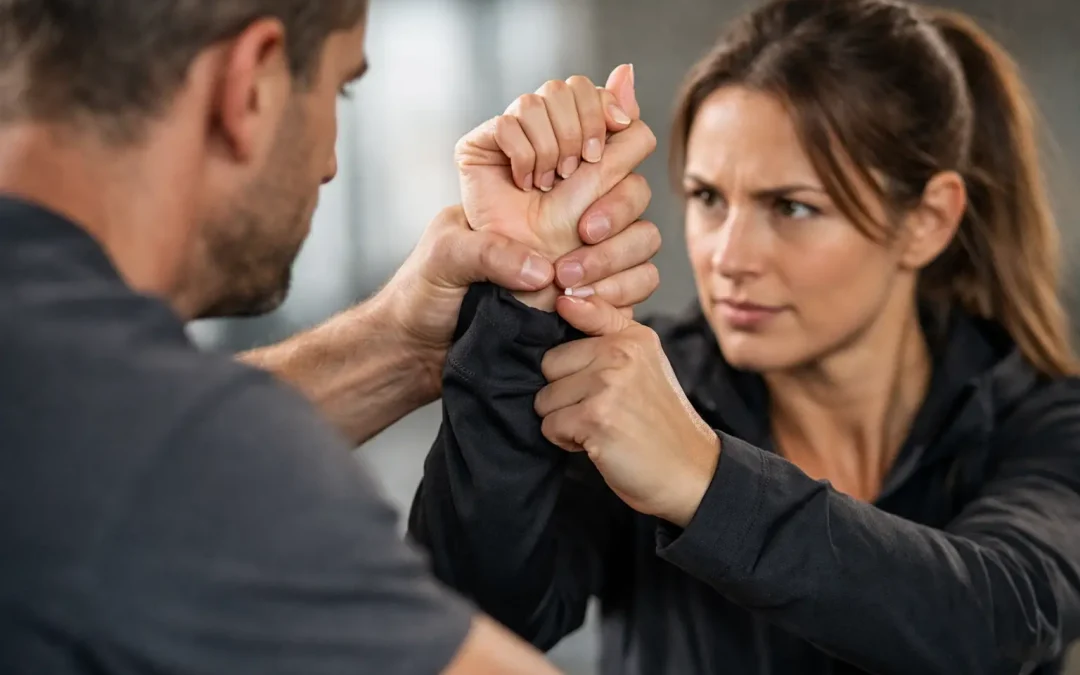
A wrist grab can happen before your brain has caught up. Someone catches your arm in a crowd, blocks you from leaving, pulls you toward a vehicle, or tries to control where you go.
The goal is not to win a grip-fighting contest.
In a chaotic situation, you may not have the time or mental capacity to identify a specific wrist grab, remember a particular technique, and perform a sequence perfectly. Your balance may be compromised, the attacker may be moving, and adrenaline can affect your coordination and decision-making.
That changes how you should train.
Instead of memorising different wrist grab escape techniques for different grips, focus on a simple principle: deal with the person, not the grip.
The First Rule: Do Not Let the Grab Become Control
A wrist grab can quickly become more than a wrist grab. The person may be trying to stop you from leaving, pull you closer, isolate you, or set up another attack.
The mistake is becoming too focused on getting your wrist free.
If someone grabs you, your attention should not be trapped on their hand. Stay on your feet, stay aware of your surroundings, and recognise the threat.
If necessary, use your voice. A clear command such as “Let go!” or “Back off!” can attract attention and make your intentions clear.
But remember: your objective is not to win the argument or the grip.
Your objective is to stop being controlled and get away.
Don’t Fight the Grip
Most people instinctively pull their wrist away when someone grabs them.
That can quickly turn into a tug-of-war.
Instead of trying to overpower the person’s grip or spending valuable time peeling fingers away, look at the bigger problem: the person who is controlling you.
If the situation requires a physical response, simple and direct actions toward vulnerable areas may create the opportunity you need to break contact.
You are not trying to perform a complicated combination.
You are not trying to prove that you can break someone’s grip.
You are trying to create an opening.
Once that opening appears, move.
Your Free Hand Is Still Available
One of the biggest problems with traditional wrist-grab training is becoming overly focused on the captured hand.
Your other hand, your movement, your surroundings and your ability to create distance are still available.
Use what the situation gives you.
Protect yourself.
Create space.
Use your voice.
Look for an exit.
If a vulnerable target is immediately available and the situation requires physical action, respond without becoming trapped in a complicated sequence of movements.
Under stress, simple actions are easier to remember than a long list of techniques.
Move After You Get the Opportunity
Creating an opening is not the same as winning a fight.
Once you have an opportunity to disengage, take it.
Move toward people, security, staff, a well-lit area, an open business or somewhere you can get help. Use your surroundings to create distance or a barrier when possible.
A car, table, counter, gate or other obstacle can give you valuable space.
The best wrist grab self defense response is not the one that looks impressive.
It is the one that gets you out of the situation.
Common Mistakes That Keep People Stuck
One common mistake is trying to memorise a different technique for every type of wrist grab.
Same-side grab.
Cross grab.
Two-hand grab.
Pulling grab.
Different positions.
Different angles.
Real violence does not follow categories.
The attacker may grab differently from how you trained. They may pull, push, strike, change direction or use their other hand.
If your response depends on recognising the exact grip before deciding what to do, you may already be behind.
Another mistake is focusing on the hand instead of the threat.
Your wrist is being grabbed, but the person grabbing it is the actual problem.
Don’t allow the grip to become your entire focus.
And don’t assume that getting your wrist free automatically means you are safe. You may still be within striking distance or the attacker may simply grab you again.
Create the opportunity. Break contact. Get away.
Train for the Mess, Not the Demonstration
Effective reality-based self-defense training should prepare you for situations that don’t look like a clean demonstration.
A partner should not always give you the perfect grip and wait patiently for your response.
Real situations can happen while walking, beside a vehicle, near a wall, in a confined space, while carrying something, or when your attention is somewhere else.
Training should gradually introduce movement, resistance, pressure and unpredictability.
But this does not mean adding more and more techniques.
It means testing whether you can still apply simple principles when things become messy.
This is why reality-based self-defense is different from memorising a routine.
The question is not:
“Can you perform the technique correctly?”
The question is:
“Can you respond when the situation does not follow the script?”
At Urban Street Defense, we believe students should train for that reality — no fancy moves, no frozen attackers and no assumption that violence will happen exactly the way it was demonstrated.
When Escaping Is Not Immediately Possible
Sometimes you may not be able to disengage immediately.
You may be pulled toward a vehicle, trapped against a wall, inside a confined space, or facing someone who is actively trying to hurt you.
If you cannot simply walk away, don’t become obsessed with finding the “correct” wrist release.
Protect your balance.
Stay aware.
Use your voice.
Look for an opening.
If there is an immediate physical threat, your response may need to become more forceful to create that opening. Targeting vulnerable areas can be part of that response when necessary.
The purpose is not to continue fighting.
The purpose is to stop the immediate threat long enough to escape.
There is no single step-by-step technique that can guarantee success against every person, every grip or every situation.
That is why we train principles rather than choreography.
Your Best Wrist Grab Escape Is Getting Away
A wrist grab does not need to become a complicated technical problem.
You do not need to memorise a separate technique for every possible grip.
You need to recognise when someone is attempting to control you, respond decisively when necessary, create an opportunity and move toward safety.
Don’t fight the grip. Deal with the threat.
At Urban Street Defense, our approach to wrist grab self defense is simple: no unnecessary techniques, no complicated sequences and no dependence on a cooperative attacker.
Train for the chaos.
Train for the unexpected.
And most importantly, train to get out safely.
by Founder of USDC | 29th August 2026 | General Safety Topics
You are walking from the office to your car after dark. Your phone buzzes. A stranger is standing near the driver-side door. This is where situational awareness matters. Not after someone grabs you. Not when the argument has already turned violent. Before it reaches that point.
Real self-defense is not a collection of flashy techniques. It is recognizing what is changing around you, making a fast decision, and acting before your options disappear. The goal is simple: see trouble early, create distance, and get home safely.
Situational Awareness Is Your First Defense
Situational awareness is the ability to notice your environment, understand what may be happening, and respond before a threat gets close. It is not paranoia. It is not walking around afraid of everyone. It is a practical habit that keeps you present enough to spot behavior, locations, and situations that do not feel right.
Most people do not get caught off guard because they lack strength or fighting skill. They get caught off guard because their attention is somewhere else. They are scrolling while entering a parking garage, wearing both earbuds on a quiet street, or assuming a person who is too close has harmless intentions.
Awareness gives you time. Time to cross the road. Time to return to a store. Time to call for help. Time to use your voice and set a boundary. If physical action becomes unavoidable, that extra second can also help you move first instead of freezing.
Stop Living on Autopilot
Urban life trains people to tune out. Commuting, errands, work messages, traffic, and fatigue all pull attention inward. A predator or aggressive person looks for exactly that: someone distracted, isolated, rushed, or easy to approach without being noticed.
The answer is not to scan every person with suspicion. The answer is to lift your head and take in useful information. Who is nearby? Where are the exits? Is anyone changing direction to follow you? Is there a well-lit place, a security guard, a shop, or a group of people you can move toward?
Think of your attention as a dial, not an on-off switch. In a familiar, busy café during daylight, your dial can stay low. In a nearly empty elevator, a dark parking area, a ride-share pickup point, or an unfamiliar street, turn it up. Context changes risk. Good judgment adjusts with it.
Your phone is one of the biggest threats to awareness. Use it when you need it, then put it away. If you must check directions, stop in a visible location with your back protected rather than walking slowly with your eyes down. Small changes like this are not dramatic. They are effective.
What to Notice Without Overthinking
You do not need to memorize every face in a crowd. Look for behavior that breaks the normal pattern of the place you are in. Someone may be harmless, but certain actions justify distance and caution.
Pay attention when a person repeatedly watches you, mirrors your movements, blocks your path, closes distance after you step away, asks invasive questions, or tries to isolate you from other people. Also notice environmental warning signs: poor lighting, blind corners, broken access controls, an empty stairwell, or a vehicle parked too close to yours with people inside.
One sign alone does not prove danger. Someone looking at you may simply be waiting for a friend. A person asking for directions may genuinely need help. But you do not need proof before taking a safer position. Trust patterns, not politeness. If your instincts say something is off, move toward safety while you have space to do so.
This is a key trade-off. You want to stay calm and avoid making assumptions, but you also cannot let the fear of seeming rude keep you trapped in a bad position. Your safety matters more than a stranger’s approval.
Build a Simple Safety Routine
Awareness works best when it becomes automatic. Before entering any new space, take two seconds to orient yourself. Identify the nearest exit, the people closest to you, and the safest direction to move if you need help. This is useful in a mall, an office, a train station, a hotel, or a public event.
When walking, keep enough space that another person cannot suddenly grab you without taking a clear step toward you. Avoid getting pinned between a wall, a parked car, or a doorway. If someone approaches, angle your body so you can move. Do not stand squarely and let them close the gap while you decide what to do.
At your vehicle, look around before you unlock it. Get in, lock the doors, and leave. Do not sit in the driver’s seat answering messages with the doors open or your attention down. At home, do not automatically open the door because someone knocks. Check first. Simple routines remove easy opportunities.
For professionals, this also applies at work. Be aware when leaving late, meeting unknown visitors, moving through empty floors, or dealing with a customer whose behavior is escalating. Workplace safety is not only a security team’s responsibility. Staff who notice early warning signs can move colleagues away, call for support, and prevent a situation from becoming physical.
Use Your Voice Before Your Hands
Many confrontations can be disrupted by clear verbal boundaries. If someone moves too close, use a strong voice: “Stop.” “Stay back.” “I don’t know you.” “Do not touch me.” Short words work better than explanations when stress is high.
Your voice does three things. It tells the person you have noticed them. It creates attention from people nearby. And it gives you a mental trigger to act instead of freezing. Do not negotiate your boundaries with someone who is ignoring them. Move, call out, and get help.
There are times when a quiet exit is smarter than a verbal challenge. If you believe a person is watching or following you from a distance, do not lead them home or to your car. Change direction, enter a busy business, contact someone, and stay around people. The best response depends on distance, numbers, weapons, escape routes, and the person’s behavior.
Awareness Must Work Under Pressure
Knowing what to do in a calm room is not the same as doing it with adrenaline in your system. Under pressure, people can freeze, lose peripheral vision, forget words, and make poor decisions. That is why practical self-defense training must include realistic scenarios, verbal pressure, movement, and the chance to practice decisions.
At Urban Street Defense, the focus is not on ceremonial forms or moves that require perfect timing. It is on direct responses that support the real priorities: create space, escape, get help, and protect yourself when there is no clean exit. Physical skills matter, but they work better when your mind has already learned to recognize the moment to use them.
Train your awareness the same way you train any other skill. After leaving a building, ask yourself where the exits were. When entering a parking lot, notice where you would move if someone approached. During a commute, briefly identify the people, spaces, and obstacles around you. Keep it simple. Repetition makes it faster.
The purpose is not to live tense or scared. It is to be harder to surprise. Look up. Notice the change in behavior. Give yourself room. Leave early when something feels wrong. A safer outcome often begins with one decision made before the danger has a chance to touch you.
by Founder of USDC | 27th August 2026 | General Safety Topics
A boundary is not a debate, a performance, or a request for approval. It is a clear instruction about what you will and will not allow. Essential boundary setting phrases give you words before stress takes over, whether someone is crowding you on a train, pushing for your number, ignoring a workplace limit, or trying to pressure you at home.
The goal is not to sound tough. The goal is to be understood quickly. In personal safety, clarity buys time. It can interrupt someone who is testing you, draw attention from people nearby, and help you move toward an exit or a safer group of people. But words are not magic. If a person ignores your boundary, the next move is not better wording. It is distance, attention, and action.
Why short phrases work under pressure
When people feel threatened, they often freeze, smile nervously, overexplain, or apologize. That is a normal stress response. Long explanations also give a pushy person material to argue with: “I only asked because…” or “You misunderstood me.”
Short language closes that opening. Say one sentence. Use a firm voice. Repeat it if needed. Then act in line with it. If you say, “Do not touch me,” step back, raise your hands between you and the person if necessary, and move toward safety. Your body language and your words must deliver the same message.
A boundary can be polite when the situation is safe and the other person is respectful. It does not have to be polite when someone is intimidating, touching, following, blocking, or threatening you. Personal safety comes before social comfort.
12 essential boundary setting phrases to practice
These phrases are designed to be simple enough to recall under pressure. Do not memorize them like a script. Practice saying the ones that feel natural until they come out clearly and without apology.
- “No.”
This is complete. You do not owe a stranger, colleague, date, friend, or family member a detailed reason for refusing something. A plain no is especially useful when a person is fishing for an opening to negotiate.
- “I said no.”
Use this when your first answer has been ignored. The phrase signals that the issue is no longer a misunderstanding. It is now a refusal to respect your decision.
- “Stop.”
One word can cut through confusion. Use it when unwanted behavior is happening now: unwanted comments, pressure, grabbing, standing too close, or following. Say it loud enough for others to hear when public attention will help.
- “Do not touch me.”
Be specific about physical contact. Avoid softening it into “Please don’t” if the person is already ignoring your space. Make eye contact only if it is safe to do so, create distance, and prepare to leave.
- “Step back.”
This works when someone is inside your personal space but has not touched you. Put a hand up, palm forward, as a visible barrier. In crowded places, angle your body toward an exit rather than allowing yourself to be boxed in.
- “I am leaving now.”
A boundary becomes stronger when it includes your action. This phrase is useful with a hostile argument, an uncomfortable date, a workplace confrontation, or anyone who will not let a conversation end. Do not announce it and remain standing there. Leave.
- “Move away from me.”
Use this when someone is lingering, shadowing you, or closing distance after you have already tried to disengage. It is direct and public-facing. People around you can understand what is happening immediately.
- “I do not feel safe. I need help.”
This is one of the most useful phrases for public situations. It tells bystanders exactly why you need them to act. Direct your request to a specific person where possible: “You in the blue shirt, I do not feel safe. Please stay with me.” Specific requests are harder to ignore than a general call for help.
- “Do not follow me.”
If you believe someone is following you, do not lead them home, to your car, or into an isolated area. Say this only if speaking will not increase immediate danger. Move into a staffed shop, security point, busy restaurant, or other public place and ask for assistance.
- “That does not work for me.”
Not every boundary is an emergency. This phrase is strong for work, friendships, and family situations where you need to decline a demand without starting a long argument. For example: “Last-minute weekend work does not work for me. I can handle it Monday.” Keep the answer practical, not defensive.
- “I am not discussing this further.”
Some people use repetition, guilt, anger, or charm to wear down a boundary. This phrase ends the cycle. Repeat it once if necessary, then disengage. You cannot win a conversation with someone who believes persistence should override your consent.
- “If you continue, I will call for help.”
Use consequences you are ready to carry out. In a workplace setting, that might mean involving a manager or HR. In public, it may mean calling security, contacting emergency services, or asking others for immediate help. Never make empty threats. Follow through promptly if the behavior continues.
Match the phrase to the level of risk
Boundary setting is not one-size-fits-all. A difficult coworker, an overbearing relative, and a stranger who has cornered you require different responses. The words may overlap, but your priorities change.
In a low-risk setting, you may choose a calm boundary and a practical alternative: “I cannot take that on today. I can review it tomorrow.” This protects your time without creating unnecessary conflict.
In a higher-risk setting, reduce the conversation. Your priorities are space, witnesses, exits, and support. Use commands such as “Stop,” “Back up,” or “Do not touch me.” Make noise if it helps bring attention. Move rather than standing still and explaining yourself.
There is also a trade-off worth understanding: being direct can upset people who benefit from your silence. That does not mean you were rude. It means the boundary changed what they could get from you. Their disappointment is not evidence that your boundary was wrong.
How to say it so people hear it
Your voice does not need to be loud all the time, but it needs to be clear. Drop filler words such as “just,” “maybe,” and “sorry.” Compare “Sorry, I just think I should probably go” with “I am leaving now.” The second statement is easier to hear, easier to remember, and harder to twist.
Stand balanced, with your feet under you instead of locked together. Keep enough distance to move. If the situation feels unsafe, do not let someone stand between you and an exit. These are not fighting stances. They are practical positions that give you options.
Practice matters because pressure changes the body. Say several phrases out loud at home. Practice them with a trusted friend using realistic but controlled scenarios: a stranger standing too close, a colleague refusing to end a conversation, or a date pressuring you to stay. Start calmly, then practice using a stronger voice. The purpose is not drama. It is building an instinctive response.
At Urban Street Defense, scenario-based training treats verbal boundaries as part of self-protection, not as an afterthought before physical techniques. The strongest response is often the one that identifies trouble early, creates room to leave, and avoids a physical confrontation altogether.
When words are no longer enough
A person who respects boundaries may apologize, stop, and give you space. A person who keeps advancing, grabs you, blocks your exit, threatens you, or tries to isolate you has given you critical information. Stop trying to convince them.
Create distance. Move toward people, light, staff, security, or a locked door. Call for help clearly. If you are in immediate danger, use the force necessary to break contact and escape, then get help as soon as you can. Your objective is not to punish the other person or prove you were right. It is to get safe.
Choose three phrases from this list that you can say without hesitation. Practice them until they sound like your voice. When a boundary is needed, you should not have to search for permission or perfect words. You need a clear message, a way out, and the willingness to act.