
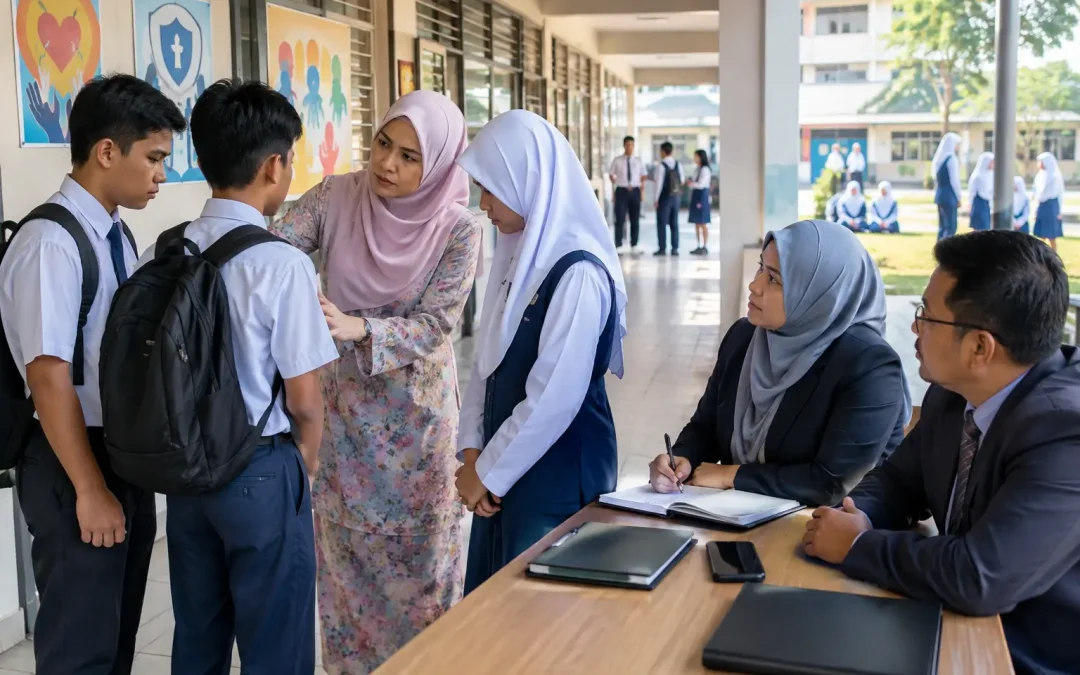
A student who suddenly stops taking the usual route to school, asks to stay home with vague stomachaches, or goes silent when a phone notification appears may be signaling more than a bad week. School bullying in Malaysia is not a harmless rite of passage. It can change how a young person moves through classrooms, friendships, public spaces, and family life.
The first job is not to tell them to toughen up. It is to take the signal seriously, establish what is happening, and make a plan that works when pressure hits. Awareness posters are not enough if a child still has no safe way to leave a confrontation, call for help, or report repeated harm without being dismissed.
What School Bullying in Malaysia Can Look Like
Bullying is repeated behavior intended to intimidate, isolate, humiliate, control, or hurt someone. It may be physical, but it does not need bruises to cause real damage. A student can be targeted through insults, threats, exclusion, extortion, harassment, unwanted touching, damage to belongings, or cruel content circulated in group chats.
The online and offline sides often feed each other. A student may be mocked in a classroom, filmed during lunch, then face hundreds of comments after school. Telling them to simply log off misses the point when the same people are waiting at the gate the next morning.
Not every argument is bullying. Students disagree, friendships break down, and tempers flare. The difference is pattern and power. If one student or group has social, physical, digital, or seniority-based power and repeatedly uses it to make another person feel unsafe, adults should treat it as a safety issue.
Warning signs vary. Some students become withdrawn, unusually angry, anxious, or guarded about their devices. Others begin missing school, losing belongings, changing routes, eating alone, or showing an unexpected drop in concentration. These signs do not prove bullying, but they justify a calm, direct conversation.
Start With Safety, Not Shame
A child who shares what happened has already taken a risk. Do not interrogate them like they are on trial. Do not lead with, “Why didn’t you fight back?” That question can teach them that asking for help creates another problem.
Start with simple questions: What happened? Who was there? Where does it usually happen? Has anyone been hurt or threatened? Is there a message, video, photo, or witness? Ask what would help them feel safer tomorrow, not only what they think should happen to the other student.
Write down dates, times, locations, names, injuries, damaged items, and exact words where possible. Save screenshots, usernames, voice notes, and images before content disappears. Documentation does not replace action, but it turns a vague complaint into a clear record of a repeated pattern.
If there is an immediate threat, physical assault, sexual harassment, weapon, extortion, or credible threat of serious harm, treat it as urgent. Get the student away from danger, inform school leadership, and contact emergency services or the police when necessary. Do not wait for a “perfect” amount of evidence while someone is at risk.
A Plan for the Next School Day
A good plan is specific. “Be careful” is not a plan. “Ignore them” may work for a one-off insult, but it can be dangerous advice if intimidation is escalating.
The student should know where to go if approached: a staffed office, counselor’s room, library desk, teacher’s classroom, or other agreed safe point. They should identify at least two adults at school who know the situation and can respond. They also need a way to move between vulnerable places, such as stairwells, bathrooms, bus stops, parking areas, or isolated corridors, without being alone.
A trusted friend can help, but no student should be made responsible for physically protecting another student. Use the buddy system to reduce isolation, get help quickly, and provide a witness. Arrange check-ins before school, after dismissal, and after any known risk period.
Students also need short, usable language. Under stress, long speeches disappear. Practice a firm boundary such as, “Stop. Do not touch me.” Then leave toward people and authority. The goal is not to win an argument or prove courage. The goal is to create distance, draw attention, and get safe.
What Schools Must Do Beyond a Talk
Schools carry a duty to respond consistently. A single assembly on kindness will not protect a student if reports disappear into a drawer or staff treat violence as normal student behavior.
A serious response starts with a named point of contact, a clear reporting route, prompt fact-finding, and communication with the affected student’s family. The school should address both the immediate safety plan and the behavior driving the harm. Separating students temporarily may be needed, but it should not punish the targeted student by forcing them to lose activities, classes, or access to support.
Confidentiality matters, but it should not become silence. Families may not be able to receive every detail of disciplinary action involving another child. They can still expect confirmation that the report was received, that safety steps are in place, and that follow-up will happen on a stated timeline.
Staff also need to watch the predictable gaps: changing rooms, buses, bathrooms, hallways, dismissal areas, and online spaces connected to school life. Bullying thrives where supervision is assumed but not actually present.
Why “Fight Back” Is the Wrong Default
Physical self-protection has a place, but it must be taught honestly. Telling a scared student to hit first can intensify violence, create legal and disciplinary consequences, and leave them facing several aggressors rather than one. It is not a strategy. It is a gamble.
At the same time, telling students to never resist under any circumstances ignores reality. If someone is being grabbed, trapped, assaulted, or unable to leave, they may need to use reasonable force to break free and escape. The purpose is not punishment. It is escape.
Practical self-defense training should reinforce that distinction. It should teach awareness, verbal boundary-setting, movement, balance, escape from common holds, and decisions under pressure. It should also teach students to recognize when escape is possible and when calling for adults is the smarter move. Fancy techniques and choreographed responses are not useful when panic narrows attention and timing disappears.
For older teens, parents, educators, and organizations, reality-based training can build confidence without selling false certainty. Urban Street Defense focuses on simple, direct responses that help people create space and get away when a situation turns physical. Training is one layer of safety, not permission to seek confrontation.
Bystanders Can Change the Outcome
Many bullying incidents depend on an audience. Silence can feel like approval to the aggressor and abandonment to the person being targeted. Bystanders do not need to become heroes or step into a fight. They need a safer response.
They can interrupt with a distraction, bring an adult immediately, walk the targeted student toward a safer area, refuse to share humiliating content, and save evidence if doing so does not put them at risk. A private message afterward also matters: “I saw what happened. It was not okay. I can go with you to report it.”
Parents should teach this directly. Children often know bullying is wrong but freeze because they fear becoming the next target. Give them permission to leave, report, and seek help rather than demanding a dramatic confrontation.
Build Confidence Before a Crisis
The strongest safety culture is built before the next incident. Families can rehearse how to make a report, whom to call, and what routes feel unsafe. Schools can train staff to respond without minimizing, blaming, or forcing instant face-to-face reconciliation. Students can learn that confidence is not loudness. It is the ability to make a clear decision under stress.
A young person should never have to earn protection by being tougher, quieter, more popular, or more physically capable. Make the next step simple: listen, document, report, create a safety plan, and keep following up. Fast action tells a student the most important thing they need to hear: you are not alone, and this does not get to continue.