
Hi, I’m Joshua, founder of Urban Street Defense. What you’re about to read is something personal.
I want to share with you my journey on how and why I started Urban Street Defense, and how my understanding of self-defense evolved over the years.
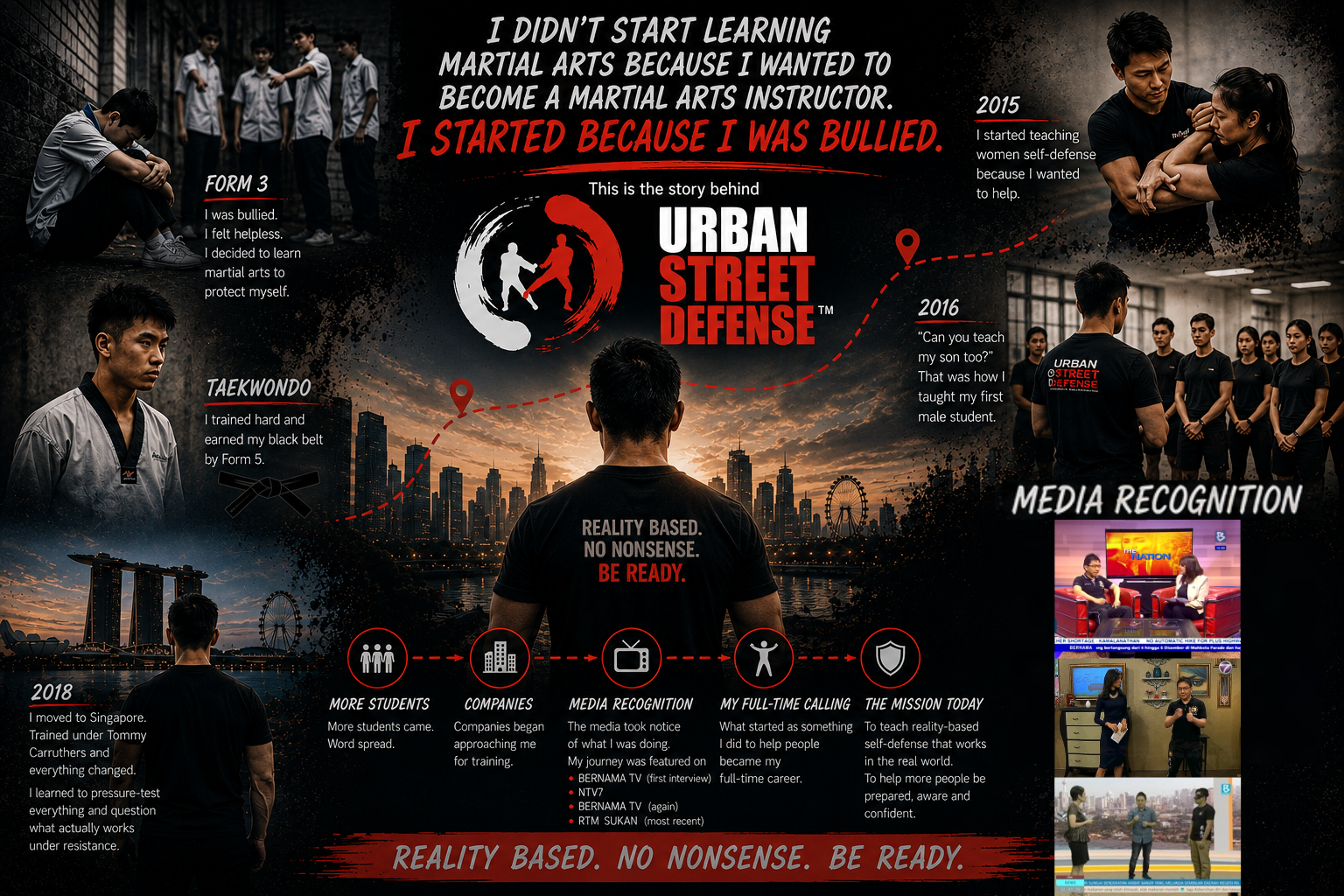
I didn’t start learning martial arts because I wanted to become a martial arts instructor.
I started because I was bullied.
Urban Street Defense was created in 2015, but the story behind it started much earlier.
1999 — Where It All Started
When I was in Form 3, I experienced bullying at school. I knew what it felt like to feel vulnerable and not know how to protect myself. Towards the end of Form 3, I decided to start learning Taekwondo. I became deeply committed to training and eventually earned my black belt by Form 5. But even after earning my black belt, I felt that something was missing. I had learned techniques, forms after forms, controlled sparring. I had trained hard to achieved the rank I had worked towards.
Yet one question kept coming back to me:
“Would this actually work if someone really attacked me?”
I didn’t have the answer. So I kept searching.
2007–2014 — The Search for Something More
I went on to study different martial arts and trained under two different Wing Chun sifus. Eventually, my journey led me to Bruce Lee’s Jeet Kune Do. I trained with different instructors and eventually learned from two masters with very different areas of expertise. Every stage taught me something new. But more importantly, I began to understand that martial arts isn’t simply about collecting techniques or achieving the next rank. It is about constantly questioning what you think you already know.
The more I trained, the more I wanted to understand one thing:
“What actually works when someone doesn’t cooperate?”
2015 — Why I Started Teaching
In 2015, I started my own training school, Urban Street Defense. At the time, I was primarily teaching Jeet Kune Do, and my teaching approach was still very different from what I teach today.
And I didn’t start teaching because I wanted to make money. There was another reason. My aunt was involved with an NGO, and through her I became aware of many domestic violence cases involving women.
Those stories impacted me, and I kept thinking about how vulnerable these women must have felt and whether I could do something to help. So I decided to start teaching women’s self-defense.
In the beginning, I focused entirely on women.
Then, in 2016, one of the parents asked me:
“Can you teach my son too?”
That was how I ended up teaching my first male student. And from there, everything started to change.
More students came. Word spread.
Eventually, companies began approaching me for training. Then something I never expected started happening.
The Media Began Taking Notice
I was first interviewed on BERNAMA TV, followed by NTV7, then another feature on BERNAMA TV, and most recently, RTM Sukan.
What started as something I was doing simply because I wanted to help people gradually grew into something much bigger.
2016 — My First Training Centre
As the programme grew, I eventually rented my own training space at Sunway Mas Commercial Centre. It was a major milestone. Something that started with me simply wanting to help people had grown into a real business. But the journey wasn’t straightforward. In 2018, I made the decision to close the centre in Malaysia and move to Singapore for work. At the time, I didn’t realise that this would become one of the most important turning points in my martial arts journey.
2018 — Singapore Changed My Perspective
While I was in Singapore, I discovered another Jeet Kune Do school under Sifu Tommy Carruthers (IFO). What I experienced there fundamentally changed the way I looked at martial arts and self-defense. It wasn’t simply about learning more techniques. It was about questioning whether the things I had been practising for years actually held up when someone resisted, moved unpredictably and didn’t cooperate.
So I started pressure-testing. Things that looked good during controlled training didn’t always work the same way when the situation became chaotic.
That forced me to confront an uncomfortable question:
“If a technique only works when the attacker behaves exactly as expected, how useful is it in a real fight?”
That question changed everything.
2019–Present — From Martial Arts to Reality-Based Self-Defense
My focus gradually shifted. I became less interested in collecting techniques and more interested in finding what actually worked. I began looking at self-defense differently.
- Real violence doesn’t come with a script.
- You don’t know exactly what attack is coming.
- You don’t know how the person will react.
- You don’t know where you’ll be standing.
- You don’t know whether there will be one attacker or more.
- You don’t know whether a weapon will appear.
- You don’t know whether you’ll freeze, panic or react differently from how you imagined during training.
There are simply too many variables. I started calling this the Infinite Variables of violence. And that became one of the foundations of what I teach today.
I began moving away from fixed scenarios, rehearsed responses and techniques that depended on a predictable attack.
Instead, I became increasingly focused on:
Simplicity.
Adaptability.
Pressure-testing.
And the ability to respond when things don’t go according to plan.
The Journey Continues
Urban Street Defense has come a long way from where it began in 2015. From my original training location in Petaling Jaya, the school eventually expanded to Ipoh and continued to evolve along with my own understanding of self-defense.
After more than 20 years of training, teaching, questioning and pressure-testing, I’ve learned that I don’t have all the answers.
I also have deep respect for all martial arts. After all, martial arts is where my own journey began, and it has shaped who I am today.
But I believe in always asking one question:
“Does what we train actually prepare us for reality?”
That question started my journey. And it continues to drive me today.
From a bullied teenager who simply wanted to protect himself, to building a reality-based self-defense system designed to help others do the same.