
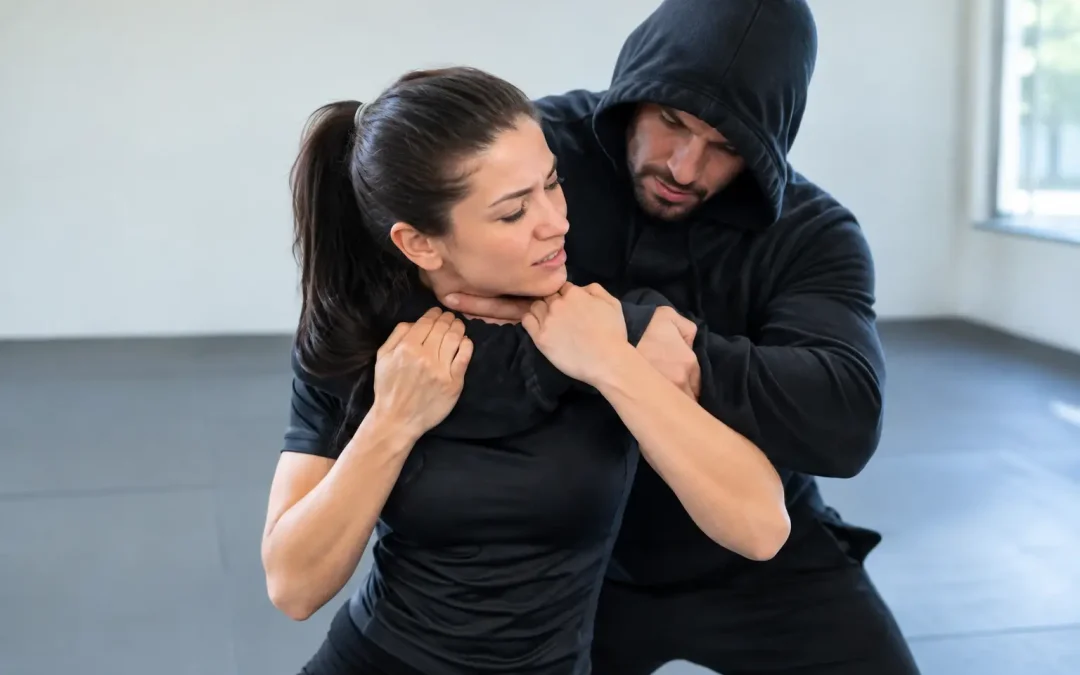
A rear choke is not a clean martial arts demonstration. It is sudden, close, disorienting, and often paired with being pulled off balance. To defend against rear choke attacks, you need a response that works before you have time to think through a sequence. Your job is not to look technical. Your job is to protect your neck, stay on your feet if possible, create an exit, and get to safety.
That is why reality-based self-defense training starts with simple priorities. No fancy moves. No pauses. No assumption that an attacker will stand still and cooperate.
What Makes a Rear Choke So Dangerous
An attacker behind you has already taken away your visual awareness. If their arm is around your neck, they may be trying to restrict breathing, compress the sides of the neck, drag you to the ground, or control your body while they assault or rob you. The danger rises fast when you panic, reach wildly, or allow yourself to be pulled backward.
There is no single rear choke. The arm may be across the front of your throat, around the side of your neck, or locked in a tighter hold. The attacker may be taller, stronger, moving you toward a vehicle, or using a wall to limit your movement. That is why memorizing one perfect escape is not enough.
Your response must be built around principles that still make sense when the angle, grip, and environment change.
Defend Against Rear Choke Attacks With Clear Priorities
The first priority is immediate airway protection. If an arm is across your neck, bring your hands to the attacking arm and create a frame between it and your throat. Keep your chin tucked toward your chest when you can. Do not waste time trying to peel off every finger or pull straight backward against a stronger person.
The second priority is posture and balance. Lower your center of gravity by bending your knees slightly and widening your stance. Step into a stable position rather than standing tall and rigid. If you are being pulled backward, resisting only with upper-body strength can make you easier to control. Use your legs, your hips, and your bodyweight.
The third priority is movement. Turn toward the space on the side of the attacking arm whenever possible. This can reduce the pressure on your neck and place you closer to the attacker instead of hanging at the end of their grip. A choke is usually strongest when you stay directly in front of the attacker and let them keep their structure.
Then create a distraction or break in their control using direct, gross-motor actions. Depending on the position and what is legally necessary to escape, that may mean forceful strikes to vulnerable targets, stomping, driving your weight into them, or using the environment to disrupt their balance. The purpose is not to trade blows. It is to make enough room to get out.
Once you have space, leave. Do not remain to prove you won. Move toward people, light, security, a locked room, or any place that reduces the attacker’s access to you.
Do Not Reach for Complicated Techniques
Under fear, fine motor control drops. Your hands may shake. Your vision may narrow. You may not even be sure which arm is around your neck. A technique that depends on finding a precise grip, executing several steps in order, or throwing someone perfectly is a poor first answer for most people.
Simple actions survive stress better: protect the neck, stabilize your base, turn into available space, disrupt the attacker, and escape. These actions are not glamorous. That is exactly why they deserve practice.
A common mistake is grabbing at the attacker’s arm with both hands while staying upright and frozen. Hand fighting may be necessary, but it cannot be your only plan. If your feet are planted badly and the attacker controls your posture, you are working from their position of strength.
The Ground Changes the Problem
If the attacker takes you down, the situation becomes more urgent. Hard surfaces, curbs, furniture, multiple attackers, and restricted movement can make ground fighting a terrible place to stay. Protect your head as you fall if you can, keep working to make space around your neck, and use your legs and hips to help turn rather than relying on your arms alone.
But be realistic: not every takedown can be prevented, and not every escape will be clean. Sometimes the best available outcome is getting loose enough to run, shout for help, or reach a safer area. Self-defense is not about guaranteeing control. It is about improving your odds when control has already been taken from you.
If you experience neck pain, trouble swallowing, voice changes, dizziness, confusion, breathing difficulty, or loss of consciousness after a choke, seek urgent medical evaluation. Serious effects can appear after the incident, even if you initially feel able to walk away.
Use Your Voice Before and During the Escape
A strong verbal response can help in two ways. It may draw attention, and it can interrupt the attacker’s focus. Shout short, clear commands such as “Get off me!” or “Help!” Do not negotiate in long sentences. Your breathing, body position, and escape movement need your attention.
In public, direct your call to a specific person if you can: “You in the blue shirt, call emergency services!” People are more likely to act when they know exactly what to do.
Of course, it depends on the threat. If the attacker has a weapon, demands property, or is trying to move you into a more isolated place, your decisions must account for the immediate danger. Property can be replaced. Your safety cannot. Yet being forced into a car, stairwell, or secluded area is often a major warning sign that you need to resist escape immediately if there is a viable opening.
Why Training Matters More Than Knowing the Idea
Reading about a rear choke can give you useful priorities. It cannot teach timing, pressure, balance, or the shock of someone grabbing you without warning. Those skills come from controlled, responsible practice with resistance that increases over time.
Good training does not throw beginners into chaos on day one. It teaches the basic body mechanics first, then adds movement, verbal pressure, awkward angles, limited visibility, walls, and realistic decision-making. You learn what happens when your first attempt fails, when the attacker is bigger, and when the environment is working against you.
At Urban Street Defense, training is built around this reality. You do not need forms, rank ceremonies, or a collection of moves you cannot remember under stress. You need repeatable actions that fit the problem in front of you.
Practice the Right Way
Never practice choke defenses casually or apply pressure to a partner’s neck to prove toughness. Train with clear rules, controlled intensity, and instructors who understand safety. Tap early, stop immediately when a partner signals, and avoid prolonged neck compression.
Start with positional awareness. Practice noticing who is close behind you in parking areas, elevators, corridors, public transit, and building entrances. Then work on your stance, protective hand position, turning mechanics, and movement after release. The escape is not finished when the hold breaks. It is finished when you are moving toward safety.
Training with partners of different sizes matters too. A response that works only against someone your size, moving slowly, is not yet a dependable response. Pressure reveals the gaps. That is not failure. It is useful information.
Build Awareness Into Daily Life
The best rear choke defense starts before hands reach your neck. Avoid walking while fully absorbed in your phone. Keep one ear free when you are alone in public. Notice bottlenecks, blind corners, parked vehicles, and entrances where someone can close distance unseen.
This is not about living afraid. It is about being switched on when your environment demands it. Awareness gives you more time. More time gives you more choices.
You do not need a perfect response. You need a practiced one that appears when your heart rate spikes. Train simple, direct actions until protecting your neck, breaking balance, making space, and moving to safety become your default.