Hi, I’m Joshua, founder of Urban Street Defense. What you’re about to read is something personal.
I want to share with you my journey on how and why I started Urban Street Defense, and how my understanding of self-defense evolved over the years.
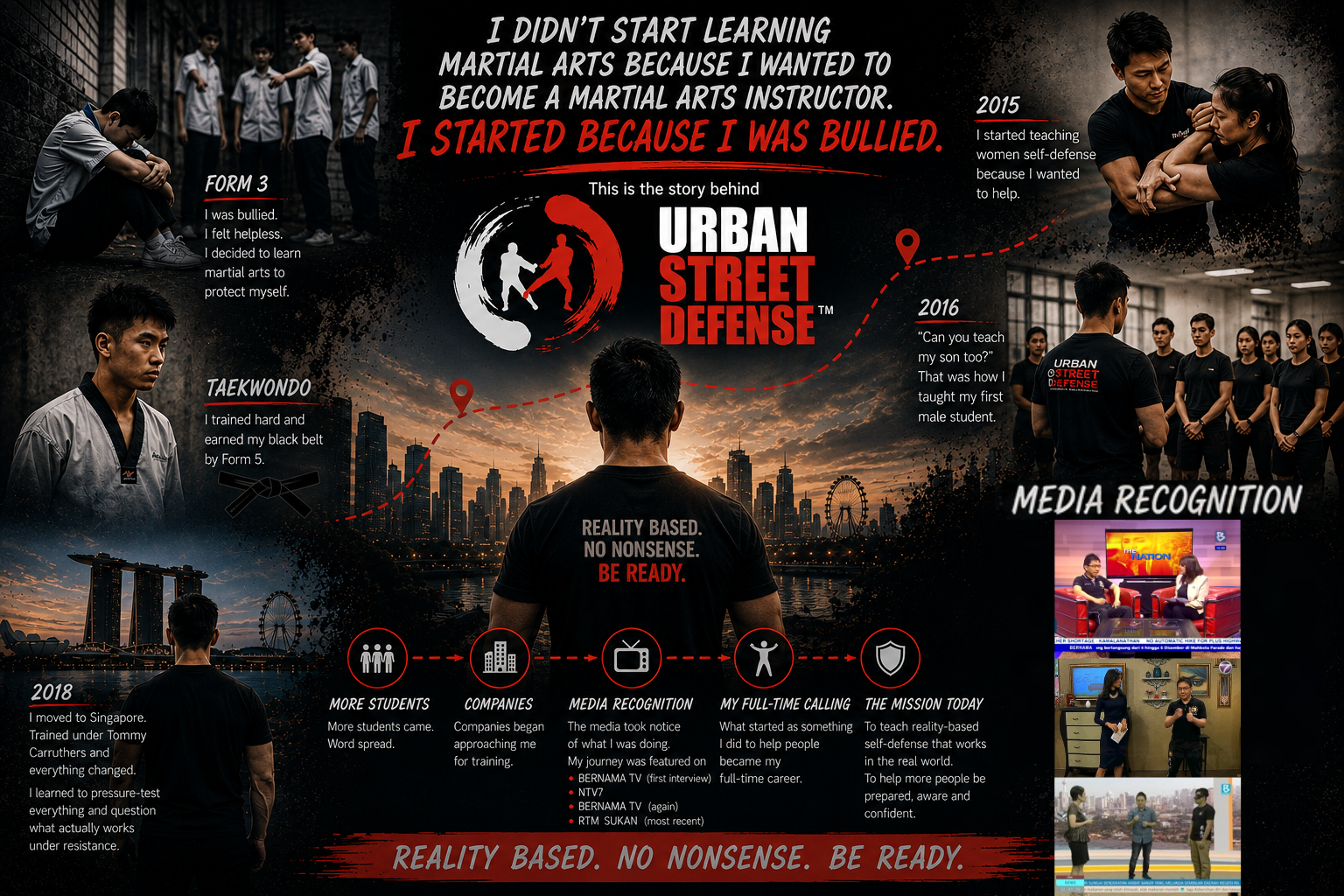
I didn’t start learning martial arts because I wanted to become a martial arts instructor. I started because I was bullied.
Urban Street Defense was created in 2015, but the story behind it started much earlier.
1999 — Where It All Started
When I was in Form 3, I experienced bullying at school. I knew what it felt like to feel vulnerable and not know how to protect myself. Towards the end of Form 3, I decided to start learning Taekwondo. I became deeply committed to training and eventually earned my black belt by Form 5. But even after earning my black belt, I felt that something was missing. I had learned techniques, forms after forms, controlled sparring. I had trained hard to achieved the rank I had worked towards.
Yet one question kept coming back to me:
“Would this actually work if someone really attacked me?”
I didn’t have the answer. So I kept searching.
2007–2014 — The Search for Something More
I went on to study different martial arts and trained under two different Wing Chun sifus. Eventually, my journey led me to Bruce Lee’s Jeet Kune Do. I trained with different instructors and eventually learned from two masters with very different areas of expertise. Every stage taught me something new. But more importantly, I began to understand that martial arts isn’t simply about collecting techniques or achieving the next rank. It is about constantly questioning what you think you already know.
The more I trained, the more I wanted to understand one thing:
“What actually works when someone doesn’t cooperate?”
2015 — Why I Started Teaching
In 2015, I started my own training school, Urban Street Defense. At the time, I was primarily teaching Jeet Kune Do, and my teaching approach was still very different from what I teach today.
And I didn’t start teaching because I wanted to make money. There was another reason. My aunt was involved with an NGO, and through her I became aware of many domestic violence cases involving women.
Those stories impacted me, and I kept thinking about how vulnerable these women must have felt and whether I could do something to help. So I decided to start teaching women’s self-defense.
In the beginning, I focused entirely on women.
Then, in 2016, one of the parents asked me:
“Can you teach my son too?”
That was how I ended up teaching my first male student. And from there, everything started to change.
More students came.Word spread.
Eventually, companies began approaching me for training. Then something I never expected started happening.
The Media Began Taking Notice
I was first interviewed on BERNAMA TV, followed by NTV7, then another feature on BERNAMA TV, and most recently, RTM Sukan.
What started as something I was doing simply because I wanted to help people gradually grew into something much bigger.
2016 — My First Training Centre
As the programme grew, I eventually rented my own training space at Sunway Mas Commercial Centre. It was a major milestone. Something that started with me simply wanting to help people had grown into a real business. But the journey wasn’t straightforward. In 2018, I made the decision to close the centre in Malaysia and move to Singapore for work. At the time, I didn’t realise that this would become one of the most important turning points in my martial arts journey.
2018 — Singapore Changed My Perspective
While I was in Singapore, I discovered another Jeet Kune Do school under Sifu Tommy Carruthers (IFO). What I experienced there fundamentally changed the way I looked at martial arts and self-defense. It wasn’t simply about learning more techniques. It was about questioning whether the things I had been practising for years actually held up when someone resisted, moved unpredictably and didn’t cooperate.
So I started pressure-testing. Things that looked good during controlled training didn’t always work the same way when the situation became chaotic.
That forced me to confront an uncomfortable question:
“If a technique only works when the attacker behaves exactly as expected, how useful is it in a real fight?”
That question changed everything.
2019–Present — From Martial Arts to Reality-Based Self-Defense
My focus gradually shifted. I became less interested in collecting techniques and more interested in finding what actually worked. I began looking at self-defense differently.
Real violence doesn’t come with a script.
You don’t know exactly what attack is coming.
You don’t know how the person will react.
You don’t know where you’ll be standing.
You don’t know whether there will be one attacker or more.
You don’t know whether a weapon will appear.
You don’t know whether you’ll freeze, panic or react differently from how you imagined during training.
There are simply too many variables. I started calling this the Infinite Variables of violence. And that became one of the foundations of what I teach today.
I began moving away from fixed scenarios, rehearsed responses and techniques that depended on a predictable attack.
Instead, I became increasingly focused on:
Simplicity. Adaptability. Pressure-testing. And the ability to respond when things don’t go according to plan.
The Journey Continues
Urban Street Defense has come a long way from where it began in 2015. From my original training location in Petaling Jaya, the school eventually expanded to Ipoh and continued to evolve along with my own understanding of self-defense.
After more than 20 years of training, teaching, questioning and pressure-testing, I’ve learned that I don’t have all the answers.
I also have deep respect for all martial arts. After all, martial arts is where my own journey began, and it has shaped who I am today.
But I believe in always asking one question:
“Does what we train actually prepare us for reality?”
That question started my journey. And it continues to drive me today.
From a bullied teenager who simply wanted to protect himself, to building a reality-based self-defense system designed to help others do the same.
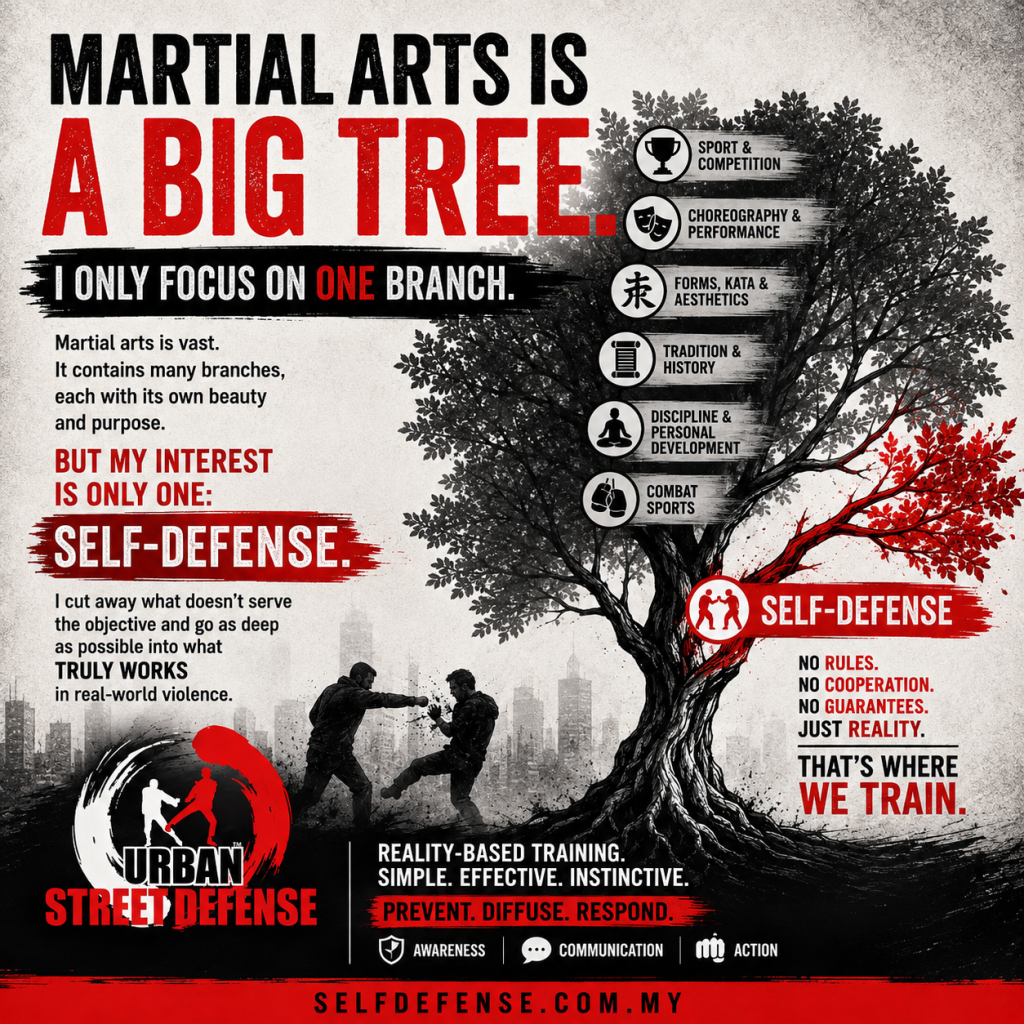
Recently, I started thinking of martial arts as a huge tree. The roots represent its history, culture, philosophy and the knowledge passed down through generations.
The trunk represents the martial arts itself, its principles, techniques, systems and traditions.
And from that trunk grow many different branches.- Sport and competition.
Forms / Pattern
Choreography and performance
Aesthetics
Tradition and culture
Physical & Mental development
Combat sports
Self-defense
Every branch has its own purpose and value. But I realised something about what I teach.I am only interested in one branch.
Self-defense.
I’m not interested in trying to cover the entire tree. I don’t want to spend my time making techniques look beautiful, perfecting choreography, collecting forms, or training for competition.
Not because those things are wrong.They simply aren’t my objective.
My objective as the head coach of Urban Street Defense in Malaysia is to take the self-defense branch and go as deep as possible. And once you choose that branch, you have to start asking uncomfortable questions.
What actually works when someone is trying to hurt you?
What happens when there are no rules?
When the attacker doesn’t cooperate.
When the distance is wrong.
When the environment is unfamiliar.
When you’re afraid.
When adrenaline takes over.
When there is more than one variable happening at the same time.
When reality doesn’t look anything like the training scenario.
That’s where my interest begins. I want to strip self-defense down to its essentials and keep testing it against reality.
Not what looks impressive.
Not what looks good on camera.
Not what works only when everything goes according to plan.
What actually works when things go wrong?
Martial arts is a huge tree. There are many branches, and I respect them all.
I’ve simply chosen one branch — self-defense — and decided to see how far it can truly grow.
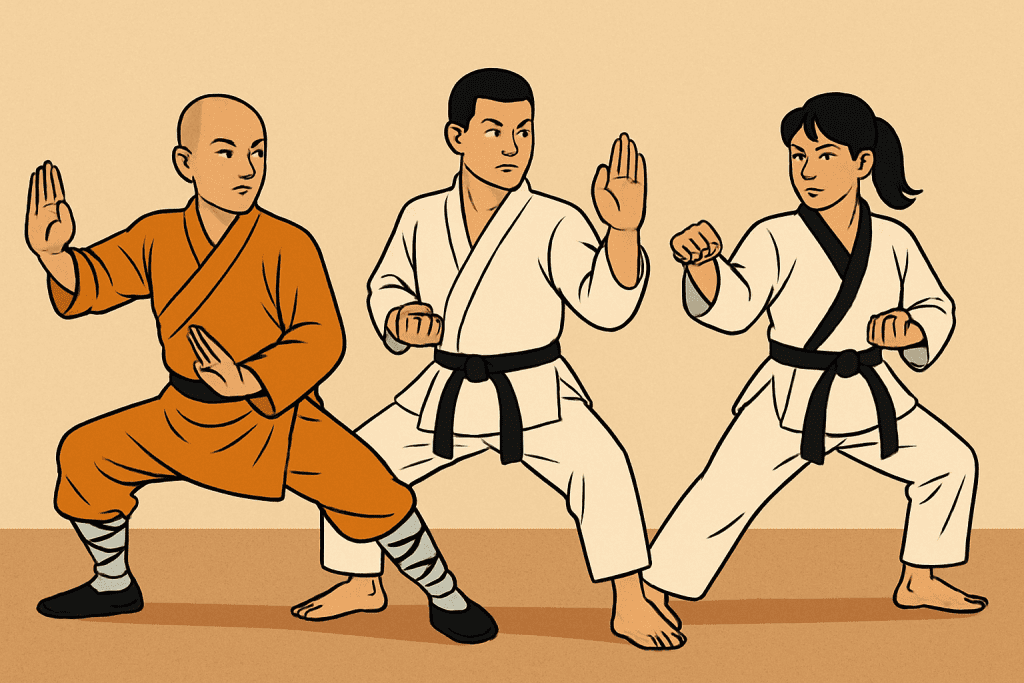
Let’s be honest: in a real fight, no one’s going to let you finish your beautiful kata or poomsae. That’s why many in the self-defense world dismiss traditional forms as outdated or even useless.
But here’s the truth most don’t talk about: Forms weren’t originally created for show—they were created for survival.
The Real Origin of Forms
In ancient times, warriors didn’t always have sparring partners. Forms were solo blueprints to train deadly techniques—strikes, grabs, takedowns, escapes—against multiple attackers. Every move had a purpose. It wasn’t choreography; it was coded combat. They were once powerful training tools meant to preserve and transmit real fighting techniques.
The problem? Over time, martial arts became sports and performances. Forms got watered down, stylized, and stripped of their original intent. Flash replaced function.
A Brief History of Forms
The history of forms stretches back centuries:
In China, styles like Shaolin Kung Fu developed elaborate Taolu to preserve their systems. These were influenced by military drills, animal movements, and battlefield tactics.
In Okinawa, Kata evolved under the influence of both Chinese martial arts and indigenous fighting methods, later forming the basis of Karate.
In Korea, Hyung and later Poomsae were developed post-war as part of national efforts to unify martial arts systems like Taekwondo.
Each culture used forms not just as training tools, but as a way to codify knowledge, especially in times when oral or written instruction was limited.
So, Are They Still Worth Learning?
Yes—but only if you strip away the fancy stuff and train them the right way.
In Reality-Based Defense, we don’t perform forms—we extract from them:
Practical moves for real-world violence
Fast responses under chaos
Response memory training under pressure
Drills that simulate real threats
Conclusion
Forms were never meant to be performance pieces. They were living libraries—preserving the knowledge of warriors who fought for survival. While modern interpretations have diluted their combat value, the original essence still remains—waiting to be rediscovered by those willing to look deeper than the surface.
The difference between “Early Stage JKD” and “Latter Stage JKD”.
Jeet Kune Do (JKD) is a philosophy or better known by the public as a Gung Fu system founded by the Late Bruce Lee. JKD system is a combination of mostly Western Boxing, Fencing (footwork), Savate kicking and selected Wing Chun concepts.
Firstly, JKD was developed by Bruce Lee to show the world that an Old Art need to evolve through time, otherwise it will eventually lose its effectiveness.
The latter stage JKD was developed by Bruce Lee during his final years before he passed away, and was handed down to his private student, Ted Wong.
JKD was never meant to be completed
Jeet Kune Do (JKD) was never meant to be a finished product, but rather a continuous process of improvement and breakthrough. If we are so fixed in a certain way of learning, then we will never improve.
The History
During the early years, Bruce Lee started learning Wing Chun with Yip Man and his Si Heng (Wong Shun Leung). He picked up the art quickly and achieve proficiency in the system, however he left Hong Kong to America on April 1959, therefore he did not complete his journey in Wing Chun.
Early Stage JKD (A.k.a Jun Fan Gung Fu)
Upon arriving at America, he began researching, modifying and formed his own fighting methods. He mainly modified the Classical Wing Chun art that he has picked up in Hong Kong, and named it as Jun Fan Gung Fu.
The modifications include:
Forward weight placement — for further reach and forward pressure
Removing impractical / unrealistic techniques
Center Line Dominance
Emphasize on Close Quarter Combat
Reliance on Touch Reference (Sensitivity through touch)
Most JKD practitioners / JKD observers / JKD lovers tend to understand JKD in the form of The Early Stage JKD. One way to spot them is their level of understanding or their over emphasis on touch reference and close quarter combat, such as Chi Sau, Pak Sau Da, Lap Sau Da, Bong Sau, Siu nim tau form, Bruce Lee’s Um Moon form (5 gates) & etc.
Latter Stage JKD
The latter stage JKD were mainly based on science of combat (physics, body alignment and combat strategies). This stage of JKD turned towards the scientific approach of Western Boxing, Fencing, Savate and modified trappings. The common misconception by most people is that one can add anything into the art and named it as JKD. If that is true, then everybody is a JKD practitioner. JKD system itself is unique, without understanding the history, the fundamentals and the science behind it, one cannot claim that they are a JKD practitioner.
One can identify a Latter Stage JKD school / practitioner through the following:
A strong distance control, just like how a trained fencer manipulates the space between him and his opponent
A strong timing on when to strike, with the ability to flow throughout the 4 range of combat (Long, Short, Close Quarter & Grappling Range)
Further simplified footwork and striking methods
Rapid Recovery from movement to movement
Emphasize on Reflex Training Based on Reality Combat Situation
Emphasize on Explosive and sudden movements and strikes
Emphasize on striking first before an opponent (Identifying opponent’s telegraphic moves and motives)
Emphasize on Combat tactics and strategies
Simplified & Disengaged Trappings
Non-reliance on touch reference
In Summary:
Hack away at the unessential
Simplification
Absorb what is useful
Discard what is useless
Partiality
Fluidity
Emptiness
Reference: The Latter Stage Jeet Kune Do by Kenneth Pua & Andy Kunz, 2018 (ISBN: 1979463131), United States of America.
During Raya Festive Season, most of us will head back to our hometown, looking forward to visit our loved ones, and re-visit some places that bring back good or bad memories.
For me, as I was travelling back to my hometown, not only did I re-visited some places in my hometown, I re-visited my past and the origins of the formation of The Women’s Self-Defense Community Program. I reflected on what triggered the idea and passion within me to form the Women’s Self-Defense Community and specially tailored program that continues to develop the community.
More and more reasons began to unfold, as I revisited my past and met up with my friends and relatives.
Some may be curious about the motivations and reasons behind my efforts. If you are curious enough, I encourage you to read on.
It is a common thing to hear from my family members and friends about their relatives, friends or even family members who were victims of crimes at some point in their lives. Crimes such as snatch theft and robbery in broad day light. But among all the crimes, the most common cases are wives being abused by their own husbands, both physically and verbally. Physical & Verbal Abuse usually come in one package and the consequences and impact on the women and family is great.
Every time I hear of these incidents, a surge of anger will rise within me but at the same I feel helpless as I could not do anything but to just pray. For the past 2 years, I have heard of increasing incidents happening to the people around me, I even witnessed a few incidents which involved road bullies and snatch thefts in front of my very own eyes. A lady driver being bullied with insulting words, yet another lady was screaming for her life as she was dragged along by a motorcyclist as her hand was still holding on to her bag. Her hands and face were scarred. It may be temporary but the emotional effect can be permanent. On another occasion, a group of robbers managed to robbed one of my neighbor’s car. I rushed out and tried to stopped the robbers but it was too late. The car was no where to be seen. They escaped.
Apart from the above, my worst encounter was a wife that has fallen victim in the hands of her own husband, experiencing and bearing the pain of physical and verbal abuse. Husbands are supposed to protect and love their wives at all costs, and not become headlines for domestic violence. In fact, no man should ever hit a woman. The feelings of injustice and anger are indescribable.
There are two incidents I wish to share here.
Case #1: A man owned a business, and whenever his business was not doing well, he will then return home to lash out his anger and disappointment by beating up his wife and verbally abuse her. It eventually became a frightful routine. Despite all the sacrifices the wife had made for the home, this man thought he had every right to throw his temper on her, just because he was the sole provider for the family. Worst of all, he encouraged their son to abuse the mother together. The wife, being a foreigner, had no relatives or family to turn to for help. Sometimes, the husband will just throw her belongings out and command her to get out of the house. Where do you expect your wife to go to in the middle of the night? At wits end, she sought shelter at the nearest Motel, not knowing what her future holds. Overwhelmed by fear, anger, injustice and at the same time torn by the love any wife or or mother would have for her husband and child, she just could not comprehend why all these are happening to her. Abandoned by her husband and her very own flesh and blood, she had no where to go, no one to turn to. Despite all odds, she knew that she must stand up and fend for herself. Eventually, with the minimal resources she had, she took up the challenge to set up a food store selling noodles and was determined to earn her own living expenses. When her husband came to knew about this, he started to demand money from her to sustain his business. She refused and the beatings started again with her precious belongings often thrown out onto the streets. It has then became a norm for her to head back to the same motel to stay for the night. But I admire this woman, because of her courage to step up and start a business of her own and having the endurance to overcome the struggles she faced, and despite the painful circumstances that she has been subjected to by her own beloved family, yet she remained strong. Physically and emotionally bruised, but her spirit was not beaten.
Case #2: A man with criminal record was released from jail, and currently living with his wife and child who is in his early teens. Despite serving time in jail, his lazy and undisciplined attitude remained the same. Not willing to search for a proper job, always seeking the fastest route to earn a living with the least amount of effort. It didn’t take long for him to return to his old ways of distributing drugs and gambling. He often gambles off the money he took from his wife, and ends up beating his wife whenever he feels like it. Left with no options, the wife took up two jobs, one in the morning, one at night to make ends meet. There was once they were unable afford a place to stay, one of her friend willingly offered to help and manage to find a temporary place for free for a duration of 6 months.When it was time to move out, her friend took the initiative to find another suitable place for the family. Eventually, by God’s grace they found an owner that was willing to take them in.
Due to their financial constraints, her friend offered to pay for their deposit and some minor repair cost for the house. To the wife’s astonishment, the husband not only did not appreciate the effort, he REFUSED to move out from the previous house he enjoyed for free. But this is not for him to decide, he was forced to pack his bags and shift to the new place.
On that very day when they were due to move in, the husband had a heated argument with the wife. He complained that the house did not have air condition, and his family is not fit to be staying in such a house. Consumed with anger, the husband slapped the wife’s face several times until it was was swollen. He then had the guts to drive the wife to the police station, challenging her to make a police report, because he knew that her love for him was so great that she will surely not press charges against him. With a swollen face, tattered clothes and slippers torn apart, she was left abandoned and stranded at the police station by her husband. She then approached the police officer to lodge a police report, but the officer told her that this station does not take in husband and wife cases. She was told to report at the Headquarters which was quite a distance away. Armed with grit and determination, she walked for 40 minutes under the scorching hot sun all the way to her friend’s house to seek help. Her friend immediately took a cab with her to the police station HQ to lodge a report, followed by medical check ups and all the tedious procedures she had to patiently go through.
Eventually, the husband was called back to the police station. When he arrived, again he and his wife were hurling insults and blaming each other for causing the arguments. The police lady officer stepped in and stated that regardless of who is at fault, under the eyes of law, as long as a man hits his wife, the wife has every right to press charges against the husband. The man then retaliated that his wife would not dare take such drastic action as she loved him so much. And yes, sadly, the husband went free. His wife did NOT press charges against the husband. As a wife and a woman, to protect your own dignity and your future, would you not make a stand ? The choice is yours.
So, why did I bring up these 2 cases? From these 2 cases you can see and appreciate the differences of their characters, their response and the choices they made in life. The stark contrast in these cases had greatly impacted me to continue my efforts and work in this society.
One of the main reason for the existence of the Women’s Self-Defense Community is to build up women’s confidence, increase their ability to defend themselves and also EMPOWER other women to do the same. I cannot do this alone, I need more women to step up against violence.
I am not concluding that physical self-defense or learning martial arts is the solution to all abusive relationships or crimes involving women. But it is part of a necessary skill that is able to condition the mind and body to step up and stand firm on your ground in life, without fearing and allowing anyone (not only men) to take advantage of you and abuse you (whether physically or verbally). Everything starts from the mind, and it flows to the way we present ourselves to others. Confidence begins from your mind.
If you think that you are one of the women who supports the Mission and Movement of the group, please come forward by messaging me on my Facebook account : Urban Street Defense
Thank you for reading my blog thus far.
This blog is written on: 7th July 2016 (Transferred from my old blog website)




 It is a common thing to hear from my family members and friends about their relatives, friends or even family members who were victims of crimes at some point in their lives. Crimes such as snatch theft and robbery in broad day light. But among all the crimes, the most common cases are wives being abused by their own husbands, both physically and verbally. Physical & Verbal Abuse usually come in one package and the consequences and impact on the women and family is great.

