by Founder of USDC | 9th September 2026 | General Safety Topics
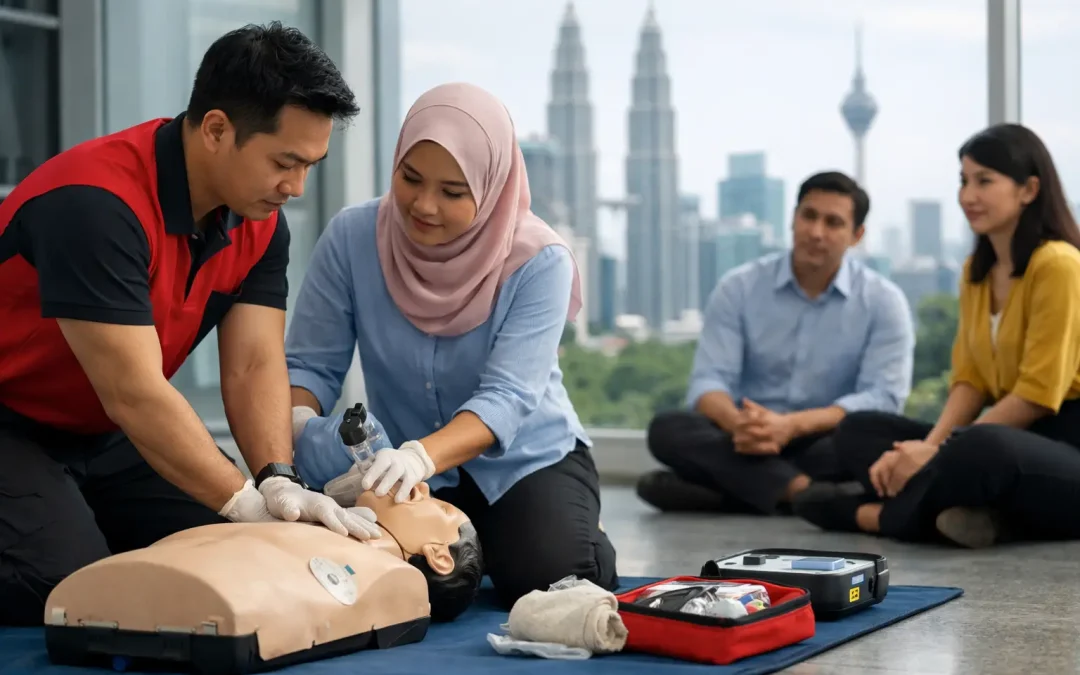
A medical emergency does not wait for a convenient time. It can happen in an office meeting, on the LRT platform, during a family meal, or after a traffic collision. First aid training in Malaysia gives ordinary people a practical advantage: the ability to recognize danger, take the right immediate action, and stay useful until professional help arrives.
That does not mean playing doctor. It means knowing your limits, protecting yourself from further risk, contacting emergency services, and delivering the basic care a casualty may need in the first critical minutes. Under pressure, simple actions beat panic, hesitation, and half-remembered advice.
What First Aid Training in Malaysia Should Teach
A useful course is not a lecture where participants watch an instructor demonstrate skills from the back of a room. It should put people close to the real decisions they may face: Is the area safe? Is the person responsive? Are they breathing normally? Who calls 999? What must happen first?
The exact syllabus varies by provider, course duration, and whether the training is designed for workplaces, parents, schools, or the public. Still, solid first aid training should cover the situations most likely to demand immediate action.
CPR and AED response
When a person collapses and is not breathing normally, every second counts. Participants should practice checking responsiveness, calling for help, performing CPR, and using an automated external defibrillator, or AED. An AED is designed to guide users with voice prompts, but training matters because stress can make even straightforward instructions feel difficult.
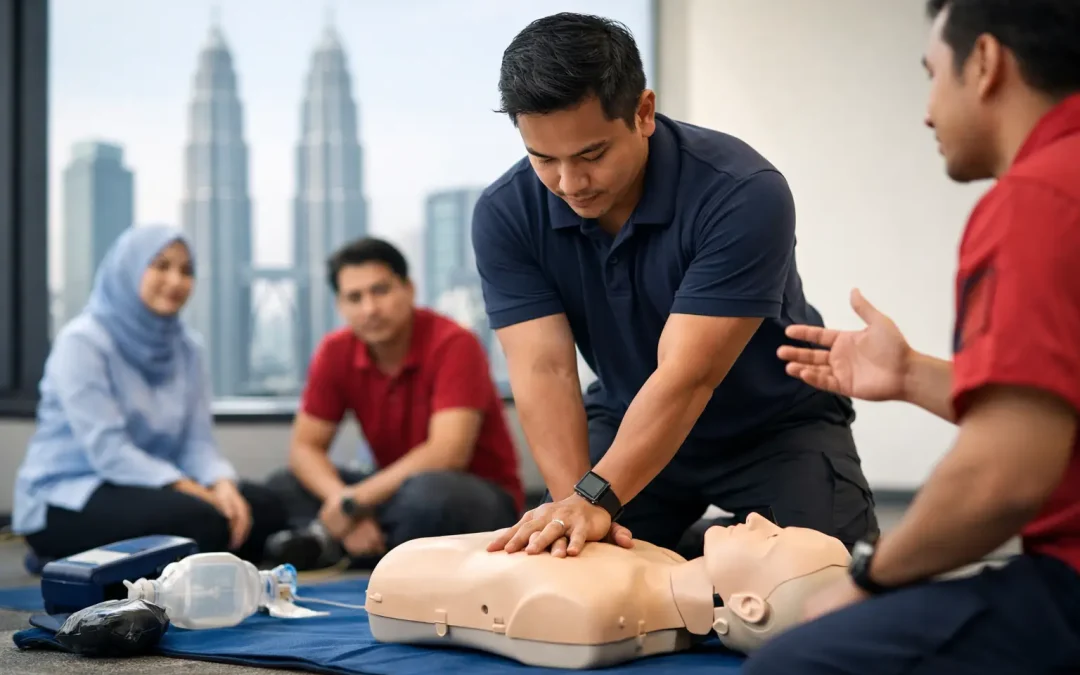
Hands-on repetition is the point. You need to feel the correct body position, learn the rhythm of compressions, and understand how quickly fatigue appears. Watching a video is not the same as kneeling beside a manikin and doing the work.
Severe bleeding, wounds, and shock
Major bleeding needs fast, direct action. A course should teach participants how to apply firm pressure, use dressings appropriately, recognize when bleeding is life-threatening, and monitor a casualty for signs of shock while waiting for emergency responders.
This is where practical instruction matters most. In an emergency, people can become distracted by the sight of blood or unsure whether they are making the injury worse. Clear training replaces guesswork with a sequence: make the scene safe, protect yourself where possible, call for help, control the bleeding, and keep observing the casualty.
Choking, burns, and common medical events
First aid is not only about dramatic accidents. Choking, fainting, seizures, allergic reactions, burns, heat-related illness, diabetic emergencies, and asthma attacks can happen at home, at work, or in public. The right response depends on what you see, what the person can communicate, and whether their condition is getting worse.
Good instructors do not pretend every incident has one magic technique. They teach recognition, basic care, escalation, and when not to interfere. For example, moving an injured person may be unsafe unless there is an immediate danger such as traffic, fire, or an unstable environment.
The Gap Between Knowing and Acting
Most people have heard that CPR saves lives. Far fewer have practiced what they would actually say when calling for help, where they would place their hands, or how they would manage bystanders who are crowding the scene.
The gap is pressure. Your heart rate rises. Someone is crying. The casualty may look completely different from a training manikin. You may fear getting it wrong. That is why first aid should be learned as an active response, not as a collection of facts.
Scenario-based practice builds calm decision-making. It forces participants to prioritize the next action rather than trying to solve every problem at once. In a real emergency, you do not need an encyclopedic answer. You need to notice the immediate threat and act decisively within your training.
This principle also applies to personal safety. A first aid course prepares you to respond after an injury or medical crisis. Reality-based self-defense training prepares you to recognize risk, create distance, escape danger, and protect yourself before an incident becomes a medical emergency. They are different skills, but both reject passive thinking.
How to Choose a Course That Is Worth Your Time
Not all training is equal. A short awareness session can be useful, but it may not provide enough time for meaningful skills practice. A full certification course may be the better choice for a designated workplace first aider, a parent, a coach, or someone responsible for a group.
Before enrolling, ask how much of the program is hands-on. Confirm whether participants practice CPR on manikins and train with an AED device. Find out who delivers the course, whether the certification is recognized for your intended purpose, and how often you should refresh your skills.
For employers, the course must match the actual risks of the workplace. An office has different concerns from a warehouse, construction site, gym, school, kitchen, or field-based team. Training should also account for shift schedules, staff numbers, access to emergency equipment, and how quickly ambulance services can reach the location.
A course is less useful if it is built around passing a test but leaves participants afraid to act. Look for instructors who explain the reason behind each step, correct technique in real time, and allow questions about realistic situations.
First Aid at Work Is a Team Responsibility
A first aider cannot carry an entire workplace safety plan alone. Employers and teams need clear procedures: accessible first aid kits, visible emergency contacts, known AED locations, incident reporting, and a plan for guiding emergency responders to the right floor, gate, or building.
Training is also a chance to expose small failures before they become serious. Does anyone know where the kit is? Has it expired? Is the AED blocked by furniture or locked behind a door? Who takes charge when the designated first aider is away?
For corporate teams, first aid training works best when it is treated as a live operational skill rather than a compliance box. Run realistic scenarios. Assign roles. Practice communication. Review what slowed the response down. The goal is not drama. The goal is coordinated action when someone needs it.
Confidence Without False Confidence
Training should make you more capable, not reckless. A first aider must assess the scene before rushing in. Traffic, electrical hazards, violence, fire, chemicals, and unstable structures can turn one casualty into two.
There are also moments when the best move is to get professional help immediately and provide reassurance rather than attempt treatment beyond your ability. First aid training teaches boundaries as well as interventions. That restraint is part of competence.
The same mindset belongs in personal safety training. No fancy moves. No assumption that you can control every outcome. Use simple actions, create space, seek safety, and get help early. Urban Street Defense applies that reality-first approach to self-protection: train for the pressure you may actually face, not for a performance.
Make Training Part of Your Safety Plan
A certificate is a starting point, not permanent readiness. Skills fade when they are never practiced. Refresh training at the interval recommended by your provider, revisit workplace procedures after staff or layout changes, and make sure family members know the basics of calling for help and sharing an exact location.
Keep the standard simple: if someone near you stopped breathing, bled heavily, collapsed, or choked, could you recognize the emergency and take the first useful step? You do not need to be fearless. You need enough practice to move before panic takes over.
by Founder of USDC | 8th September 2026 | General Safety Topics
A person collapses at the office, on a train platform, or during a family meal. The room often freezes for a few seconds. Those seconds matter. CPR training in Malaysia is not about collecting a certificate or memorizing medical language. It is about recognizing a life-threatening emergency, taking control of the scene, and starting the right actions before emergency responders arrive.
For people who care about real-world safety, this is a skill worth having. You may never need it. But if cardiac arrest happens in front of you, being ready is far better than wishing you had acted.
Why CPR Training in Malaysia Is a Practical Safety Skill
Cardiac arrest can happen without warning. The person may suddenly collapse, become unresponsive, and stop breathing normally. They may make irregular gasping sounds that do not count as normal breathing. Waiting to see whether they recover wastes valuable time.
CPR keeps blood moving to the brain and vital organs until a defibrillator or professional medical care can take over. It does not guarantee an outcome. No honest instructor should promise that. What it does is give the person a better chance than doing nothing.
That is why practical training matters. A good course teaches you to make decisions under pressure, not merely repeat facts in a classroom. You need to know what an unresponsive person looks like, how to call for help, where to place your hands, how hard and how fast to compress, and how to use an automated external defibrillator, or AED, when one is available.
For working adults, parents, commuters, coaches, security personnel, and team leaders, the value is straightforward: you become someone who can act when others hesitate.
What You Should Learn in a Quality CPR Course
The best CPR courses are hands-on. You should spend meaningful time practicing on a manikin, not just watching a presentation. Chest compressions are physical. Correct hand position, body posture, depth, rate, and full chest recoil are easier to understand when an instructor can correct you in real time.
A capable course should cover how to assess scene safety first. You cannot help anyone if you enter a dangerous area without thinking. Traffic, electrical hazards, fire, violence, unstable structures, and panicked crowds can turn one casualty into two.
From there, training should move through a clear response sequence: check responsiveness, get emergency help moving, begin CPR if the person is unresponsive and not breathing normally, and bring in an AED as quickly as possible. The AED is designed to guide users with voice prompts. Do not be intimidated by it. Early defibrillation can be critical in certain cardiac emergencies.
Choking response is another valuable component. A person who cannot speak, cough, or breathe effectively needs immediate help. Training should teach you how to identify severe choking and when to switch from choking assistance to CPR if the person becomes unresponsive.
Ask whether the program also includes recovery position, bleeding control, and how to communicate clearly with emergency responders. These are not extras. They are part of managing the first minutes of a real emergency.
Certification Matters, but Ability Matters More
A recognized certificate can be useful for workplaces, schools, gyms, childcare settings, and organizations with compliance requirements. It shows that you completed a course and may need periodic renewal. If your employer has a specific requirement, confirm which provider or credential it accepts before you enroll.
But a card in your wallet will not perform compressions. Skill fades when it is not practiced. Someone who trained years ago and never touched a manikin again may struggle to respond with confidence. Refresher training is not a formality. It is how you keep the sequence clear and your movements effective.
When comparing providers, look beyond the certificate. Ask how much practical practice is included, whether AED use is taught, how large the class is, who delivers the instruction, and how often you can refresh your skills. Small-group practice usually gives you more coaching than a crowded lecture room.
There is also a trade-off between speed and depth. A short awareness session may help people understand what CPR is. It may not give them enough repetition to perform well under stress. If you want real readiness, choose a course that gives you time to practice, ask questions, make mistakes, and repeat the process until it feels familiar.
The First Minutes: Simple Actions, No Fancy Moves
Emergency response should be simple because stress makes complicated plans fall apart. If you find an adult who has collapsed, make sure the area is safe, check whether they respond, and call emergency services or direct a specific person to call. If they are not breathing normally, begin CPR and send someone for an AED.
Do not shout vaguely for help. Point to a person and give a direct instruction: Call emergency services now. Bring the AED. Clear the area. Specific commands cut through confusion.
Start firm, continuous chest compressions in the center of the chest, following the method taught in your certified course. Allow the chest to recoil between compressions and minimize interruptions. If you are trained and willing to provide rescue breaths, use the current method your course teaches. If you are not, hands-only CPR is still an immediate action that can make a difference for a collapsed adult until help arrives.
Follow the AED prompts as soon as the device is available. It will tell you when to stop, when to stand clear, and whether a shock is advised. Your job is not to diagnose the heart rhythm. Your job is to keep the response moving.
CPR Is Part of Personal Safety, Not a Replacement for It
Personal safety is not one skill. It is a layered response. Awareness helps you spot danger early. Practical self-defense can help you create space and escape an immediate assault. First aid and CPR prepare you to help when someone is injured or collapses.
These skills overlap in one crucial way: pressure changes people. Fine motor skills degrade. Memory narrows. Panic spreads. Training must build a simple response you can access when your heart rate rises.
That is also why scenario-based learning has value. In a real incident, you may be dealing with noise, a crowd, limited space, a frightened family member, or a person who looks more asleep than seriously ill. Practice that acknowledges those conditions is more useful than polished theory.
Still, know the boundaries. CPR is for a medical emergency, not a way to handle an ongoing violent threat. If the scene is unsafe, create distance and get help. No technique is worth staying in a position where you become the next casualty.
Choosing CPR Training for Your Workplace or Group
CPR training is especially valuable in workplaces because emergencies do not wait for a convenient location. Offices, warehouses, retail spaces, schools, fitness centers, and event venues all have people on site who may be able to respond first.
For employers, the right format depends on the environment. A small office may need a focused session for designated first responders. A larger organization may need broader staff participation, AED familiarization, and regular refresher scheduling. Teams that work with the public, operate machinery, travel, or host customers should consider how quickly emergency help can reach them and where an AED is located.
Private groups can benefit too. Families caring for older relatives, parents of young children, sports communities, and residential groups often have strong reasons to train together. Learning with people you already know can improve communication during an emergency. Assign roles during practice: one person calls, one retrieves the AED, one starts CPR, and another guides responders to the scene.
Do not choose a provider solely because it is cheapest or closest. Convenience matters, especially if it gets people trained. But practical time, competent instruction, current methods, and enough equipment for participants matter more.
Build Readiness Before an Emergency Happens
Training is the start, not the finish. After your course, identify the AEDs in places you use often. Your office, condominium, gym, mall, or transit hub may have one nearby. Learn the emergency contact process where you work. Make sure your family knows your address and can explain it clearly under stress.
Refresh the skill regularly. Practice the decision sequence in your head: safe scene, unresponsive person, call for help, CPR, AED. The goal is not to become a medical professional. The goal is to avoid paralysis when immediate action is needed.
Real safety has no room for ornamental knowledge. Learn the skill, practice it properly, and be prepared to step forward when someone else cannot.
by Founder of USDC | 7th September 2026 | General Safety Topics
A threat does not announce itself and wait for you to choose a stance. It can begin with someone closing distance too fast in a parking lot, a wrist grab outside a train station, or an aggressive confrontation that turns physical without warning. Panic response training prepares you for that first critical moment when your heart rate spikes, your thinking narrows, and doing nothing can cost you your chance to get away.
The goal is not to turn ordinary people into fighters. The goal is to help them act with purpose under stress: create distance, protect vulnerable targets, disrupt the attacker, and escape. No fancy moves. No routines that fall apart when someone resists. Just actions you can access when the situation is ugly, close, and fast.
What Panic Response Training Actually Teaches
Panic is not weakness. It is a normal survival response. When the brain detects danger, your body may freeze, tense up, lose fine motor control, breathe shallowly, or react without clear thought. A person who performs a complicated technique perfectly in class may struggle to remember the first step when fear takes over.
That is why practical training starts with simple, direct movements. Gross-motor actions are easier to perform under pressure than delicate grips, long sequences, or high kicks. A strong shove to create space, a direct strike to interrupt an attack, a protective cover, an escape from a grab, and rapid movement toward safety are all more useful than a technique that requires ideal timing.
Panic response training also teaches recognition. Many dangerous situations provide warning signs before physical contact: a person ignores your verbal boundary, blocks your path, follows you, crowds your personal space, or uses conversation to close distance. Seeing the pattern early gives you more options. You may leave, move toward people and light, use a firm voice, call for help, or prepare your body position before the threat becomes physical.
Why Knowledge Alone Does Not Hold Up Under Pressure
Watching self-defense videos can introduce ideas, but exposure is not training. Knowing what you should do is different from being able to do it when a larger person is pushing, grabbing, shouting, or driving you backward.
Under stress, people do not usually rise to the level of their knowledge. They fall toward the level of their practiced response. If you have only practiced slowly with a cooperative partner, slow and cooperative is what your body expects. Real violence does not offer that condition.
Pressure-based practice closes the gap. It introduces controlled resistance, movement, verbal stress, surprise, and decision-making. Training should be progressive. Beginners do not need to be thrown into hard sparring on day one. But they do need to move beyond static demonstrations if the goal is real personal safety.
A good instructor increases intensity with care. First, you learn the movement. Then you perform it with a partner. Next, the partner adds realistic resistance. Finally, you apply the skill in a scenario where you must identify danger, respond, and get away. Each stage builds confidence without pretending the situation is comfortable.
The First Seconds Matter Most
Most self-defense failures happen before any technique is attempted. The person stands too close. Their hands are down. Their attention is elsewhere. They wait for proof that the aggressor is dangerous, even after multiple warning signs.
A practical response begins with position. Keep space where possible. Use your hands naturally between yourself and a person who is crowding you, palms visible and ready. This looks non-aggressive, but it gives you a barrier and a faster route to protect yourself. Angle your body instead of standing square in front of the person. Look for exits, obstacles, witnesses, and places where you can move.
Your voice matters too. A clear command such as Stop, Back up, or Don’t touch me can set a boundary, attract attention, and force the other person to reveal intent. It is not magic. Some attackers will ignore it. But silence and compliance are not the only options.
If contact happens, the priority is not proving you can win a fight. The priority is breaking the attacker’s control long enough to escape. That may mean protecting your head, attacking a vulnerable target, moving off the line, freeing a trapped arm, or using your body weight to drive space between you. What works depends on the attack, your position, the environment, and whether an escape route is open.
Train the Mind Along With the Body
Fear becomes more dangerous when it causes mental shutdown. Effective training gives people a short decision framework they can recall under pressure:
- Notice the threat and trust clear warning signs.
- Set a boundary and create distance early.
- If attacked, protect yourself and respond decisively.
- Escape, get to safety, and seek help.
This is not a script for every situation. Real encounters are chaotic. The value of a framework is that it prevents the most common trap: standing still and hoping the danger will resolve itself.
Mental rehearsal helps as well. Picture the places you use every week: the elevator lobby, the office parking area, the walkway from public transit, the entrance to your apartment, or a late-night convenience store. Where are the exits? Where are people likely to be? What would you do if someone started closing distance? This kind of awareness is not paranoia. It is preparation.
Breathing also affects performance. You cannot always stop adrenaline, but you can avoid feeding it. A quick exhale, a stable stance, and a simple command to yourself such as move or get out can interrupt the freeze response. The aim is not to feel calm. The aim is to remain functional.
What Realistic Practice Should Look Like
Reality-based self-defense does not mean reckless training. It means training with honest variables. Clothing restricts movement. Floors can be slippery. Bags, phones, walls, cars, tight spaces, and multiple people change what is possible. An attacker may be stronger, heavier, or more committed than you expect.
Training should account for these realities. Practice from common positions, including being grabbed, pinned against a wall, seated, or surprised at close range. Learn how to use verbal boundaries before physical action. Work on movement while tired. Test whether a response still works when the partner is not helping you.
There is a trade-off. The more realistic the drill, the more carefully it must be managed. Protective equipment, clear rules, qualified coaching, and gradual intensity are not optional. Training should challenge you without causing needless injury or teaching reckless behavior.
At Urban Street Defense, the focus is on simple, adaptable responses shaped by pressure and realistic scenarios. That approach serves beginners especially well because it does not demand years of forms or rank progression before practical skills are introduced. It also challenges experienced martial artists to test whether their habits work outside a controlled sport setting.
Panic Response Training Is Not About Being Fearless
The person who gets home safely may still be shaking afterward. That does not mean they failed. Courage is not the absence of fear. It is the ability to take useful action while fear is present.
Your training should make you harder to surprise, harder to control, and quicker to move toward safety. It should also sharpen judgment. Sometimes the right answer is a loud boundary and a fast exit. Sometimes it is physical resistance because there is no safer option. Knowing the difference is part of the skill.
Do not wait for confidence to appear before you prepare. Start with simple movements, honest scenarios, and repeated practice. When pressure arrives, you may not get time to think. Give yourself a response worth trusting.
by Founder of USDC | 6th September 2026 | General Safety Topics
A stranger is shouting. A customer is making threats. Someone is standing too close and refusing to back off. This is when you need to use verbal deescalation – not to win an argument, but to reduce danger long enough to create distance and get out.
Words are not a magic shield. They will not work on every aggressive person, especially someone who is intoxicated, armed, determined to assault you, or already in a violent state. But used early and correctly, verbal deescalation can interrupt the path toward violence. It can give you time. Time creates options.
Real personal safety is not about having the last word. It is about going home safe.
What Verbal Deescalation Is Really For
Verbal deescalation means using your voice, language, tone, and body position to lower immediate tension without surrendering your boundaries. It is not begging. It is not trying to reason endlessly with an unreasonable person. It is a practical tool for managing a dangerous moment.
Your objective is simple: make yourself less of a target, avoid feeding the other person’s anger, and move toward a safer place. That may mean an exit, a crowded area, security desk, vehicle, store counter, or other people who can help.
The key distinction matters. You are not trying to fix their emotions. You are trying to control your own response while assessing whether you can leave.
Use Verbal Deescalation Before the Fight Starts
Most confrontations give off warning signs before physical contact happens. The person may start pacing, clenching their jaw, pointing, invading your space, insulting you, blocking your path, or demanding an immediate answer. Do not wait for a shove or grab before changing your position and tone.
Start by creating space. Take a step back or angle your body away rather than squaring up chest-to-chest. Keep your hands visible at about chest level in a natural, nonthreatening position. This can look like a calming gesture, but it also keeps you ready to protect your head, frame against a push, or break contact if necessary.
Then use a low, clear voice. Fast speech, sarcasm, yelling, and insults raise the temperature. A calm voice does not mean a weak voice. Speak firmly enough to be heard, but do not compete with their volume.
Short phrases work best because stress reduces everyone’s ability to process complex language. Try statements such as: “I don’t want any trouble.” “I hear you.” “I’m leaving now.” “Please give me space.” “You can have it.” “I’m not looking for a fight.”
Choose words that match the situation. If the conflict is over a parking space, a misunderstanding, spilled drink, or rude comment, letting the issue go may be the smartest move. Pride is cheap. Emergency room bills are not.
Do Not Accidentally Feed Their Aggression
A person in an aggressive state may be looking for a reason to escalate. Do not hand them one.
Avoid challenging language such as “What are you going to do about it?” “Calm down.” “You’re crazy.” “Touch me and see what happens.” Even if you have every right to be angry, these phrases can sound like a challenge or dismissal. They turn a tense encounter into a contest.
Also avoid arguing facts. If someone insists you disrespected them, cut them off, stared at them, or caused a problem, correcting every detail is rarely useful in the moment. You do not have to admit wrongdoing to acknowledge what they are feeling. “I understand you’re upset” is different from “You’re right.”
Your nonverbal signals matter just as much. Do not smirk, roll your eyes, point, invade their space, or make sudden movements toward your pockets or bag. Watch their hands without staring them down. Scan for exits, companions, obstacles, and weapons.
This is not submission. It is tactical behavior.
Set a Boundary Without Making a Challenge
Deescalation is not passive. A clear boundary tells the person exactly what needs to happen while avoiding unnecessary provocation.
Use direct statements: “Stop there.” “Do not come closer.” “Back up.” “I need you to give me space.” If other people are nearby, make your message loud enough for them to hear. A firm “Please step back” can alert witnesses and establish that you are trying to disengage.
Do not overexplain. The more you talk, the more material an aggressive person has to twist, argue with, or use against you. Repeat the same simple boundary if needed. This is sometimes called the broken-record approach: one calm message, delivered again without getting dragged into a debate.
For example: “I’m leaving. Please do not follow me.” If they continue, repeat it while moving toward safety: “I said I’m leaving. Do not follow me.”
If you are in a workplace, public venue, or apartment building, identify help specifically. Instead of shouting “Help!” say, “Security, I need help here,” or “You in the blue shirt, call emergency services.” Clear instructions are easier for bystanders to act on.
Know When Talking Has Stopped Working
Verbal deescalation has limits. If the person keeps closing distance, blocks your escape, reaches for you, shows a weapon, threatens immediate harm, or ignores repeated commands to stop, the situation has changed.
At that point, do not stay locked in conversation because you hope the right sentence will solve it. Move. Run if you can. Put barriers between you and the threat. Get to people, light, security, or a locked area. Call emergency services when safe to do so.
If physical contact becomes unavoidable, your response must be simple, direct, and focused on escape. This is where pressure-tested self-defense training matters. Fancy techniques depend on cooperation and perfect timing. Real violence is fast, messy, and stressful.
A useful verbal posture supports physical readiness. Your hands are up naturally. Your body is angled. You are aware of your footing. You are not trapped against a wall, car, elevator, or table. You have already identified where you will go next.
That is why verbal skills and physical skills should be trained together. One creates an opportunity. The other helps you act if that opportunity disappears.
Practice the Voice You Need Under Stress
People often freeze because they have never practiced saying clear boundaries out loud. They know what they should say, but when adrenaline hits, their voice goes quiet, shaky, apologetic, or aggressive.
Practice a few phrases until they are automatic. Stand with a stable base, hands up naturally, and say them with controlled volume. “Back up.” “Stay there.” “I don’t want trouble.” “I’m leaving.” “Help. Call emergency services.” Your wording can vary, but the message must stay short and decisive.
Practice with realistic pressure, not staged politeness. A training partner can interrupt, raise their voice, move closer, or argue back while you work on maintaining space and repeating your boundary. The purpose is not to become fearless. The purpose is to function while afraid.
Urban Street Defense trains this principle as part of a reality-based approach: no routines, no pauses, and no dependence on a perfect attacker. You learn to make decisions when a situation is loud, close, and uncertain.
The Best Outcome Is an Exit
Verbal deescalation is effective when it helps you avoid injury, avoid a legal nightmare, and get away before violence starts. Sometimes that means apologizing for something you did not do. Sometimes it means leaving a place you had every right to stay. Sometimes it means saying nothing at all and moving toward safety.
Make peace with that. You do not need to prove courage to a stranger. You need enough awareness, voice control, distance, and decisive action to protect yourself and the people with you. When tension rises, keep your goal brutally clear: create space, find an exit, and leave.
by Founder of USDC | 4th September 2026 | General Safety Topics
A stranger closes distance on the train platform. Their voice gets louder. Their hands are moving. You do not have time for a perfect speech or a complicated technique. Deescalation versus physical resistance is not an argument about which response is tougher. It is a fast safety decision: can you create space and leave, or is immediate physical action necessary to stop harm?
The goal is never to win a confrontation. The goal is to get home safe. That means recognizing danger early, refusing to let ego take control, and having a simple response when words no longer work.
The Decision Is Not About Winning
Most confrontations do not begin with punches. They begin with pressure: aggressive questions, unwanted attention, insults, someone blocking your path, or a person moving too close after you have asked for space. Many can be interrupted before they become physical. That is where deescalation matters.
But deescalation is not submission. It is not standing still and hoping an aggressive person suddenly becomes reasonable. It is an active process of reducing risk while positioning yourself to leave. You use your voice, your awareness, your movement, and the people around you to make yourself a harder target.
Physical resistance has a different job. It is for the moment an attacker is already using force, is about to use force, or will not allow you to escape. Its purpose is not to punish, prove a point, or control someone indefinitely. Its purpose is to break contact, create an opening, and get away.
That distinction matters because the wrong mindset creates bad decisions. Trying to “talk it out” with someone who has already committed to violence can cost precious seconds. Throwing hands when a clear exit exists can turn a verbal incident into a dangerous fight.
Deescalation Versus Physical Resistance: The Real Divide
The dividing line is not whether someone is rude, angry, drunk, or bigger than you. It is whether you still have a safe, realistic path to disengage.
Deescalation works best when the other person still has choices. They may be upset, embarrassed, intoxicated, or looking for attention, but they are responding to boundaries and have not trapped you. Your job is to keep your communication brief, non-provocative, and clear. Say what you need once: “I don’t want trouble.” “Please step back.” “I’m leaving.” Then move toward safety.
Do not debate. Do not trade insults. Do not explain yourself repeatedly. Long conversations create more opportunities for manipulation, distraction, and escalation. A calm voice can help, but calm does not mean passive. Keep your hands up naturally in front of your body, maintain distance, and angle your body toward an exit.
Physical resistance becomes more likely when the person ignores repeated boundaries and their behavior shows immediate intent or ability to harm you. A grab, choke, attempted forced movement, weapon threat, cornering, or assault changes the problem. At that point, verbal skill alone may not solve it.
Read the Threat, Not Your Ego
Real threats are messy. There is no alarm that announces when a situation has crossed the line. You need to notice behavior, environment, and access to escape.
Watch for four warning signs that demand immediate attention:
- The person is closing distance despite your attempts to move away.
- They are blocking doors, paths, or your access to other people.
- Their hands disappear from view, clench, reach for you, or move toward a waistband or bag.
- They make threats, attempt to isolate you, or start touching you without consent.
One sign does not always guarantee an attack. A crowded elevator, a noisy street, or an accidental bump can create confusion. Context matters. Still, you do not need courtroom-level proof before taking safety measures. Trust the pattern. If someone is making you feel trapped, create distance early.
This is also why awareness beats bravado. Looking at your phone with earbuds in while walking through an empty parking area reduces your reaction time. So does allowing a stranger to lead you to a quieter location to “talk.” Stay where people can see you. Move toward light, staff, security, or a populated business whenever possible.
When Talking Stops Being the Safer Option
There is no magic phrase that controls an attacker. Some people want money. Some want power. Some are under the influence. Some are looking for an easy victim. Your words may help, but they are not a force field.
If a person grabs you, tries to drag you somewhere, pins you, begins striking, or presents a credible immediate threat, your priority changes. Protect your head and balance. Attack vulnerable targets only as necessary to create a chance to escape. Move with urgency. Run when you can. Get to people. Call for help.
This is where fantasy techniques fail. Under adrenaline, fine motor skills drop. You may lose grip strength, timing, and memory. A response that depends on ten precise steps, perfect leverage, or an opponent cooperating is not a reliable plan for a parking lot, hallway, elevator, or moving train.
Simple actions hold up better: establish a protective position, strike or disrupt when necessary, break away from the hold, and leave. The exact response depends on the threat, your physical condition, the environment, and whether there are multiple attackers or weapons involved. There are no guarantees. But doing nothing because you are waiting for the “right” technique is rarely a strategy.
What Physical Resistance Should Actually Do
Effective self-defense is not about collecting moves. It is about creating a result under pressure. In a real encounter, physical resistance should do three things: protect you from immediate injury, disrupt the attacker’s ability to continue, and give you an exit.
That may mean using your forearms to shield your head while moving off line. It may mean breaking a grip and driving away. It may mean using your voice loudly enough to draw attention while you escape. The details change, but the objective does not.
Avoid getting locked into a fight after you have an opening. Many people make the mistake of continuing after they could leave because anger takes over. That is dangerous physically, legally, and tactically. The attacker may have friends nearby, retrieve a weapon, or recover faster than expected. Escape is the finish line.
Local laws differ, and any use of force can carry legal consequences. In general, the more clearly you can show that you acted to stop an immediate threat and get away, rather than to retaliate, the stronger your safety decision will be. Once you are safe, contact emergency services, seek medical attention, and document what happened while details are fresh.
Why Training Changes the Decision
Knowing that deescalation is preferable when possible is easy. Making that judgment while your heart is racing is harder. Stress narrows vision, makes time feel strange, and can freeze even strong, confident people.
That is why practical training must include more than techniques. You need scenario work. You need to practice verbal boundaries, movement, distance management, protective posture, escape decisions, and simple physical responses against realistic resistance. You need to feel pressure in a controlled setting before you face it unexpectedly outside.
At Urban Street Defense, the focus is not ceremonial forms or impressive choreography. It is building direct, adaptable responses that work when you are tired, startled, off balance, or afraid. Pressure-oriented practice teaches a crucial lesson: you may not perform perfectly, but you can still act effectively.
Training also helps people avoid unnecessary violence. When you have confidence in your ability to move, speak, and protect yourself, you are less likely to panic, posture, or let pride pull you into a fight. Real readiness makes you calmer because you have options.
Build Your Response Before You Need It
Start with a personal rule: create distance at the first sign that something feels wrong. You do not owe a stranger access to your space, your time, or your attention. Practice clear phrases out loud so they come naturally. “Stop.” “Back up.” “Don’t touch me.” Short words are easier to use under stress.
Next, look at your daily routes. Where do you park? When do you commute? Which areas are isolated? Where are the exits, security desks, brighter streets, and places where you can ask for help? This is not paranoia. It is preparation.
Then train your body and judgment together. A self-defense class should not merely show you what to do after someone grabs you. It should teach you how to recognize the setup, manage the space before contact, respond decisively if contact happens, and leave without hesitation.
The strongest response is not always verbal, and it is not always physical. It is the response that gives you the best chance to break the threat, keep control of your choices, and walk away. Better. Faster. Stronger.