
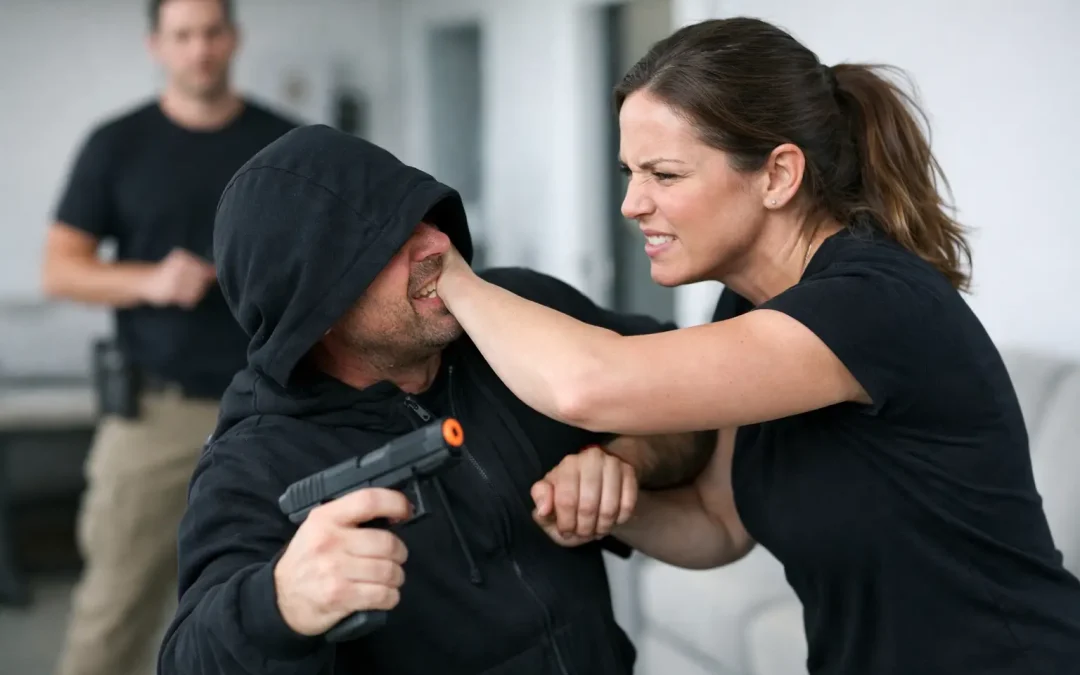
A crowded parking garage. A stranger who keeps closing distance after you have said no. A confrontation that begins with words, then suddenly changes. Scenario based self defense training prepares you for the moment when a situation stops feeling normal and you need to make a fast, clear decision.
That is the difference between knowing a move and being able to use it. Real danger does not arrive on schedule. It does not pause so you can set your stance, remember a sequence, or wait for a referee. Effective self-defense training must account for confusion, fear, awkward spaces, uneven footing, noise, and the pressure of another person refusing to back off.
What Scenario Based Self Defense Training Really Means
Scenario-based training puts skills inside realistic problems. Instead of repeating a technique in isolation, you practice recognizing a threat, using your voice, managing distance, responding to physical pressure, creating an opening, and getting to safety.
The goal is not to win a fight. The goal is to avoid harm and escape as quickly as possible.
A useful scenario has context. You may be standing beside your car with your hands full. You may be seated at a restaurant. You may be moving through a hallway, entering an elevator, commuting after work, or dealing with an aggressive person at close range. Each setting changes your options.
This is why a technique that looks impressive in a controlled class may fail outside it. A high kick may be a poor choice in narrow clothing or on a wet surface. A complicated joint lock may disappear the moment someone jerks, shoves, or throws repeated strikes. No fancy moves – just what works when your balance, space, and attention are compromised.
Why Pressure Changes Everything
Under stress, your body does not perform like it does during a relaxed demonstration. Your heart rate rises. Fine motor control drops. Vision can narrow. You may freeze, rush, or struggle to process what is happening.
That is not weakness. It is a human stress response.
Good training does not pretend stress will vanish. It teaches you to work through it. Students need gradual exposure to resistance, verbal aggression, movement, and uncertainty so they can practice staying functional when their body wants to panic.
Pressure has to be introduced responsibly. Beginners do not need to be thrown into full-contact chaos on day one. They need a supportive environment where drills become progressively more difficult as awareness and confidence grow. The lesson is simple: stay present, protect yourself, act decisively, and leave.
Controlled sparring and resistance drills matter because a cooperative partner can make almost any technique look effective. A resisting partner reveals what is simple enough to remember, direct enough to apply, and adaptable enough to continue if the first attempt does not work.
The Skills That Matter Before Physical Contact
The strongest response often happens before an attack begins. Scenario training should teach students to read behavior, not just react to hands.
Look for patterns that deserve attention: someone testing your boundaries, blocking your path, asking questions that keep you engaged, following too closely, invading your personal space, or ignoring a clear refusal. One signal alone does not always mean danger. Several signals, especially combined with isolation or escalating behavior, should change your decision-making.
Your voice is a practical tool. Clear commands such as “Stop,” “Back up,” and “Do not touch me” establish a boundary, attract attention, and create mental space to act. You do not need to sound polite when someone is violating your safety. You need to be understood.
Positioning matters too. Keep distance where possible. Avoid allowing an unknown person to trap you against a wall, vehicle, table, or doorway. Notice exits and move toward people, light, or a staffed area when something feels wrong. These decisions are not dramatic. They are smart.
What Realistic Scenarios Should Cover
A well-designed program does not train one “perfect” response. It builds a small set of reliable principles that can be adapted across situations.
For urban adults, useful training scenarios commonly include boundary violations and unwanted grabbing, close-range pushing or striking, escapes from common holds, defending yourself in tight spaces, and dealing with verbal intimidation. Training can also address personal-safety decisions around commuting, parking areas, workplace conflict, travel, and social settings.
The physical response should stay simple. Protect your head and balance. Create space. Use direct actions that interrupt the attack. Move toward an exit. Get help. The exact choice depends on the threat, your physical condition, who is with you, and whether escape is available.
Weapon situations require extra honesty. There is no guaranteed unarmed defense against a weapon. Training should never sell fantasy or encourage unnecessary risk. The priority is awareness, escape, cooperation when appropriate, and survival. Physical action is a last-resort decision when there is no safer option.
Scenario Based Self Defense Training Is Not Choreography
Choreographed drills have a place when learning basic movement. They give beginners a way to understand position, timing, and body mechanics. But choreography cannot be the destination.
If every partner attacks at the same speed, with the same hand, from the same angle, students learn to predict rather than respond. They may feel confident until the pattern breaks. Real threats are messy. People move unexpectedly, resist, grab clothing, crowd your space, and do not follow a script.
Reality-based training adds variation. The attacker may begin with words instead of a punch. The student may not know what is coming. The room may be loud. The goal may be to protect a friend or move around an obstacle. These details force the brain to make decisions instead of reciting routines.
That does not mean every session must be extreme. Safety, control, and skill level still matter. It means the training must eventually test whether a student can apply a principle outside the exact drill where it was learned.
Building Instinct Without Building Recklessness
Instinctive action is not magic. It is built through repetition under changing conditions.
A useful class repeats high-value movements until they become more available under pressure, then places them in different scenarios. You learn when to use verbal boundaries, when to disengage, when to protect yourself, and when force is necessary to stop immediate harm.
This approach also builds judgment. Self-defense is not permission to escalate every rude encounter. A person who insults you, cuts you off, or acts disrespectfully may be unpleasant, but that is not automatically a physical threat. The best outcome is often distance, de-escalation, and a safe exit.
Use force only when you reasonably need to protect yourself or another person from immediate harm, and stop when the danger stops. Local laws and circumstances matter. A responsible instructor teaches the mindset behind physical skills, not just the physical skills themselves.
Who Benefits Most From This Training
Scenario-based instruction is valuable for beginners because it starts with natural, usable actions rather than years of forms or rank requirements. It is also valuable for experienced martial artists who want to test whether their skills hold up in closer, less predictable conditions.
Working professionals often benefit because everyday risk tends to happen around routines: getting into a car, leaving an office, walking through a parking area, meeting someone unfamiliar, or traveling alone. Corporate teams can benefit as well when training includes awareness, communication, boundary setting, and practical emergency decision-making.
For women-focused groups, the value is not limited to a set of physical techniques. It is permission to trust discomfort, use a strong voice, break the social habit of being accommodating, and act fast when boundaries are ignored. For private groups, realistic scenarios can be shaped around the places and concerns participants actually face.
At Urban Street Defense, this means training principles inspired by Jeet Kune Do: simplicity, directness, adaptability, and effectiveness under pressure. The standard is not whether a movement looks traditional. The standard is whether it gives you a better chance to get home safely.
How to Judge a Self-Defense Program
Ask direct questions before you train. Does the program include realistic resistance, or do partners always cooperate? Does it teach awareness and verbal boundaries alongside physical responses? Are instructors honest about the limits of unarmed defense? Can beginners progress safely without being overwhelmed?
Also look at class culture. Serious training does not need to be macho, humiliating, or reckless. You should be challenged, corrected, and supported. Small classes and private instruction can be especially useful if you want more feedback or need to work around a specific concern.
The right program will not promise invincibility. It will give you practical options, better habits, and a clearer response when seconds matter.
Personal safety is not about living afraid. It is about refusing to be unprepared. Train for the situations that can actually happen, practice until simple actions become familiar, and give yourself the best possible chance to move, act, and get safe.