
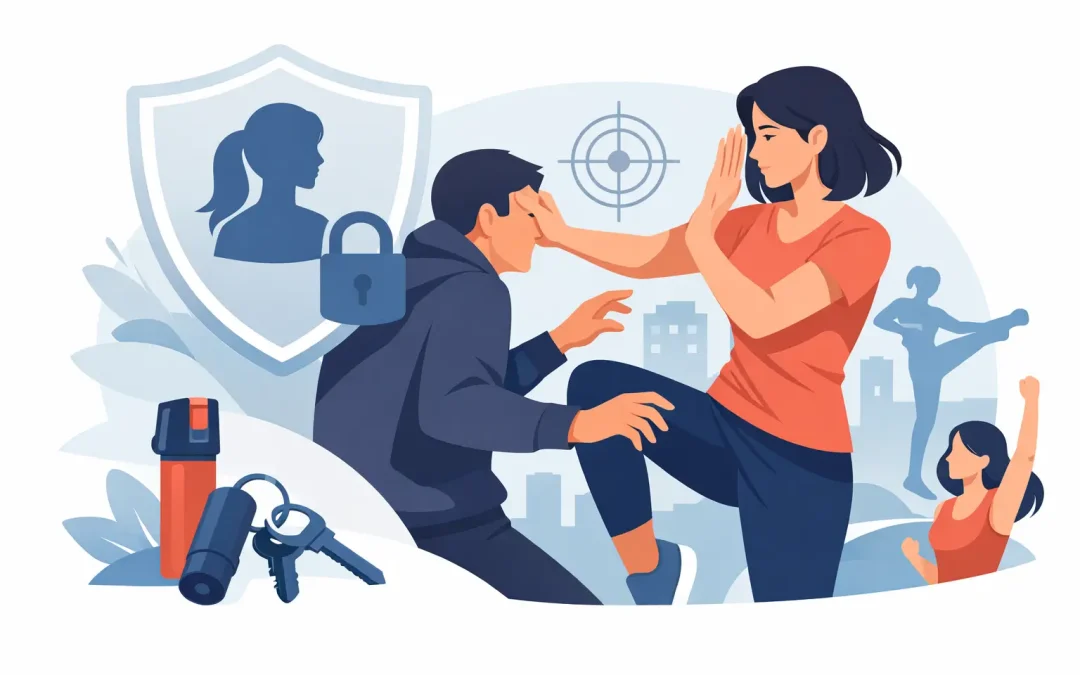
A threat rarely arrives when you are warmed up, focused, and standing in a fighting stance. It can happen while getting into your car, walking from public transport, opening your front gate, or leaving work with your hands full. A women’s self defense crash course should prepare you for that reality: fast decisions, simple movement, and the confidence to act when your body wants to freeze.
This is not about collecting impressive techniques. It is about recognizing danger early, creating space, breaking contact, and getting to safety. No fancy moves. No routines performed in slow motion. Just practical action for moments when hesitation carries a cost.
What a Women’s Self Defense Crash Course Should Teach
A good crash course does not promise that one afternoon makes anyone invincible. Real safety is more complicated than that. Size, fitness, environment, surprise, multiple attackers, and weapons all change the situation. The goal is not to win a fight. The goal is to avoid one where possible and escape one when necessary.
That means the training must begin before physical contact. Students need to practice awareness without becoming fearful or paranoid. They need to notice who is around them, spot behavior that feels wrong, and make early choices that improve their position. Crossing the street, entering a busy shop, calling someone, changing direction, or leaving an uncomfortable situation are not signs of weakness. They are smart decisions.
When avoidance is no longer available, the course should focus on natural responses that hold up under stress. Complex sequences often disappear when adrenaline hits. Simple actions are easier to remember, faster to apply, and more likely to work when space is tight.
The Skills That Matter Under Pressure
Awareness is your first line of defense
Most dangerous situations do not begin with a dramatic attack. They begin with an approach, an unwanted conversation, someone standing too close, a person following you, or an attempt to isolate you. Learn to trust the signal that says something is off. You do not owe a stranger politeness at the expense of your safety.
Practical training teaches you to keep a safe distance, maintain an exit route, and use your voice early. A clear, loud command such as “Stop,” “Back off,” or “Don’t touch me” can draw attention, establish a boundary, and disrupt a person who expected compliance. Your voice is not an accessory. It is a tool.
Position and balance beat panic
If someone crowds, grabs, or pushes you, your first job is to stay on your feet. Balance gives you options. A stable stance, hands positioned between you and the other person, and movement toward open space can prevent a situation from becoming worse.
This is where scenario training matters. Standing still while an instructor explains a move is not enough. You need to feel what it is like when someone closes distance suddenly, grabs clothing, blocks your path, or applies pressure. Controlled practice builds recognition. Recognition shortens the time between seeing the problem and responding to it.
Create distance, then leave
Self-defense is not a test of toughness. Once you create an opening, use it. Move toward people, light, security, a store, a guard station, or any place where help is available. Call emergency services and contact someone you trust as soon as you are safe.
A crash course should teach direct, gross-motor responses designed to interrupt an attack long enough to escape. The best response depends on range and circumstance. A close grab needs a different answer than someone approaching from several steps away. Training should explain those differences without burying beginners under dozens of techniques.
Expect an adrenaline response
Under fear, people may shake, lose fine motor control, experience tunnel vision, or struggle to remember what happened. That is a normal stress response, not a personal failure. Training that introduces manageable pressure helps students work through it.
Pressure does not mean recklessness. It means practicing with realistic intent, protective equipment, clear rules, and qualified supervision. You should be challenged, but never placed at unnecessary risk. The lesson is to keep moving, keep breathing, and act decisively even when your heart is racing.
What One Session Can and Cannot Do
A women-focused crash course can make an immediate difference. It can replace vague fear with a workable plan. You can learn stronger boundaries, safer positioning, basic escape priorities, and how to respond with more purpose if someone crosses the line.
But a single session is a starting point, not a finish line. Physical skills fade when they are not practiced. Your timing improves through repetition. Your ability to stay functional under pressure improves when you gradually experience pressure in training.
Think of a crash course as a foundation. It gives you practical tools now and shows you what continued training can build: better awareness, sharper reactions, stronger movement, and more confidence in unfamiliar environments. For many busy professionals, it is the right first step because it fits into a demanding schedule. For others, private coaching or regular classes may be the better choice because they want more repetition and individualized feedback.
Avoid Training That Looks Good but Fails Fast
Not every self-defense program prepares people for real danger. Be cautious of classes built around long choreographed sequences, complicated wrist-lock collections, or cooperative demonstrations where the attacker pauses and waits. Those methods may have a place in sport or traditional martial arts, but they are not automatically useful in an unexpected assault.
Ask direct questions before you enroll. Will you practice verbal boundary-setting? Will you train from common urban situations, such as parking areas, lifts, hallways, public transport, and close-range grabs? Will the instructor explain how stress changes movement? Is there controlled resistance, or does every partner cooperate?
The answer should be practical. Good instruction adapts to the student, the environment, and the threat. It does not pretend there is one perfect move for every situation.
Build a Personal Safety Plan Beyond the Class
Training works best when it supports everyday habits. Keep your phone accessible rather than buried in a bag. Know your route before leaving a new place. Tell a trusted person when you are traveling late. Avoid distractions when walking through isolated areas, especially when entering or leaving a vehicle.
These actions are not about blaming women for violence. Responsibility always belongs to the person choosing to harm someone. Safety habits simply give you more options, and options matter.
It also helps to decide in advance what you will do if something feels wrong. Where is the nearest busy place? Who can you call? What words will you use to set a boundary? What is your fastest route away? A plan is easier to use when you have considered it before stress takes over.
Train for Reality, Not Performance
At Urban Street Defense, women-focused training is built around simplicity, directness, and action under pressure. Students do not need previous martial arts experience to begin. The focus is on usable movement, clear decision-making, and the mindset to respond instead of freezing.
A supportive class environment matters, especially for beginners. You should be able to ask questions, train at an appropriate pace, and develop confidence without being treated as fragile. At the same time, training must stay honest. Real danger is chaotic. Effective instruction respects that fact while giving students practical ways to improve their chances.
Your safety is not a performance, and confidence is not pretending nothing can happen. It is knowing that if a boundary is crossed, you have a voice, a plan, and actions you have practiced. Start there. Then keep building.