
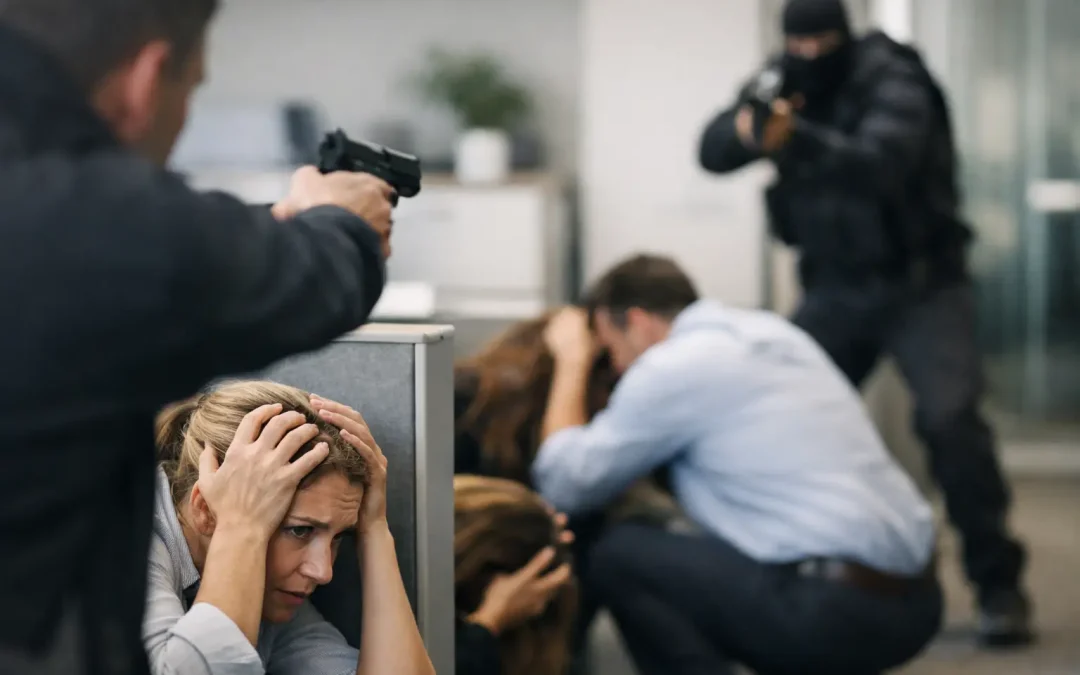
A threat does not announce itself and wait for you to choose a stance. It can begin with someone closing distance too fast in a parking lot, a wrist grab outside a train station, or an aggressive confrontation that turns physical without warning. Panic response training prepares you for that first critical moment when your heart rate spikes, your thinking narrows, and doing nothing can cost you your chance to get away.
The goal is not to turn ordinary people into fighters. The goal is to help them act with purpose under stress: create distance, protect vulnerable targets, disrupt the attacker, and escape. No fancy moves. No routines that fall apart when someone resists. Just actions you can access when the situation is ugly, close, and fast.
What Panic Response Training Actually Teaches
Panic is not weakness. It is a normal survival response. When the brain detects danger, your body may freeze, tense up, lose fine motor control, breathe shallowly, or react without clear thought. A person who performs a complicated technique perfectly in class may struggle to remember the first step when fear takes over.
That is why practical training starts with simple, direct movements. Gross-motor actions are easier to perform under pressure than delicate grips, long sequences, or high kicks. A strong shove to create space, a direct strike to interrupt an attack, a protective cover, an escape from a grab, and rapid movement toward safety are all more useful than a technique that requires ideal timing.
Panic response training also teaches recognition. Many dangerous situations provide warning signs before physical contact: a person ignores your verbal boundary, blocks your path, follows you, crowds your personal space, or uses conversation to close distance. Seeing the pattern early gives you more options. You may leave, move toward people and light, use a firm voice, call for help, or prepare your body position before the threat becomes physical.
Why Knowledge Alone Does Not Hold Up Under Pressure
Watching self-defense videos can introduce ideas, but exposure is not training. Knowing what you should do is different from being able to do it when a larger person is pushing, grabbing, shouting, or driving you backward.
Under stress, people do not usually rise to the level of their knowledge. They fall toward the level of their practiced response. If you have only practiced slowly with a cooperative partner, slow and cooperative is what your body expects. Real violence does not offer that condition.
Pressure-based practice closes the gap. It introduces controlled resistance, movement, verbal stress, surprise, and decision-making. Training should be progressive. Beginners do not need to be thrown into hard sparring on day one. But they do need to move beyond static demonstrations if the goal is real personal safety.
A good instructor increases intensity with care. First, you learn the movement. Then you perform it with a partner. Next, the partner adds realistic resistance. Finally, you apply the skill in a scenario where you must identify danger, respond, and get away. Each stage builds confidence without pretending the situation is comfortable.
The First Seconds Matter Most
Most self-defense failures happen before any technique is attempted. The person stands too close. Their hands are down. Their attention is elsewhere. They wait for proof that the aggressor is dangerous, even after multiple warning signs.
A practical response begins with position. Keep space where possible. Use your hands naturally between yourself and a person who is crowding you, palms visible and ready. This looks non-aggressive, but it gives you a barrier and a faster route to protect yourself. Angle your body instead of standing square in front of the person. Look for exits, obstacles, witnesses, and places where you can move.
Your voice matters too. A clear command such as Stop, Back up, or Don’t touch me can set a boundary, attract attention, and force the other person to reveal intent. It is not magic. Some attackers will ignore it. But silence and compliance are not the only options.
If contact happens, the priority is not proving you can win a fight. The priority is breaking the attacker’s control long enough to escape. That may mean protecting your head, attacking a vulnerable target, moving off the line, freeing a trapped arm, or using your body weight to drive space between you. What works depends on the attack, your position, the environment, and whether an escape route is open.
Train the Mind Along With the Body
Fear becomes more dangerous when it causes mental shutdown. Effective training gives people a short decision framework they can recall under pressure:
- Notice the threat and trust clear warning signs.
- Set a boundary and create distance early.
- If attacked, protect yourself and respond decisively.
- Escape, get to safety, and seek help.
This is not a script for every situation. Real encounters are chaotic. The value of a framework is that it prevents the most common trap: standing still and hoping the danger will resolve itself.
Mental rehearsal helps as well. Picture the places you use every week: the elevator lobby, the office parking area, the walkway from public transit, the entrance to your apartment, or a late-night convenience store. Where are the exits? Where are people likely to be? What would you do if someone started closing distance? This kind of awareness is not paranoia. It is preparation.
Breathing also affects performance. You cannot always stop adrenaline, but you can avoid feeding it. A quick exhale, a stable stance, and a simple command to yourself such as move or get out can interrupt the freeze response. The aim is not to feel calm. The aim is to remain functional.
What Realistic Practice Should Look Like
Reality-based self-defense does not mean reckless training. It means training with honest variables. Clothing restricts movement. Floors can be slippery. Bags, phones, walls, cars, tight spaces, and multiple people change what is possible. An attacker may be stronger, heavier, or more committed than you expect.
Training should account for these realities. Practice from common positions, including being grabbed, pinned against a wall, seated, or surprised at close range. Learn how to use verbal boundaries before physical action. Work on movement while tired. Test whether a response still works when the partner is not helping you.
There is a trade-off. The more realistic the drill, the more carefully it must be managed. Protective equipment, clear rules, qualified coaching, and gradual intensity are not optional. Training should challenge you without causing needless injury or teaching reckless behavior.
At Urban Street Defense, the focus is on simple, adaptable responses shaped by pressure and realistic scenarios. That approach serves beginners especially well because it does not demand years of forms or rank progression before practical skills are introduced. It also challenges experienced martial artists to test whether their habits work outside a controlled sport setting.
Panic Response Training Is Not About Being Fearless
The person who gets home safely may still be shaking afterward. That does not mean they failed. Courage is not the absence of fear. It is the ability to take useful action while fear is present.
Your training should make you harder to surprise, harder to control, and quicker to move toward safety. It should also sharpen judgment. Sometimes the right answer is a loud boundary and a fast exit. Sometimes it is physical resistance because there is no safer option. Knowing the difference is part of the skill.
Do not wait for confidence to appear before you prepare. Start with simple movements, honest scenarios, and repeated practice. When pressure arrives, you may not get time to think. Give yourself a response worth trusting.