
A threat does not wait for you to earn a belt, build years of flexibility, or memorize a long routine. It happens fast, close, and under stress. So, can beginners learn self defense? Yes – if they learn skills built for the way real confrontations unfold, not for looking impressive in a training hall.
The goal is not to turn a beginner into a movie fighter. It is to build a faster, clearer response: recognize trouble early, create distance, protect yourself, disrupt the attacker’s actions, and get to safety. That is a realistic starting point for anyone, regardless of age, fitness level, or previous martial arts experience.
Can Beginners Learn Self Defense Without Experience?
Absolutely. In fact, a good self-defense program should be designed for people who have never thrown a punch, escaped a grab, or felt comfortable with physical contact. Beginners do not need a fighting background. They need instruction that removes unnecessary complexity.
Under pressure, fine motor skills drop. Your heart rate rises, your vision narrows, and your ability to recall a sequence of ten moves disappears. This is why complicated techniques, ceremonial forms, and perfectly timed counters are a poor foundation for personal safety.
Start with natural, direct actions. Use your voice. Move your feet. Cover your head. Create space. Strike vulnerable targets when escape is blocked. Break grips with leverage and body movement rather than arm strength alone. These actions can be taught, repeated, and pressure-tested from the first stages of training.
That does not mean self-defense is easy. It means the learning path is clear. You do not need to become an expert before you can become harder to control.
What Beginners Should Learn First
The first lesson is not a flashy disarm or a spinning kick. It is understanding distance and decision-making. Many dangerous situations offer warning signs before physical contact begins: someone closing distance too quickly, blocking your path, ignoring a clear boundary, following you, or trying to isolate you.
A beginner should practice using a firm voice and simple language. “Stop.” “Back up.” “I don’t know you.” These words are not magic, but they set a boundary, draw attention, and prepare your mind to act. Hesitation is common when someone appears aggressive but has not attacked yet. Training helps you recognize that you are allowed to leave, make noise, and protect your space early.
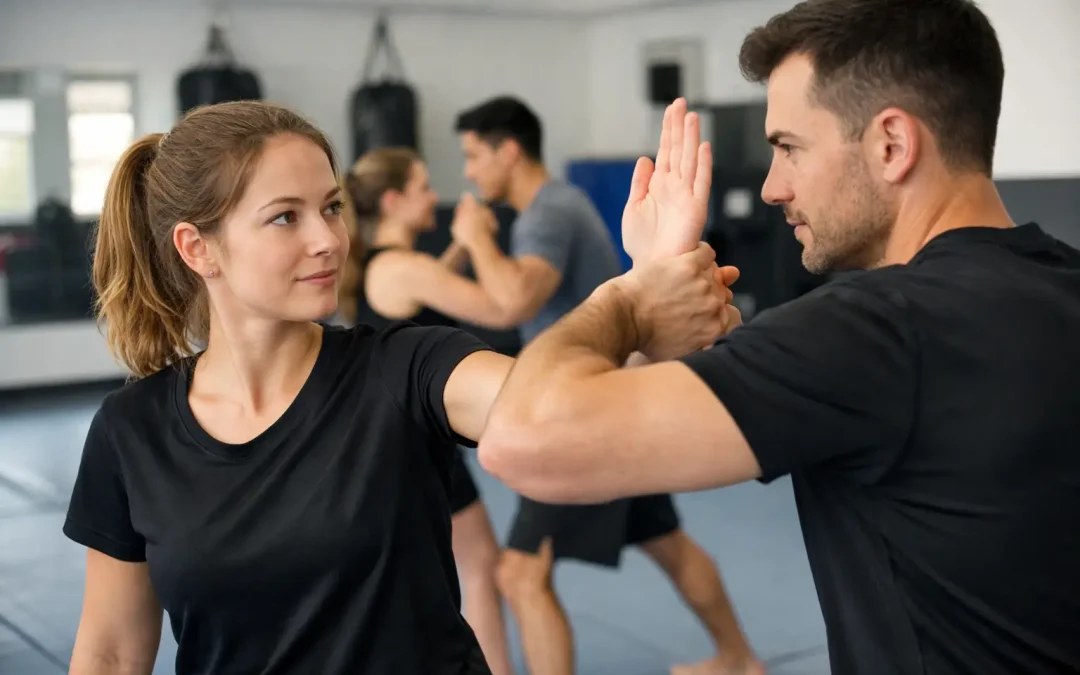
From there, the physical priorities are simple: maintain balance, protect the head and body, avoid being trapped, and create an exit. A practical class should cover common situations such as wrist grabs, shirt grabs, pushes, choking attempts, bear hugs, and attacks in close range. The techniques should work for smaller people against larger people because they rely on position, timing, target selection, and commitment – not strength alone.
There is a trade-off here. Simple does not mean careless. A single technique taught without context can create false confidence. Students need to know when an action is appropriate, what can go wrong, and what comes next if the first attempt fails.
Training Must Include Pressure
A technique that works only when a partner stands still is not a self-defense skill. It is choreography.
Beginners need controlled resistance. At first, that may mean a partner applies a grab with light pressure while the student learns the movement. As confidence grows, the partner resists more, moves more realistically, and adds verbal stress or surprise. The student learns to act while uncomfortable, not just while calm.
This should be progressive, not reckless. Throwing a new student into hard sparring on day one is not smart coaching. But avoiding all resistance is equally unhelpful. The right environment challenges people safely, teaches them to manage adrenaline, and lets them discover what actually holds up when timing is imperfect.
At Urban Street Defense, this is the difference between practicing moves and building responses. Jeet Kune Do-inspired training keeps the focus on simplicity, directness, adaptability, and effectiveness. No routines, no pauses, no pretending an attacker will cooperate.
Confidence Comes From Evidence, Not Motivation
Many people begin self-defense training because they want confidence. That is a valid reason. But confidence should not mean believing you can win every confrontation. It should mean knowing you have options and have practiced using them.
Real confidence is evidence-based. You felt someone resist a grip and found a way to break free. You practiced speaking loudly while someone invaded your space. You moved, covered, struck pads, recovered your balance, and escaped. You learned that freezing is a normal stress response, then trained a better response.
This matters for commuters, people who work late, students, travelers, and anyone navigating crowded urban spaces. Most days will never require physical self-defense. That is the best outcome. Yet awareness and preparation can change how you carry yourself, choose routes, react to boundary violations, and support someone else in a difficult moment.
How Long Does It Take to Learn Basic Self-Defense?
A focused beginner can learn useful principles in one well-run workshop. They may leave with a stronger stance, a clearer understanding of awareness, practical escape options, and a more decisive mindset. That is valuable.
But one session does not create an instinct. Retention requires repetition. The body needs enough practice to respond when your mind is busy, tired, startled, or scared. Regular training also reveals weaknesses that a single lesson cannot expose.
For many adults, consistency matters more than intensity. One or two quality sessions per week, combined with occasional scenario-based workshops, can build meaningful ability over time. Private lessons can help if you have a specific concern, a demanding schedule, or want more focused coaching. Corporate and small-group training can also give teams a practical shared language around boundaries, situational awareness, and emergency response.
The right timeline depends on your goal. If you want basic personal-safety awareness, start now. If you want the ability to function under physical pressure, commit to ongoing practice. If you are preparing for a particular risk, such as frequent late-night travel or workplace exposure, train the scenarios most relevant to that risk.
What Self-Defense Training Cannot Promise
No honest instructor can guarantee that a technique will work every time. Size, surprise, environment, multiple attackers, weapons, intoxication, and panic all change the situation. A hard floor, a narrow hallway, a parked car, or poor lighting can turn a manageable moment into a dangerous one.
That is why the purpose of self-defense is escape, not proving toughness. Avoidance is a win. De-escalation is a win. Running is a win. Calling for help is a win. Physical action is for the moment you cannot safely avoid or leave the threat.
Training should also include legal and ethical judgment. Use only the force necessary to protect yourself and stop when you can get away. Local laws and circumstances matter, so students should understand the rules that apply where they live and work.
Choosing a Beginner-Friendly Class
Look closely at what a school actually teaches. If every session centers on forms, rank progression, or sport competition, it may be a great martial art experience but not the right fit for your personal-safety goal. There is nothing wrong with sport or tradition. They simply solve different problems.
A practical beginner class should explain why each skill is used, let you practice against realistic movement, and keep safety standards high. Instructors should adapt for different sizes, fitness levels, injuries, and comfort levels without lowering the standard of realism. You should be encouraged to ask questions, make mistakes, and train with people who want you to improve.
For adults in Kuala Lumpur, Petaling Jaya, and Ipoh, convenience matters too. Training that fits your schedule is training you are more likely to continue. Start with a beginner session, a women-focused crash course, private instruction, or a practical workshop. The best format is the one you will attend and repeat.
You do not need to be fearless, athletic, or experienced to begin. You need a system that respects the reality of stress and teaches you to respond with purpose. Start before you feel ready, practice until your actions become clearer, and give yourself a better chance to get home safe.