
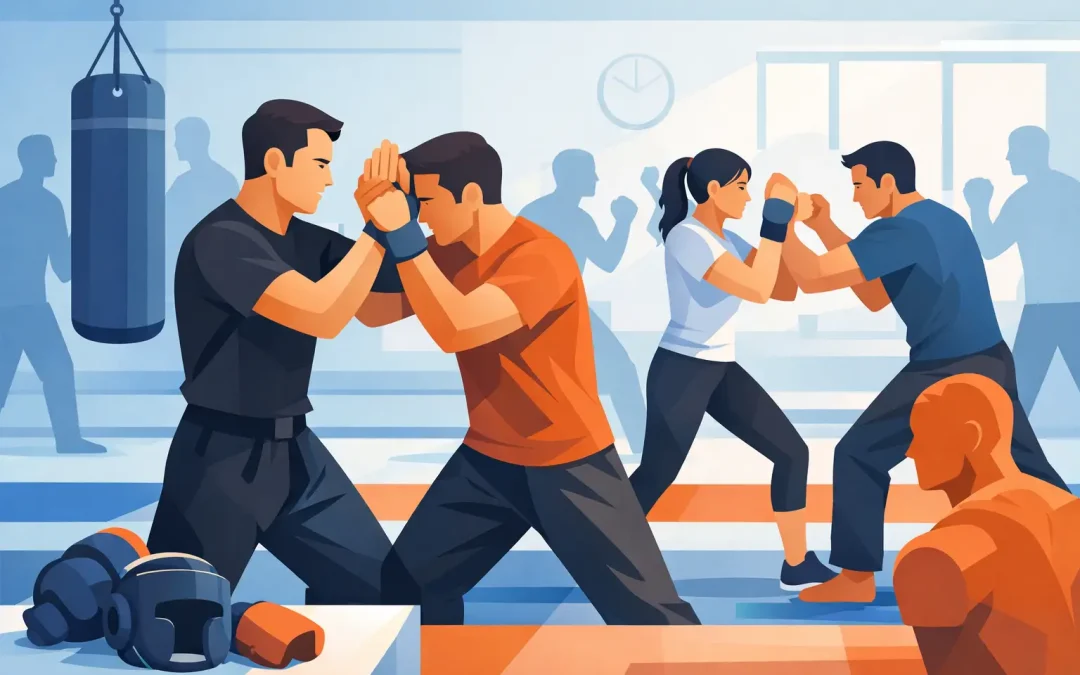
A threat does not arrive on a clean mat, with a referee, or after you have had time to plan your next move. It can happen in a parking area after work, at an elevator, on public transport, or during a night out with friends. Group self defense classes should prepare you for that reality: fast decisions, limited space, adrenaline, confusion, and the need to get safe.
That is why the right class is not built around memorizing long routines or collecting belts. It is built around usable movement, clear thinking, and actions you can access when pressure hits. No fancy moves. Just what works.
What Group Self Defense Classes Should Teach
A practical group class starts with a simple question: what is the safest response to a real threat? Sometimes that means creating distance and leaving. Sometimes it means using your voice, setting a boundary, breaking a grip, striking a vulnerable target, or getting back to your feet after being pushed down.
The goal is not to win a fight. The goal is to recognize danger early, respond decisively, and escape when the opportunity appears.
Effective training focuses on natural actions that do not require years of flexibility or athletic ability. A good instructor teaches you how to protect your head, manage your balance, move under pressure, and use direct techniques that make sense when your heart rate is high. You should understand why an action works, when it may fail, and what to do next.
Reality does not pause. Your training should not either.
Why Training With a Group Makes You Better
Learning in a group creates something solo practice cannot fully reproduce: unpredictability. Different partners have different heights, builds, energy levels, reactions, and ways of moving. That variation matters because a real attacker will not cooperate with your technique.
A controlled group environment also helps students become familiar with pressure. At first, even a raised voice, a close approach, or a firm grab can feel overwhelming. With progressive training, your body learns not to freeze. You begin to see openings, protect yourself, and act with greater purpose.
There is a community benefit too. Training alongside working professionals, beginners, women, men, and people from different backgrounds removes the intimidation factor. Everyone starts somewhere. The right class is demanding, but it is not about showing off or putting people down. You train hard, support your partners, and improve together.
For friends, couples, and colleagues, group training can also create a shared safety language. You can talk openly about risky situations, practice awareness habits, and make better decisions when you are out together.
Realistic Does Not Mean Reckless
Some people hear “reality-based self-defense” and imagine uncontrolled fighting. That is not practical training. Good instruction uses pressure intelligently.
Beginners need time to learn positioning, movement, and safe mechanics. Then intensity can increase through drills that include verbal stress, movement, resistance, awkward angles, and changing scenarios. Protective equipment and clear class rules allow students to work with intent without turning every session into an injury risk.
The balance matters. Training that is too soft can create false confidence. Training that is too hard too soon can overwhelm students, discourage attendance, or cause unnecessary injuries. The best group self defense classes build capability step by step, while keeping the focus on actions that hold up when a partner resists.
This is where sport martial arts and street defense can differ. Sport training can develop timing, fitness, discipline, and useful skills. But it also operates within rules, weight categories, gloves, rounds, and a known opponent. Real-world violence may involve surprise, confined space, uneven footing, multiple people, or an attempt to grab and control you. A practical self-defense class addresses those realities without pretending there is a guaranteed answer for every situation.
What a Useful Class Session Looks Like
You should leave class feeling that you practiced something you could apply, not merely watched a demonstration. A strong session often begins with awareness, movement, and a warm-up that builds relevant coordination rather than exhausting you for no reason.
From there, students may work on common situations: handling an aggressive approach, escaping wrist or clothing grabs, responding to a choke attempt, defending against a push, or creating space after being trapped against a wall. The techniques should stay simple. Under stress, simple is faster to recall and easier to repeat.
Partners then add resistance at an appropriate level. This is where technique becomes a response instead of a sequence. You learn how a grab actually feels, how quickly balance can disappear, and why continuing to move matters. You may also practice verbal commands, because a clear, forceful “No” can draw attention, set a boundary, and create a moment to escape.
As students gain experience, pressure-oriented sparring and scenario drills help close the gap between knowing and doing. You do not need to become a fighter to benefit from this work. You need to experience enough controlled resistance that your body stops expecting perfect conditions.
Who Benefits Most From Group Training?
Group self-defense training is useful for adults who commute, travel, work late, use parking garages, attend events, or simply want to feel less vulnerable in public spaces. It is especially valuable for people who have never trained before, because it replaces vague fear with a practical plan.
Working professionals often appreciate the structure and efficiency. A focused class can improve awareness, confidence, stress management, and physical readiness without requiring a competitive martial arts lifestyle. You do not need to spend years learning ceremonial forms before you can develop useful skills.
Corporate teams can benefit as well. Workplace safety does not end at the office door. Employees may travel, meet clients, work irregular hours, or commute alone. A practical workshop gives teams a direct way to discuss personal safety and practice simple responses together. For employers, it can be a meaningful part of a broader well-being and safety culture.
Women-focused sessions and private groups can be a better fit for some participants, particularly when they want to address specific concerns in a familiar setting. There is no single format that suits everyone. The key is choosing training that stays practical, respectful, and pressure-aware.
How to Choose the Right Class
Before joining, look past impressive photos and technical names. Ask what students actually practice. Are they learning long combinations that require a compliant partner, or are they working on direct responses against realistic resistance?
A worthwhile program should be able to explain its approach clearly. Look for limited class sizes, qualified instruction, safety standards, and opportunities to train with different partners. The instructor should correct poor habits, not simply praise every attempt. Encouragement matters, but honest feedback is what helps you improve.
Pay attention to whether the class teaches avoidance and escape alongside physical defense. Anyone who promises that one technique will solve every problem is selling certainty where none exists. Personal safety depends on awareness, judgment, movement, communication, and action when action is unavoidable.
Urban Street Defense applies Jeet Kune Do-inspired principles to this kind of training: simplicity, directness, adaptability, and effectiveness under pressure. The point is not tradition for tradition’s sake. The point is building responses that make sense when the situation is messy and time is short.
Confidence Comes From Repetition, Not Wishful Thinking
You do not become safer by watching videos or telling yourself you would know what to do. Confidence grows when you have practiced moving, speaking, protecting yourself, and recovering from mistakes with real people in front of you.
Start where you are. Attend consistently. Ask questions. Train with purpose. A few practical habits learned and repeated in a supportive group can change how you carry yourself through the world: more aware, more prepared, and harder to intimidate.
Better. Faster. Stronger.