Women’s Reality Street Defense Trainers’ Programme
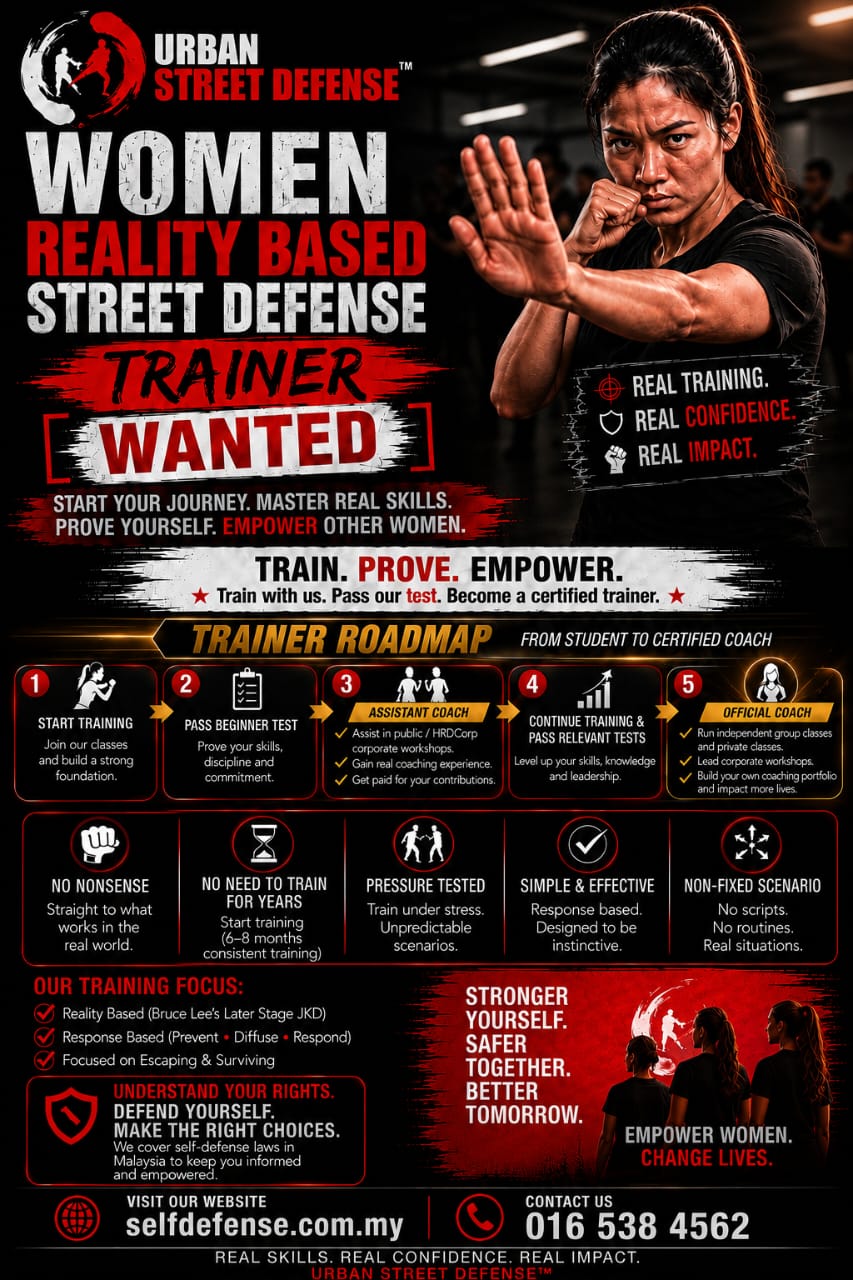
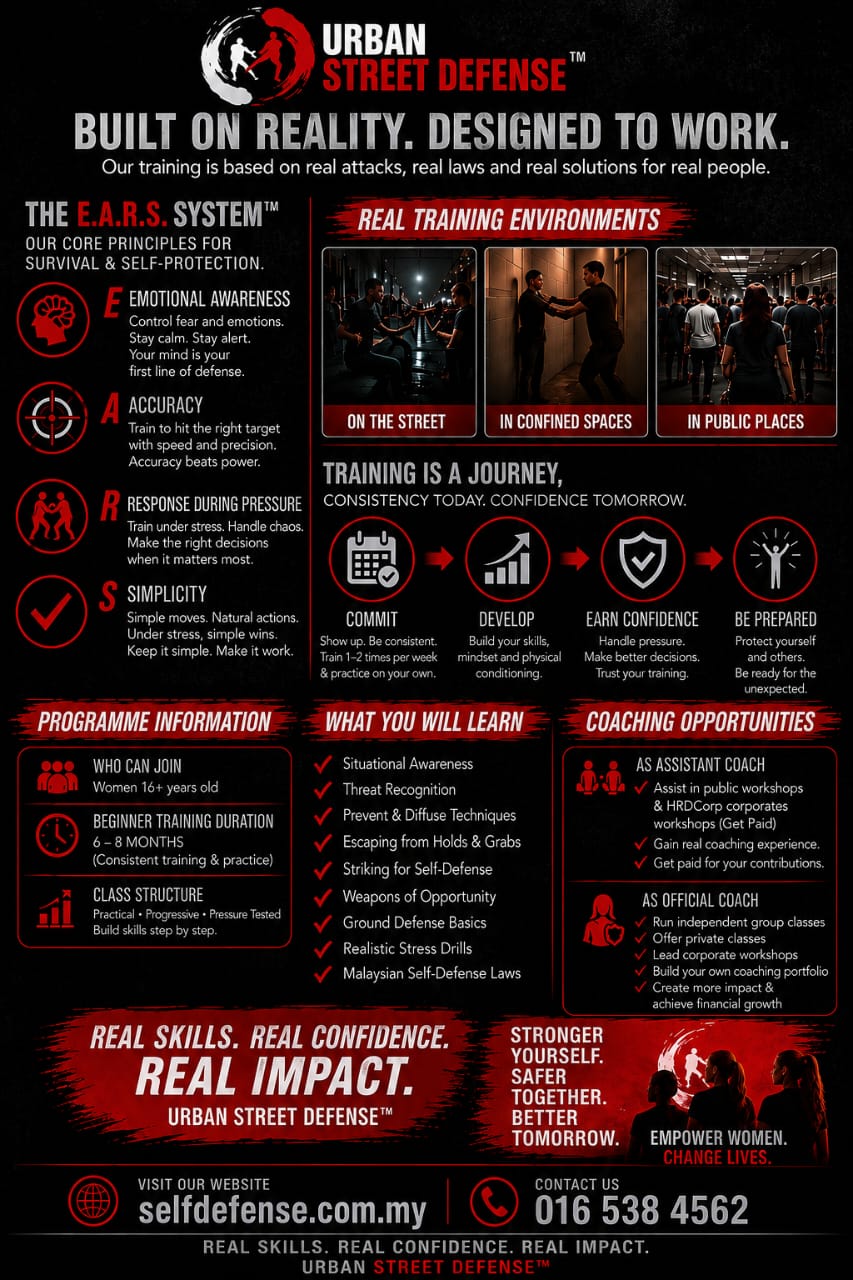


A threat does not arrive with a warning bell, a referee, or time to remember a complicated sequence. It can happen beside your car, in a parking structure, on the walk home, at work, or during travel. That is why self defense classes Kuala Lumpur residents choose should train more than techniques. They should train awareness, decision-making, movement, and the ability to act when adrenaline hits.
Real self-defense is not about looking impressive. It is about creating a chance to get away safely. The right training makes your responses simpler, faster, and more reliable under pressure.
A useful class starts with reality. Most people do not need a collection of ceremonial forms or a long list of moves designed for a cooperative partner. They need to recognize danger early, set boundaries clearly, move to a safer position, and respond decisively if physical contact becomes unavoidable.
That requires training against common urban situations: an aggressive approach, unwanted grabbing, being crowded against a wall, an attempted restraint, or an attack that begins at close range. Distance matters. Position matters. Your ability to keep moving matters. So does the judgment to leave before a situation becomes physical.
Good instruction also makes room for an uncomfortable truth: there is no guaranteed technique. Size, fitness, environment, surprise, multiple attackers, and weapons can change everything. A responsible program does not sell false certainty. It gives you practical options, builds better habits, and teaches you to prioritize escape over winning.
Look for classes that emphasize four essentials:
The last point separates knowing a move from being able to use it. A technique practiced slowly with a willing partner can feel effective. Add speed, resistance, noise, surprise, and fatigue, and the experience changes. Training must eventually reflect that reality in a controlled, responsible way.
Street violence is messy. You may be carrying a work bag, wearing office clothes, dealing with poor lighting, protecting a friend, or trying to reach your vehicle. You may freeze for a moment. You may not have room to kick. You may be off balance before you even understand what is happening.
Reality-based self-defense training prepares for those imperfect conditions. It favors direct actions over complicated patterns and repeated practice over theory alone. The goal is not to memorize dozens of answers. It is to build a small set of dependable responses and the instinct to use them.
Jeet Kune Do-inspired training follows this mindset well: simplicity, directness, adaptability, and effectiveness. There is no need to force every problem into one style or one perfect technique. Use what fits the moment. If a response fails, adjust. If an exit opens, take it.
This approach is especially useful for beginners. You do not need years of martial arts experience before learning how to stand with better balance, protect your space, strike with purpose, break contact, and move away. Experience helps, but practical foundations can begin in the first session.
At Urban Street Defense, the focus is on functional action rather than choreography. Students work through situations that demand attention, movement, and decisive responses. The environment is supportive, but the purpose is serious: build skills you can access when you are stressed, tired, and surprised.
Your first class should not be an ego test. It should be a place to learn the basics safely and honestly. A capable instructor will explain the purpose of each drill, scale intensity to the group, and correct movements before pushing speed or resistance.
Expect to work on posture, distance, footwork, protective positioning, and simple striking mechanics. You may practice escaping common grips or handling an aggressive approach. The point is not to prove toughness on day one. It is to understand how your body reacts and begin replacing hesitation with usable action.
Wear comfortable clothes you can move in. Leave jewelry and anything loose at home. Bring water, arrive ready to pay attention, and tell the instructor about injuries or physical limitations. Training can be adapted, but instructors need accurate information to do that well.
You should also expect some discomfort. Not injury or reckless contact, but the mental discomfort of being challenged, pressured, and asked to react. That is part of the value. Confidence is not pretending danger cannot happen. Confidence is knowing you have practiced what to do next.
The best format depends on your goal, schedule, and starting point. Group classes offer repetition, partner variety, and a community that keeps you accountable. They are a strong choice if you want ongoing development and regular pressure-based practice.
Private instruction gives you more flexibility and focused coaching. It can suit professionals with limited time, beginners who want extra confidence before joining a group, or people working toward a specific safety concern. Private-group sessions can also work well for families, friends, or small teams who want to train together.
For employers, corporate self-defense training addresses a different need. Staff may commute late, travel for work, meet clients off-site, or work in public-facing roles. A well-run workplace session should be practical, inclusive, and relevant to the actual environment. It should cover awareness, de-escalation, personal boundaries, and simple protective actions without turning the program into a fitness contest.
Women-focused crash courses can offer a direct entry point for people who want concentrated, practical instruction. They are not a replacement for continued practice, because skills improve through repetition. But a focused course can provide immediate tools, stronger awareness, and a clear plan for what to do when a situation feels wrong.
Ask direct questions. Does the school explain how drills connect to real situations? Is there controlled resistance, or do partners always cooperate? Are students taught to escape and de-escalate, or only to fight? Can beginners train safely? Are classes built around useful movement rather than rank, ritual, or performance?
Watch how instructors speak about violence. Be cautious of anyone promising that one move will stop every attacker or teaching students to chase confrontation. Effective training respects the risks. It teaches avoidance first, action when necessary, and escape whenever possible.
Class size matters too. In a crowded room, you may get less feedback and fewer opportunities to practice properly. Smaller groups often give instructors more room to correct technique, manage intensity, and make sure students are not merely going through motions.
Finally, choose a program you can attend consistently. One workshop can change how you think about safety. Regular training changes how you move, respond, and carry yourself. The best system is the one that is practical enough to use and structured enough to keep you coming back.
Personal safety is not about becoming suspicious of everyone around you. It is about paying attention, trusting your judgment, and refusing to surrender your choices when pressure appears. Notice the exit. Keep your phone accessible without being distracted by it. Create distance when someone ignores a boundary. Leave early when your instincts tell you something is off.
Physical self-defense adds another layer. It gives you options when awareness and words are not enough. Train for reality, practice consistently, and measure progress by how clearly you can think and act under pressure. Better. Faster. Stronger.
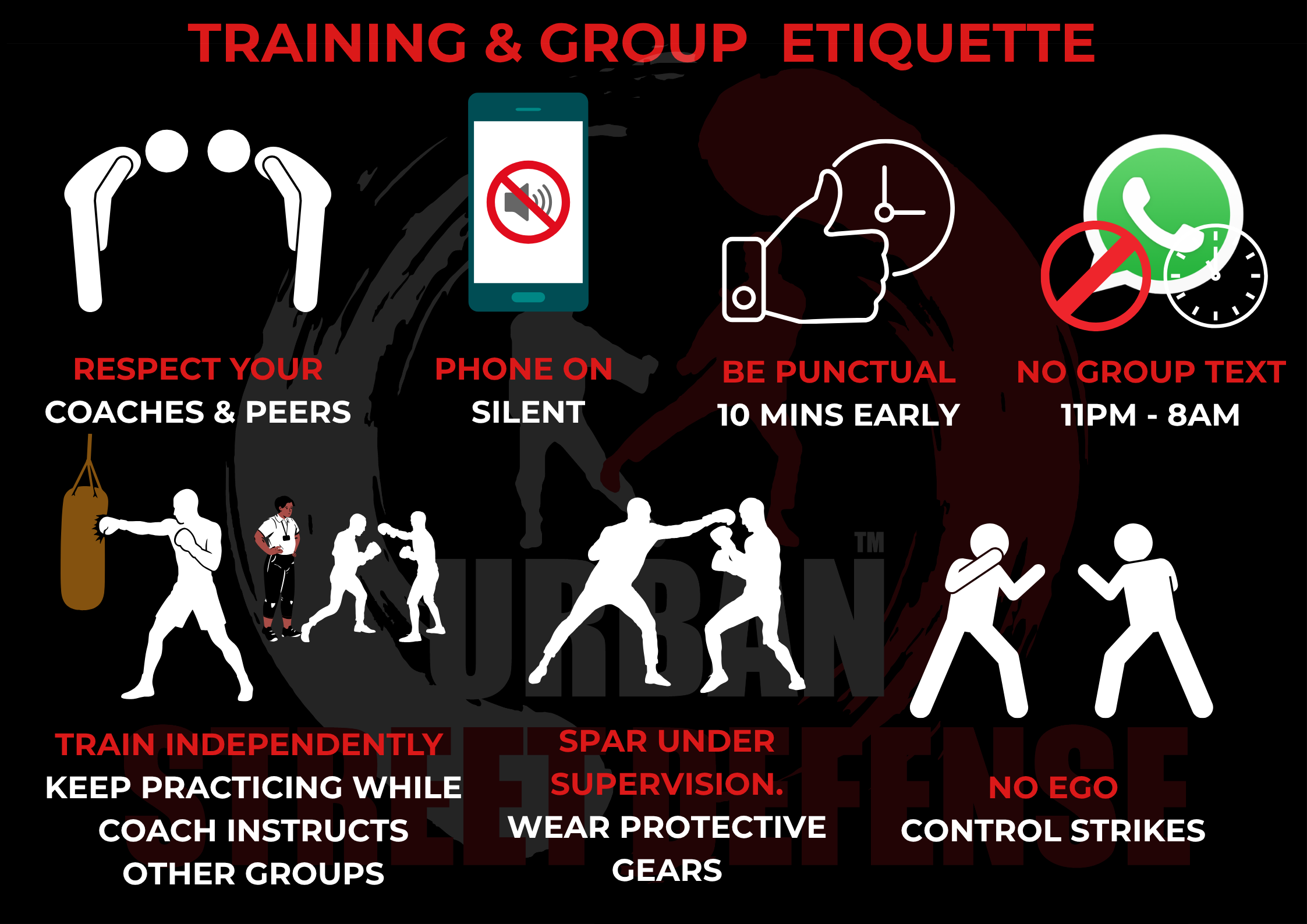

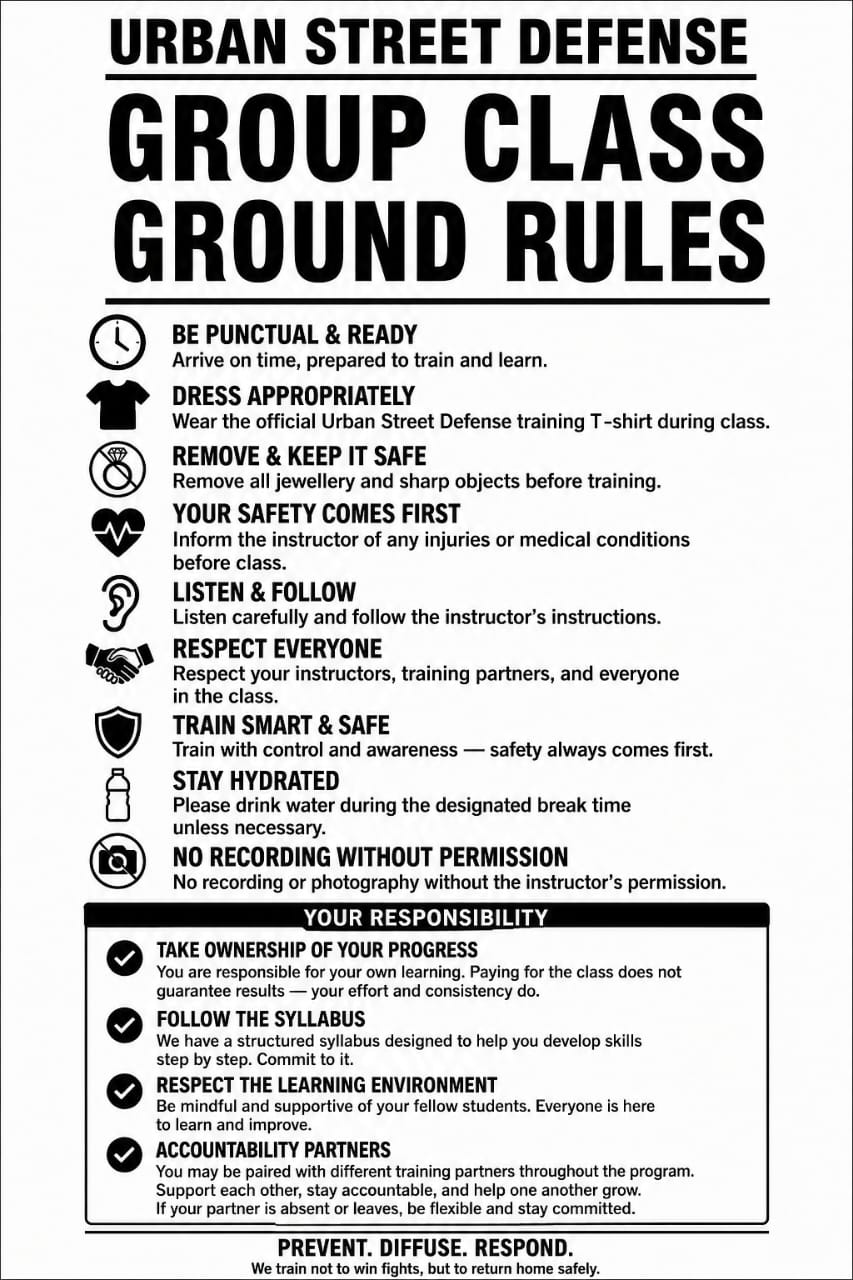
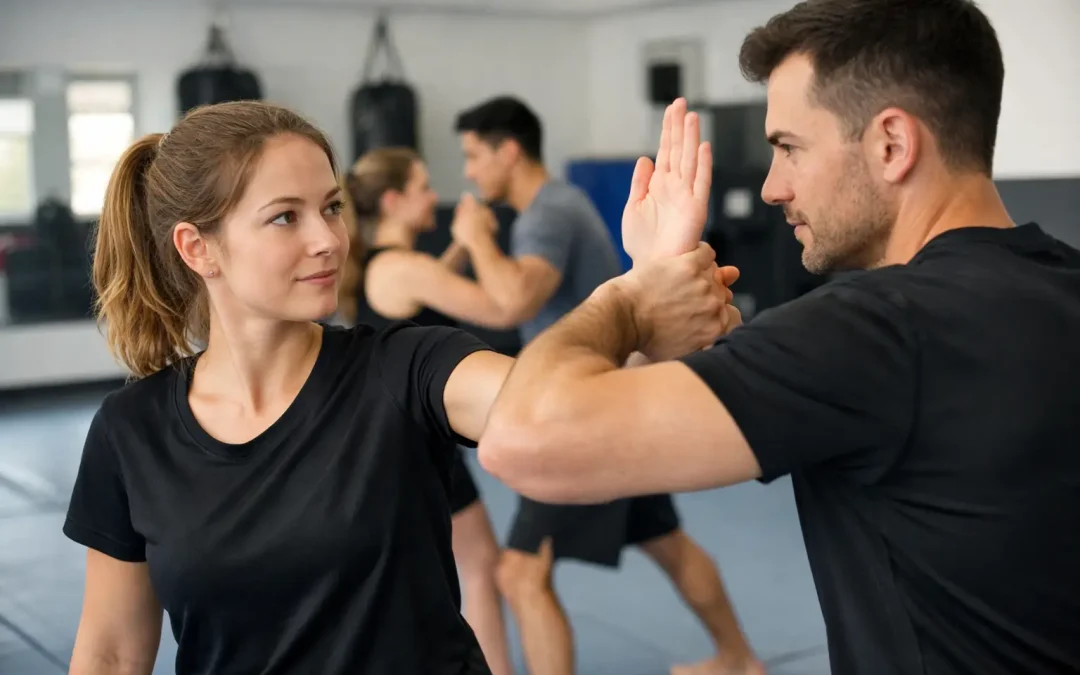
A threat does not wait for you to earn a belt, build years of flexibility, or memorize a long routine. It happens fast, close, and under stress. So, can beginners learn self defense? Yes – if they learn skills built for the way real confrontations unfold, not for looking impressive in a training hall.
The goal is not to turn a beginner into a movie fighter. It is to build a faster, clearer response: recognize trouble early, create distance, protect yourself, disrupt the attacker’s actions, and get to safety. That is a realistic starting point for anyone, regardless of age, fitness level, or previous martial arts experience.
Absolutely. In fact, a good self-defense program should be designed for people who have never thrown a punch, escaped a grab, or felt comfortable with physical contact. Beginners do not need a fighting background. They need instruction that removes unnecessary complexity.
Under pressure, fine motor skills drop. Your heart rate rises, your vision narrows, and your ability to recall a sequence of ten moves disappears. This is why complicated techniques, ceremonial forms, and perfectly timed counters are a poor foundation for personal safety.
Start with natural, direct actions. Use your voice. Move your feet. Cover your head. Create space. Strike vulnerable targets when escape is blocked. Break grips with leverage and body movement rather than arm strength alone. These actions can be taught, repeated, and pressure-tested from the first stages of training.
That does not mean self-defense is easy. It means the learning path is clear. You do not need to become an expert before you can become harder to control.
The first lesson is not a flashy disarm or a spinning kick. It is understanding distance and decision-making. Many dangerous situations offer warning signs before physical contact begins: someone closing distance too quickly, blocking your path, ignoring a clear boundary, following you, or trying to isolate you.
A beginner should practice using a firm voice and simple language. “Stop.” “Back up.” “I don’t know you.” These words are not magic, but they set a boundary, draw attention, and prepare your mind to act. Hesitation is common when someone appears aggressive but has not attacked yet. Training helps you recognize that you are allowed to leave, make noise, and protect your space early.
From there, the physical priorities are simple: maintain balance, protect the head and body, avoid being trapped, and create an exit. A practical class should cover common situations such as wrist grabs, shirt grabs, pushes, choking attempts, bear hugs, and attacks in close range. The techniques should work for smaller people against larger people because they rely on position, timing, target selection, and commitment – not strength alone.
There is a trade-off here. Simple does not mean careless. A single technique taught without context can create false confidence. Students need to know when an action is appropriate, what can go wrong, and what comes next if the first attempt fails.
A technique that works only when a partner stands still is not a self-defense skill. It is choreography.
Beginners need controlled resistance. At first, that may mean a partner applies a grab with light pressure while the student learns the movement. As confidence grows, the partner resists more, moves more realistically, and adds verbal stress or surprise. The student learns to act while uncomfortable, not just while calm.
This should be progressive, not reckless. Throwing a new student into hard sparring on day one is not smart coaching. But avoiding all resistance is equally unhelpful. The right environment challenges people safely, teaches them to manage adrenaline, and lets them discover what actually holds up when timing is imperfect.
At Urban Street Defense, this is the difference between practicing moves and building responses. Jeet Kune Do-inspired training keeps the focus on simplicity, directness, adaptability, and effectiveness. No routines, no pauses, no pretending an attacker will cooperate.
Many people begin self-defense training because they want confidence. That is a valid reason. But confidence should not mean believing you can win every confrontation. It should mean knowing you have options and have practiced using them.
Real confidence is evidence-based. You felt someone resist a grip and found a way to break free. You practiced speaking loudly while someone invaded your space. You moved, covered, struck pads, recovered your balance, and escaped. You learned that freezing is a normal stress response, then trained a better response.
This matters for commuters, people who work late, students, travelers, and anyone navigating crowded urban spaces. Most days will never require physical self-defense. That is the best outcome. Yet awareness and preparation can change how you carry yourself, choose routes, react to boundary violations, and support someone else in a difficult moment.
A focused beginner can learn useful principles in one well-run workshop. They may leave with a stronger stance, a clearer understanding of awareness, practical escape options, and a more decisive mindset. That is valuable.
But one session does not create an instinct. Retention requires repetition. The body needs enough practice to respond when your mind is busy, tired, startled, or scared. Regular training also reveals weaknesses that a single lesson cannot expose.
For many adults, consistency matters more than intensity. One or two quality sessions per week, combined with occasional scenario-based workshops, can build meaningful ability over time. Private lessons can help if you have a specific concern, a demanding schedule, or want more focused coaching. Corporate and small-group training can also give teams a practical shared language around boundaries, situational awareness, and emergency response.
The right timeline depends on your goal. If you want basic personal-safety awareness, start now. If you want the ability to function under physical pressure, commit to ongoing practice. If you are preparing for a particular risk, such as frequent late-night travel or workplace exposure, train the scenarios most relevant to that risk.
No honest instructor can guarantee that a technique will work every time. Size, surprise, environment, multiple attackers, weapons, intoxication, and panic all change the situation. A hard floor, a narrow hallway, a parked car, or poor lighting can turn a manageable moment into a dangerous one.
That is why the purpose of self-defense is escape, not proving toughness. Avoidance is a win. De-escalation is a win. Running is a win. Calling for help is a win. Physical action is for the moment you cannot safely avoid or leave the threat.
Training should also include legal and ethical judgment. Use only the force necessary to protect yourself and stop when you can get away. Local laws and circumstances matter, so students should understand the rules that apply where they live and work.
Look closely at what a school actually teaches. If every session centers on forms, rank progression, or sport competition, it may be a great martial art experience but not the right fit for your personal-safety goal. There is nothing wrong with sport or tradition. They simply solve different problems.
A practical beginner class should explain why each skill is used, let you practice against realistic movement, and keep safety standards high. Instructors should adapt for different sizes, fitness levels, injuries, and comfort levels without lowering the standard of realism. You should be encouraged to ask questions, make mistakes, and train with people who want you to improve.
For adults in Kuala Lumpur, Petaling Jaya, and Ipoh, convenience matters too. Training that fits your schedule is training you are more likely to continue. Start with a beginner session, a women-focused crash course, private instruction, or a practical workshop. The best format is the one you will attend and repeat.
You do not need to be fearless, athletic, or experienced to begin. You need a system that respects the reality of stress and teaches you to respond with purpose. Start before you feel ready, practice until your actions become clearer, and give yourself a better chance to get home safe.
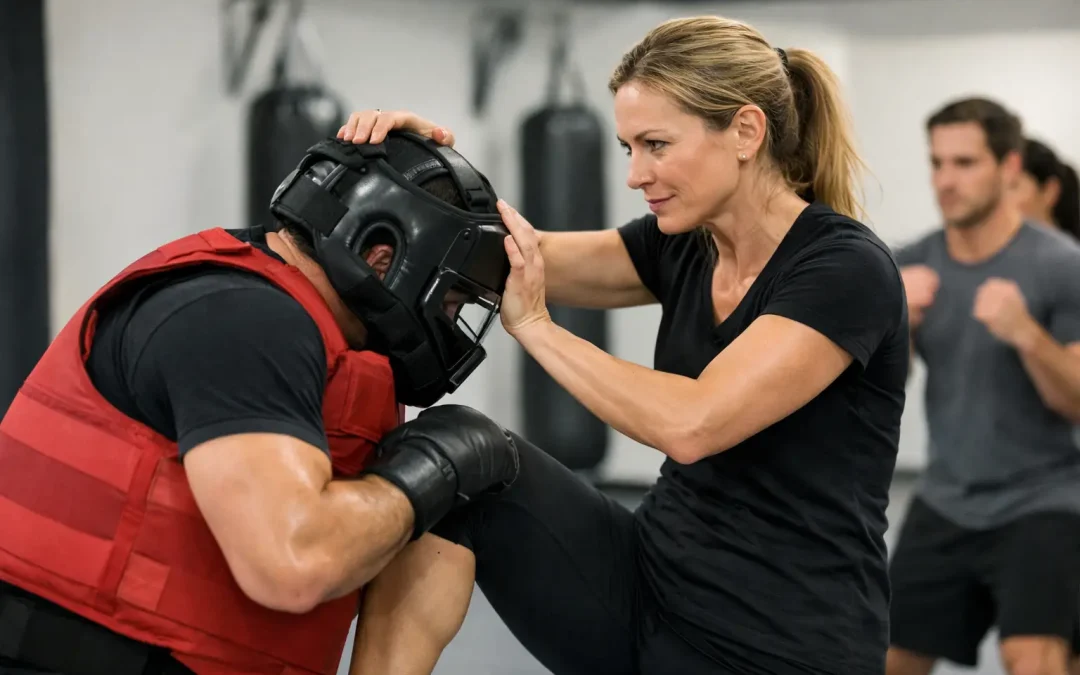
Most threats do not arrive with a warning bell. They happen in a parking area, an elevator, a ride-share pickup point, a late walk from the office, or during an argument that turns physical too fast. Self defense workshops for adults should prepare you for that reality: confusion, close distance, fear, limited space, and the need to act now.
This is not about collecting complicated moves or looking impressive in a training hall. It is about recognizing danger early, creating a chance to escape, and responding with simple actions that still work when your heart rate rises. Good training makes personal safety practical, not theoretical.
A useful workshop gives you more than a few techniques to remember. It teaches a decision-making process. When should you create distance? When do you use your voice? What happens if someone grabs you, corners you, or refuses to let go? Where is the safest exit?
The strongest programs combine awareness, verbal boundary-setting, physical response, and escape. These elements belong together. Awareness may help you avoid a confrontation. Clear verbal commands can draw attention and set a boundary. Physical action becomes necessary when the threat is immediate and leaving is not yet possible.
Adults also need training that respects how stress affects the body. Fine motor skills can disappear under pressure. You may freeze, rush, lose balance, or struggle to remember a sequence. That is why simple, direct movements matter. The goal is not perfection. The goal is to interrupt the attack, protect yourself, and get away.
A one-day workshop can build valuable awareness and give you a starting point. Regular practice builds faster recognition, stronger reactions, and better control under pressure. Both have a place. Choose based on your current needs, time, and the level of readiness you want.
There is a difference between practicing a technique and preparing for resistance. A partner who stands still, offers the same grip every time, and waits for your response can help you learn the basic motion. But real danger does not pause. A real attacker may pull, push, shout, strike, change position, or use the environment against you.
Reality-based training gradually introduces movement, uncertainty, and pressure in a controlled setting. That does not mean throwing beginners into chaos. It means learning safely, then testing whether a response still works when the other person is moving and resisting at an appropriate level.
Look for workshops that explain the purpose behind each action. A release from a wrist grab is not the final answer if the person can grab again. It should create space for a stronger response, movement toward safety, or an exit. Every technique needs a clear outcome.
Be cautious of programs built around long routines, elaborate joint locks, or moves that depend on an attacker staying cooperative. These may be interesting to study, but interest is not the same as usefulness. Under pressure, the best option is often the simplest one you can deliver decisively.
Physical defense is only one layer of personal safety. The earlier you spot trouble, the more options you have.
A practical workshop should teach you to pay attention without becoming paranoid. Notice blocked exits, people who are closing distance without a reason, repeated unwanted attention, isolated areas, and situations where alcohol, anger, or crowd behavior is changing the risk. Trusting discomfort is not weakness. It is information.
You should also practice setting boundaries with your voice. A firm command such as “Stop,” “Back up,” or “Don’t touch me” can be more effective than a polite explanation. It gives a clear message, may attract witnesses, and helps shift you from passive surprise into action.
De-escalation matters when it is safe and possible. Sometimes the smartest choice is to leave, hand over property, call for help, or avoid arguing with someone who wants conflict. There is no prize for winning a confrontation. Personal safety is the objective.
Expect controlled contact, not empty choreography. You may work on protective positioning, striking targets, breaking grabs, defending against common close-range attacks, creating distance, and moving toward an exit. You should also learn how your body responds when someone invades your space.
For beginners, good instructors explain the drill, demonstrate it clearly, and build intensity in stages. They correct unsafe habits without making people feel foolish. The training environment should be supportive, but it should not pretend that danger is comfortable.
Some discomfort is normal. You may feel awkward using your voice, hitting pads with commitment, or dealing with a partner who applies real pressure. That is part of the learning process. You are replacing hesitation with a more useful response.
Training should never require you to ignore injury, pain, or personal boundaries. A professional workshop offers appropriate safety equipment, clear rules, supervision, and options to adapt drills for physical limitations. Effective does not mean reckless.
Before you book, ask what the session is designed to deliver. A women-focused crash course, a private group session, a corporate safety program, and an ongoing class can all be valuable, but they serve different needs.
For a first workshop, ask whether the curriculum addresses common urban threats and whether participants practice against realistic movement. Find out how large the group will be. Smaller classes usually mean more coaching, more repetitions, and more time to ask questions.
Ask whether the instructor has a clear approach to pressure training. “Realistic” should not mean unsafe or intimidating. It should mean that drills are tested progressively rather than practiced only in slow motion.
Consider your own context. A commuter may want awareness and close-range escape skills. Someone who travels for work may need strategies for hotels, parking areas, and unfamiliar locations. A corporate team may benefit from workplace boundary-setting, situational awareness, and scenario-based response. Private instruction can be useful if you want focused coaching or have a specific concern to address.
At Urban Street Defense, training is built around simplicity, directness, adaptability, and effectiveness under pressure. The standard is clear: no ornamental forms, no pauses for an imaginary attacker, and no false confidence from techniques that have never been tested against resistance.
People often assume better self-defense means learning more moves. Usually, it means building a smaller set of reliable responses and practicing them until they become easier to access under stress.
A workshop may introduce the core tools, but retention comes from repetition. Practice your stance, movement, verbal commands, protective cover, and escape responses. Revisit them after weeks, not just hours. A skill you can recall when startled is more valuable than ten skills you can describe from memory.
This is also why sparring and pressure drills, when taught responsibly, matter. They reveal problems that static practice hides: stepping too close, dropping your hands, freezing after the first action, or failing to look for the exit. These are not failures. They are useful lessons before the stakes are real.
Self-defense works best alongside practical habits. Keep your phone accessible rather than buried in a bag. Tell someone when you are meeting a stranger or arriving home late. Avoid being absorbed by your screen in isolated places. Know where you can move if a situation feels wrong.
None of these habits guarantee safety, and responsibility always belongs to the person choosing to threaten or harm another person. But preparation gives you more choices. It helps you act earlier, move with purpose, and avoid the shock of having no plan.
The right workshop does not promise invincibility. It gives you something more honest: a clearer mind, stronger boundaries, and practical actions you can use when seconds matter. Start before you feel fully ready. Readiness is built through action.