
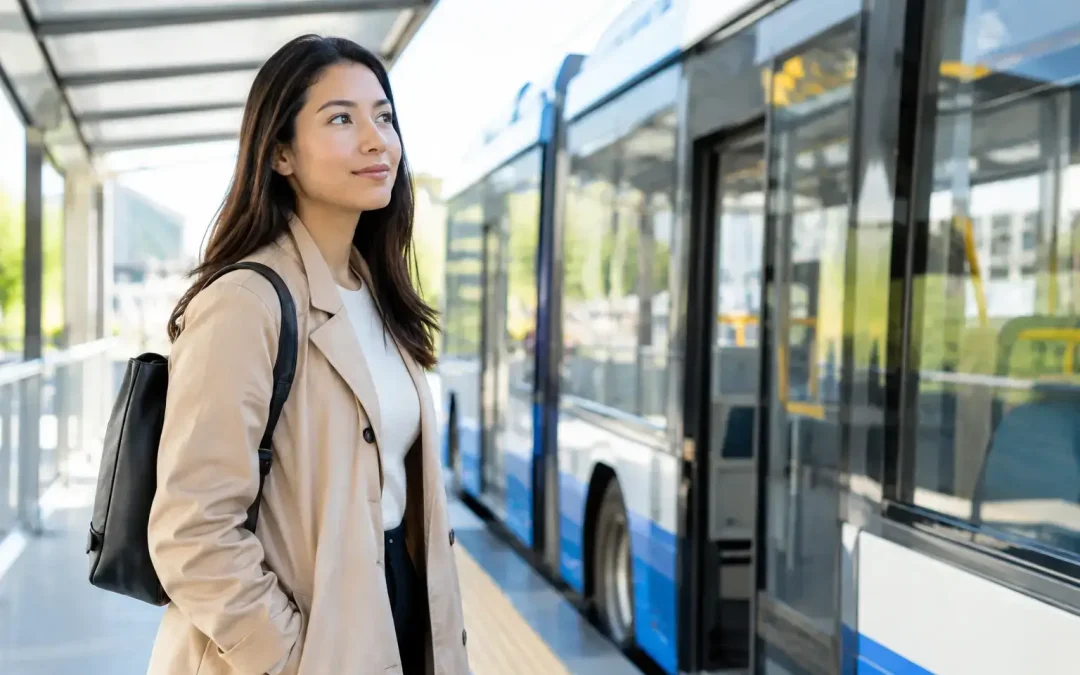
The train is crowded, your phone is in one hand, and the doors are about to close. That is exactly when awareness drops. This public transport safety guide is built for real commuting: buses, trains, stations, ride connections, late shifts, and the short walk between them. Personal safety is not about looking scared or acting tough. It is about noticing early, creating options, and acting decisively when something feels wrong.
Most commutes end without incident. That should not make you careless. Public transport brings strangers into close contact, often in tight spaces where movement is limited and help may not be immediate. Your goal is simple: avoid being selected, avoid being trapped, and get out before a problem becomes physical.
Public Transport Safety Starts Before You Leave
Safety begins at your front door, not when a stranger gets too close. Check your route, know where you will transfer, and keep enough battery to call for help or arrange an alternative ride. If you are traveling late, tell someone when you expect to arrive. This is not paranoia. It is basic preparation that gives you choices if service changes, a platform feels unsafe, or someone follows you.
Dress and carry your belongings in a way that lets you move. A bag worn across the body is generally harder to grab than one hanging loose from a shoulder. Keep keys, access cards, and your phone available without digging through your bag while distracted. Avoid walking with both earbuds in, especially when approaching stations, parking areas, or isolated bus stops.
The trade-off is comfort versus awareness. You do not have to spend every commute scanning people like a security guard. But you should know who is around you, where the exits are, and what has changed in your immediate environment.
Choose Position Over Comfort
Where you stand or sit matters. On a platform, stay in visible areas with other passengers and away from isolated corners. Keep a sensible distance from the platform edge, particularly during crowded boarding. Do not let yourself get boxed between a wall, a pillar, and a stranger.
On a bus or train, choose a seat that gives you a clear path out when possible. Near the driver, conductor, or other passengers is often better than an empty end carriage or rear corner. If someone makes you uncomfortable, move early. You do not need proof that they are dangerous before changing seats or stepping into another car.
If the vehicle is crowded, protect your balance. Stand with stable footing, avoid being pinned against doors, and keep your hands free where possible. A backpack may be safer held in front of you in a dense crowd, where it is harder for someone to open and easier for you to control. Pickpocketing and unwanted contact both become easier when people are compressed together and distracted by the rush.
Read Behavior, Not Appearances
Do not judge danger by clothing, age, race, or whether someone looks rough. Focus on behavior. A person who repeatedly closes distance after you move, watches you too intensely, blocks your path, tries to isolate you, or ignores clear boundaries deserves attention.
Watch for patterns. One accidental bump in a packed train can happen. Repeated contact after you reposition is different. Someone asking for directions may be harmless. Someone using questions to keep you engaged while scanning your bag, body, or surroundings may be testing your awareness.
Trust the signal in your body, but pair it with action. If you feel uneasy, move toward people, staff, cameras, or a different carriage. Call someone and state your location out loud. Do not stay put because you worry about appearing rude. A stranger’s opinion is never more valuable than your safety.
Set Boundaries Early and Clearly
Predatory behavior often relies on hesitation. The offender expects you to freeze, apologize, or quietly tolerate discomfort. Break that pattern with a direct voice and simple words.
If someone is too close, step away and say, “Give me space.” If they touch you, say, “Do not touch me.” If they block you, use a louder command: “Move.” Your objective is not to win an argument. It is to create attention, space, and an exit.
Avoid long explanations. You do not owe a stranger a polite debate about why you moved seats, refused help, or will not share personal details. Keep your body angled so you can leave, rather than standing squarely in front of them. Look around for allies and make a specific request if needed: “You in the blue shirt, please stay with me,” or “Driver, this person is bothering me.”
Specific requests work better than hoping a crowd will intervene. People respond faster when they know exactly what you need.
If Someone Follows You
Do not lead a suspected follower home, to your car, or into an empty stairwell. Stay in a public, well-lit area. Change direction, enter a staffed business or transit office, and observe whether the person mirrors your movement. If they do, treat it seriously.
Call emergency services or local transit security when there is an immediate threat. If it is safe, describe your location, the direction of travel, and the person’s clothing or identifying details. Do not confront a follower just to confirm your suspicion. Confirmation is not required to choose safety.
If you are getting off at a stop and believe someone intends to follow, remain on board if possible or exit where there are other people. On a train, move between cars at a normal stop only when permitted and safe. On a bus, tell the driver before you exit. A small disruption to your route is a cheap price for avoiding isolation.
What to Do When Trouble Turns Physical
The priority changes fast when a person grabs, corners, or attacks you. Forget perfect technique. Your first job is to stay on your feet, protect your head, make noise, and get away.
Use your voice hard and loud: “Back off!” “Help!” “Call police!” Clear commands can draw witnesses and disrupt an attacker’s plan. Create distance with movement and barriers. Put a seat, gate, bag, pole, door, or other passengers between you and the threat whenever you can.
If escape is available, take it. Do not remain to prove a point, recover property, or punish someone. A phone, wallet, or bag can be replaced. Your health cannot be treated so casually.
Real violence is chaotic. You may be tired, carrying items, restricted by clothing, or caught in a narrow aisle. This is why safety training should not depend on fancy moves, choreographed sequences, or a cooperative partner. Under pressure, simple actions, balance, awareness, and the ability to keep moving matter more.
A Practical Commuter Response Plan
Build a response plan you can remember under stress:
- Notice the environment before you enter a station, stop, or vehicle.
- Position yourself near exits, staff, groups, and visible areas.
- Move early when behavior feels wrong.
- Use a clear voice to set a boundary and attract attention.
- Leave, report, and get help instead of escalating a confrontation.
Practice this mentally on ordinary commutes. Where is the nearest exit? Who could you approach? What is the next safe place if you miss your stop? Rehearsal makes decisions faster when adrenaline hits.
Train for Reality, Not Performance
Awareness prevents many problems, but awareness alone is not a complete plan. If someone suddenly grabs you or closes distance in a crowded space, your body needs a response that works while stressed. That response should be simple, direct, and built around escape.
Good self-defense training uses realistic scenarios, pressure, verbal boundaries, movement, and controlled resistance. It teaches you when to disengage, not just how to strike. It also recognizes that size, fitness, location, and the number of attackers change the answer. There is no magic move for every situation.
Urban Street Defense teaches this reality-based mindset: no ornamental routines, no pauses, and no false confidence. The goal is to develop practical reactions that help you break contact and get safe.
Your commute should not feel like a battlefield. Keep it that way by staying alert without becoming fearful, trusting discomfort before it becomes danger, and giving yourself permission to leave early. Better awareness creates better options. Better options keep you moving.