
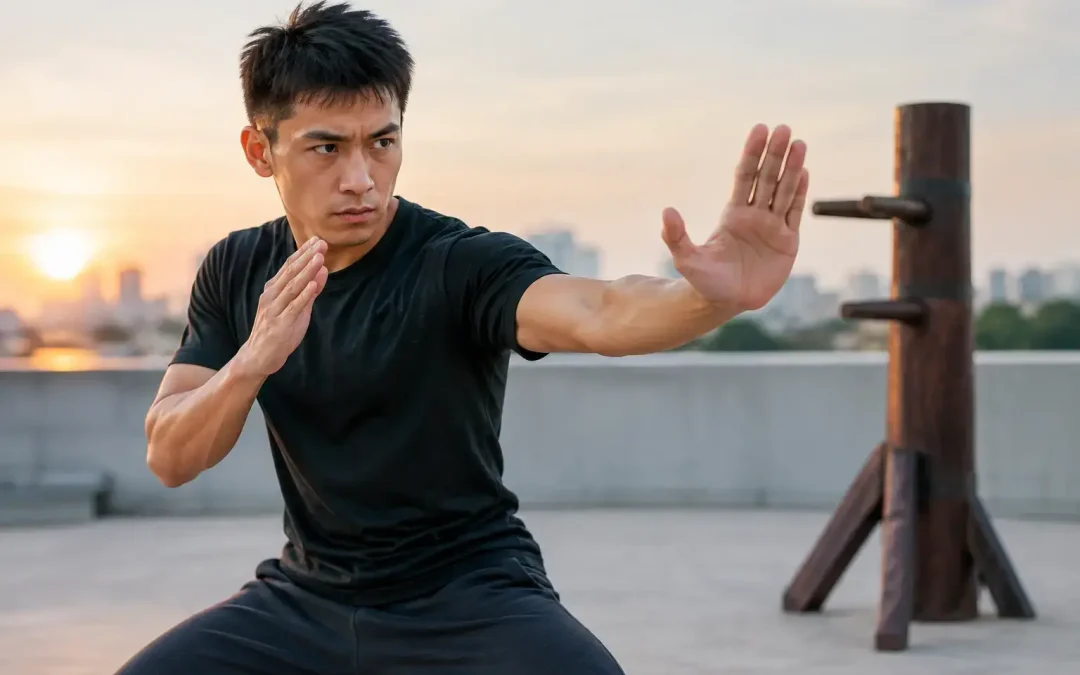
A threat does not arrive with a warning bell. It can happen in a parking lot, outside an elevator, during a late commute, or when someone ignores a clear boundary. A useful Jeet Kune Do training guide must prepare you for that reality: confusion, close distance, fear, uneven ground, and the need to act fast.
This is not about collecting moves or looking impressive in class. It is about developing simple responses that still work when your heart rate spikes and your fine motor skills disappear. The goal is not to win a fight. The goal is to recognize danger early, create an opening, escape, and get safe.
What Jeet Kune Do Training Is Really For
Jeet Kune Do is often associated with Bruce Lee, but the useful lesson is not imitation. It is a way of thinking. Keep what is functional. Remove what is unnecessary. Adapt to the person, environment, and level of danger in front of you.
For personal safety, that means avoiding complicated sequences that require perfect timing. A real confrontation may start with a grab, a shove, an attempted restraint, or an aggressive person closing distance too quickly. You may have a bag in one hand, a wall behind you, poor lighting, or no room to move freely.
Training should address those conditions. If a technique only works when your partner stands still, cooperates, and gives you plenty of space, it is not enough. You need skills that help you protect your balance, cover your head, strike with purpose when necessary, break contact, and move toward safety.
There is a trade-off here. Simple does not mean careless. A direct response still needs correct body position, timing, awareness, and practice. But simplicity gives you a better chance of recalling it under pressure.
The Four Rules That Keep Training Functional
A practical Jeet Kune Do approach is built around four rules: simplicity, directness, adaptability, and pressure testing.
Simplicity beats complicated combinations
Under stress, your body does not perform like it does during a calm demonstration. Your vision can narrow. Your hands can shake. You can lose track of distance. This is why a few reliable actions are more valuable than a long catalog of techniques.
Train movements that are natural and repeatable: a stable protective stance, open-hand boundary setting, a strong verbal command, direct strikes to create space, escapes from common holds, and immediate movement away from danger. Repeat them until they become familiar, not theoretical.
Directness creates your escape window
Self-defense is not a points match. You do not need to trade blows or prove toughness. When physical action is necessary, the response should be decisive enough to interrupt the attacker’s momentum and give you a route out.
That may mean using a palm strike, elbow, knee, low kick, or a forceful push to create separation. The right choice depends on range, position, your physical ability, and what the attacker is doing. At close range, a wide, fancy kick may be a bad decision. When someone grabs your wrist, trying to overpower them may also fail if they are larger or stronger.
Use what fits the moment. Then leave.
Adaptability matters more than a fixed plan
No two confrontations look the same. One person may shout from several feet away. Another may grab clothing. A third may use an accomplice to block your exit. The environment changes the answer too. A response in a crowded train station is different from one in an isolated stairwell.
Good training gives you principles instead of rigid choreography. Manage distance. Protect your head. Keep your feet under you. Use your voice. Look for exits. Do not get trapped against a wall. If you fall, recover quickly. If escape is available, take it.
This mindset also means knowing when not to engage. If you can leave before physical contact begins, that is the best outcome. Awareness and de-escalation are not passive skills. They are often the first layer of effective defense.
Pressure testing reveals what you can use
A technique can feel perfect when practiced slowly. That tells you very little about whether you can apply it against resistance. Pressure testing does not mean reckless sparring or trying to injure training partners. It means adding realistic movement, resistance, verbal stress, awkward angles, protective gear, and decision-making over time.
Start controlled. Learn the mechanics. Then increase the uncertainty. Can you use the escape when someone resists? Can you protect yourself after being surprised? Can you make a decision when your partner is moving and talking aggressively?
That is where confidence becomes earned. You stop relying on hope because you have felt the difference between a cooperative drill and a resisting person.
A Practical Jeet Kune Do Training Guide for Beginners
Beginners do not need months of forms before learning useful safety skills. Start with the foundations that show up in nearly every situation.
First, build awareness. Notice who is around you, where the exits are, and whether someone is closing distance in a way that feels wrong. Keep your phone use limited when walking to your car, using a ride-share pickup area, or entering isolated spaces. Trust discomfort early. You do not need to wait for proof before creating distance.
Next, train your verbal boundary. A clear, loud command such as “Stop,” “Back up,” or “Don’t touch me” can draw attention, disrupt an aggressor, and prepare your own body to act. Practice saying it while stepping into a balanced position with your hands up naturally. Your hands should look non-threatening, but they should be ready to protect your face or push away.
Then work on distance and movement. Many people freeze because they have never practiced moving while someone crowds them. Learn to angle out rather than back straight up. Keep obstacles in mind. Do not cross your feet when moving quickly. Your base is your ability to strike, escape, and stay upright.
After that, learn a small set of high-percentage physical tools. Train strikes that do not demand flexibility or perfect precision. Train releases from common wrist grabs, clothing grabs, chokes, and bear-hug positions. Train how to use your forearms and elbows to protect yourself at close range. Most importantly, train the follow-up: create space, scan, and leave.
Finally, train recovery. An attacker may shove you, knock you off balance, or force you to the ground. You need to know how to cover your head, regain your feet, and move away without staying down to wrestle unless there is no other option.
What a Useful Class Should Feel Like
You should not leave every class exhausted and bruised. But you should leave with a clearer understanding of what works, what needs practice, and how your body reacts under stress.
Look for instruction that explains the purpose behind each drill. Ask whether students practice against resistance, whether scenarios include verbal aggression and escape routes, and whether the instructor adjusts training for different body types and fitness levels. A smaller person does not need a watered-down version of self-defense. They need practical positioning, targets, timing, and options that do not depend on strength alone.
Be cautious of schools that focus entirely on rank, elaborate forms, or compliant demonstrations. Traditional training can offer discipline and fitness, but it may not match your goal if you need immediate, urban self-defense capability. It depends on why you are training. If your priority is sport competition, train for the rules of that sport. If your priority is personal safety, train for uncertainty.
At Urban Street Defense, the focus is no fancy moves, no pauses, and no pretending an attacker will cooperate. Training is built to help ordinary people make faster, safer decisions when the situation turns physical.
Train Consistently, Not Occasionally
A one-time workshop can give you valuable awareness and a starting set of tools. It cannot replace repetition. Your reaction under pressure is shaped by what you practice consistently.
Two sessions a week is enough for many beginners to develop meaningful progress, especially when training is focused. Between classes, rehearse your verbal boundary, your protective stance, and your movement in a safe space. Improve your general fitness too. Better leg strength, balance, cardio, and mobility can make escaping easier.
Do not chase perfection. Build readiness. The person who practices a few direct skills regularly is usually better prepared than the person who knows many techniques but has never used them under pressure.
Personal safety starts before the first strike. Pay attention. Set boundaries early. Keep your actions simple. When there is a safe way out, take it without hesitation. That is not fear. That is control.