You are walking from the office to your car after dark. Your phone buzzes. A stranger is standing near the driver-side door. This is where situational awareness matters. Not after someone grabs you. Not when the argument has already turned violent. Before it reaches that point.
Real self-defense is not a collection of flashy techniques. It is recognizing what is changing around you, making a fast decision, and acting before your options disappear. The goal is simple: see trouble early, create distance, and get home safely.
Situational Awareness Is Your First Defense
Situational awareness is the ability to notice your environment, understand what may be happening, and respond before a threat gets close. It is not paranoia. It is not walking around afraid of everyone. It is a practical habit that keeps you present enough to spot behavior, locations, and situations that do not feel right.
Most people do not get caught off guard because they lack strength or fighting skill. They get caught off guard because their attention is somewhere else. They are scrolling while entering a parking garage, wearing both earbuds on a quiet street, or assuming a person who is too close has harmless intentions.
Awareness gives you time. Time to cross the road. Time to return to a store. Time to call for help. Time to use your voice and set a boundary. If physical action becomes unavoidable, that extra second can also help you move first instead of freezing.
Stop Living on Autopilot
Urban life trains people to tune out. Commuting, errands, work messages, traffic, and fatigue all pull attention inward. A predator or aggressive person looks for exactly that: someone distracted, isolated, rushed, or easy to approach without being noticed.
The answer is not to scan every person with suspicion. The answer is to lift your head and take in useful information. Who is nearby? Where are the exits? Is anyone changing direction to follow you? Is there a well-lit place, a security guard, a shop, or a group of people you can move toward?
Think of your attention as a dial, not an on-off switch. In a familiar, busy café during daylight, your dial can stay low. In a nearly empty elevator, a dark parking area, a ride-share pickup point, or an unfamiliar street, turn it up. Context changes risk. Good judgment adjusts with it.
Your phone is one of the biggest threats to awareness. Use it when you need it, then put it away. If you must check directions, stop in a visible location with your back protected rather than walking slowly with your eyes down. Small changes like this are not dramatic. They are effective.
What to Notice Without Overthinking
You do not need to memorize every face in a crowd. Look for behavior that breaks the normal pattern of the place you are in. Someone may be harmless, but certain actions justify distance and caution.
Pay attention when a person repeatedly watches you, mirrors your movements, blocks your path, closes distance after you step away, asks invasive questions, or tries to isolate you from other people. Also notice environmental warning signs: poor lighting, blind corners, broken access controls, an empty stairwell, or a vehicle parked too close to yours with people inside.
One sign alone does not prove danger. Someone looking at you may simply be waiting for a friend. A person asking for directions may genuinely need help. But you do not need proof before taking a safer position. Trust patterns, not politeness. If your instincts say something is off, move toward safety while you have space to do so.
This is a key trade-off. You want to stay calm and avoid making assumptions, but you also cannot let the fear of seeming rude keep you trapped in a bad position. Your safety matters more than a stranger’s approval.
Build a Simple Safety Routine
Awareness works best when it becomes automatic. Before entering any new space, take two seconds to orient yourself. Identify the nearest exit, the people closest to you, and the safest direction to move if you need help. This is useful in a mall, an office, a train station, a hotel, or a public event.
When walking, keep enough space that another person cannot suddenly grab you without taking a clear step toward you. Avoid getting pinned between a wall, a parked car, or a doorway. If someone approaches, angle your body so you can move. Do not stand squarely and let them close the gap while you decide what to do.
At your vehicle, look around before you unlock it. Get in, lock the doors, and leave. Do not sit in the driver’s seat answering messages with the doors open or your attention down. At home, do not automatically open the door because someone knocks. Check first. Simple routines remove easy opportunities.
For professionals, this also applies at work. Be aware when leaving late, meeting unknown visitors, moving through empty floors, or dealing with a customer whose behavior is escalating. Workplace safety is not only a security team’s responsibility. Staff who notice early warning signs can move colleagues away, call for support, and prevent a situation from becoming physical.
Use Your Voice Before Your Hands
Many confrontations can be disrupted by clear verbal boundaries. If someone moves too close, use a strong voice: “Stop.” “Stay back.” “I don’t know you.” “Do not touch me.” Short words work better than explanations when stress is high.
Your voice does three things. It tells the person you have noticed them. It creates attention from people nearby. And it gives you a mental trigger to act instead of freezing. Do not negotiate your boundaries with someone who is ignoring them. Move, call out, and get help.
There are times when a quiet exit is smarter than a verbal challenge. If you believe a person is watching or following you from a distance, do not lead them home or to your car. Change direction, enter a busy business, contact someone, and stay around people. The best response depends on distance, numbers, weapons, escape routes, and the person’s behavior.
Awareness Must Work Under Pressure
Knowing what to do in a calm room is not the same as doing it with adrenaline in your system. Under pressure, people can freeze, lose peripheral vision, forget words, and make poor decisions. That is why practical self-defense training must include realistic scenarios, verbal pressure, movement, and the chance to practice decisions.
At Urban Street Defense, the focus is not on ceremonial forms or moves that require perfect timing. It is on direct responses that support the real priorities: create space, escape, get help, and protect yourself when there is no clean exit. Physical skills matter, but they work better when your mind has already learned to recognize the moment to use them.
Train your awareness the same way you train any other skill. After leaving a building, ask yourself where the exits were. When entering a parking lot, notice where you would move if someone approached. During a commute, briefly identify the people, spaces, and obstacles around you. Keep it simple. Repetition makes it faster.
The purpose is not to live tense or scared. It is to be harder to surprise. Look up. Notice the change in behavior. Give yourself room. Leave early when something feels wrong. A safer outcome often begins with one decision made before the danger has a chance to touch you.
A boundary is not a debate, a performance, or a request for approval. It is a clear instruction about what you will and will not allow. Essential boundary setting phrases give you words before stress takes over, whether someone is crowding you on a train, pushing for your number, ignoring a workplace limit, or trying to pressure you at home.
The goal is not to sound tough. The goal is to be understood quickly. In personal safety, clarity buys time. It can interrupt someone who is testing you, draw attention from people nearby, and help you move toward an exit or a safer group of people. But words are not magic. If a person ignores your boundary, the next move is not better wording. It is distance, attention, and action.
Why short phrases work under pressure
When people feel threatened, they often freeze, smile nervously, overexplain, or apologize. That is a normal stress response. Long explanations also give a pushy person material to argue with: “I only asked because…” or “You misunderstood me.”
Short language closes that opening. Say one sentence. Use a firm voice. Repeat it if needed. Then act in line with it. If you say, “Do not touch me,” step back, raise your hands between you and the person if necessary, and move toward safety. Your body language and your words must deliver the same message.
A boundary can be polite when the situation is safe and the other person is respectful. It does not have to be polite when someone is intimidating, touching, following, blocking, or threatening you. Personal safety comes before social comfort.
12 essential boundary setting phrases to practice
These phrases are designed to be simple enough to recall under pressure. Do not memorize them like a script. Practice saying the ones that feel natural until they come out clearly and without apology.
“No.”
This is complete. You do not owe a stranger, colleague, date, friend, or family member a detailed reason for refusing something. A plain no is especially useful when a person is fishing for an opening to negotiate.
“I said no.”
Use this when your first answer has been ignored. The phrase signals that the issue is no longer a misunderstanding. It is now a refusal to respect your decision.
“Stop.”
One word can cut through confusion. Use it when unwanted behavior is happening now: unwanted comments, pressure, grabbing, standing too close, or following. Say it loud enough for others to hear when public attention will help.
“Do not touch me.”
Be specific about physical contact. Avoid softening it into “Please don’t” if the person is already ignoring your space. Make eye contact only if it is safe to do so, create distance, and prepare to leave.
“Step back.”
This works when someone is inside your personal space but has not touched you. Put a hand up, palm forward, as a visible barrier. In crowded places, angle your body toward an exit rather than allowing yourself to be boxed in.
“I am leaving now.”
A boundary becomes stronger when it includes your action. This phrase is useful with a hostile argument, an uncomfortable date, a workplace confrontation, or anyone who will not let a conversation end. Do not announce it and remain standing there. Leave.
“Move away from me.”
Use this when someone is lingering, shadowing you, or closing distance after you have already tried to disengage. It is direct and public-facing. People around you can understand what is happening immediately.
“I do not feel safe. I need help.”
This is one of the most useful phrases for public situations. It tells bystanders exactly why you need them to act. Direct your request to a specific person where possible: “You in the blue shirt, I do not feel safe. Please stay with me.” Specific requests are harder to ignore than a general call for help.
“Do not follow me.”
If you believe someone is following you, do not lead them home, to your car, or into an isolated area. Say this only if speaking will not increase immediate danger. Move into a staffed shop, security point, busy restaurant, or other public place and ask for assistance.
“That does not work for me.”
Not every boundary is an emergency. This phrase is strong for work, friendships, and family situations where you need to decline a demand without starting a long argument. For example: “Last-minute weekend work does not work for me. I can handle it Monday.” Keep the answer practical, not defensive.
“I am not discussing this further.”
Some people use repetition, guilt, anger, or charm to wear down a boundary. This phrase ends the cycle. Repeat it once if necessary, then disengage. You cannot win a conversation with someone who believes persistence should override your consent.
“If you continue, I will call for help.”
Use consequences you are ready to carry out. In a workplace setting, that might mean involving a manager or HR. In public, it may mean calling security, contacting emergency services, or asking others for immediate help. Never make empty threats. Follow through promptly if the behavior continues.
Match the phrase to the level of risk
Boundary setting is not one-size-fits-all. A difficult coworker, an overbearing relative, and a stranger who has cornered you require different responses. The words may overlap, but your priorities change.
In a low-risk setting, you may choose a calm boundary and a practical alternative: “I cannot take that on today. I can review it tomorrow.” This protects your time without creating unnecessary conflict.
In a higher-risk setting, reduce the conversation. Your priorities are space, witnesses, exits, and support. Use commands such as “Stop,” “Back up,” or “Do not touch me.” Make noise if it helps bring attention. Move rather than standing still and explaining yourself.
There is also a trade-off worth understanding: being direct can upset people who benefit from your silence. That does not mean you were rude. It means the boundary changed what they could get from you. Their disappointment is not evidence that your boundary was wrong.
How to say it so people hear it
Your voice does not need to be loud all the time, but it needs to be clear. Drop filler words such as “just,” “maybe,” and “sorry.” Compare “Sorry, I just think I should probably go” with “I am leaving now.” The second statement is easier to hear, easier to remember, and harder to twist.
Stand balanced, with your feet under you instead of locked together. Keep enough distance to move. If the situation feels unsafe, do not let someone stand between you and an exit. These are not fighting stances. They are practical positions that give you options.
Practice matters because pressure changes the body. Say several phrases out loud at home. Practice them with a trusted friend using realistic but controlled scenarios: a stranger standing too close, a colleague refusing to end a conversation, or a date pressuring you to stay. Start calmly, then practice using a stronger voice. The purpose is not drama. It is building an instinctive response.
At Urban Street Defense, scenario-based training treats verbal boundaries as part of self-protection, not as an afterthought before physical techniques. The strongest response is often the one that identifies trouble early, creates room to leave, and avoids a physical confrontation altogether.
When words are no longer enough
A person who respects boundaries may apologize, stop, and give you space. A person who keeps advancing, grabs you, blocks your exit, threatens you, or tries to isolate you has given you critical information. Stop trying to convince them.
Create distance. Move toward people, light, staff, security, or a locked door. Call for help clearly. If you are in immediate danger, use the force necessary to break contact and escape, then get help as soon as you can. Your objective is not to punish the other person or prove you were right. It is to get safe.
Choose three phrases from this list that you can say without hesitation. Practice them until they sound like your voice. When a boundary is needed, you should not have to search for permission or perfect words. You need a clear message, a way out, and the willingness to act.
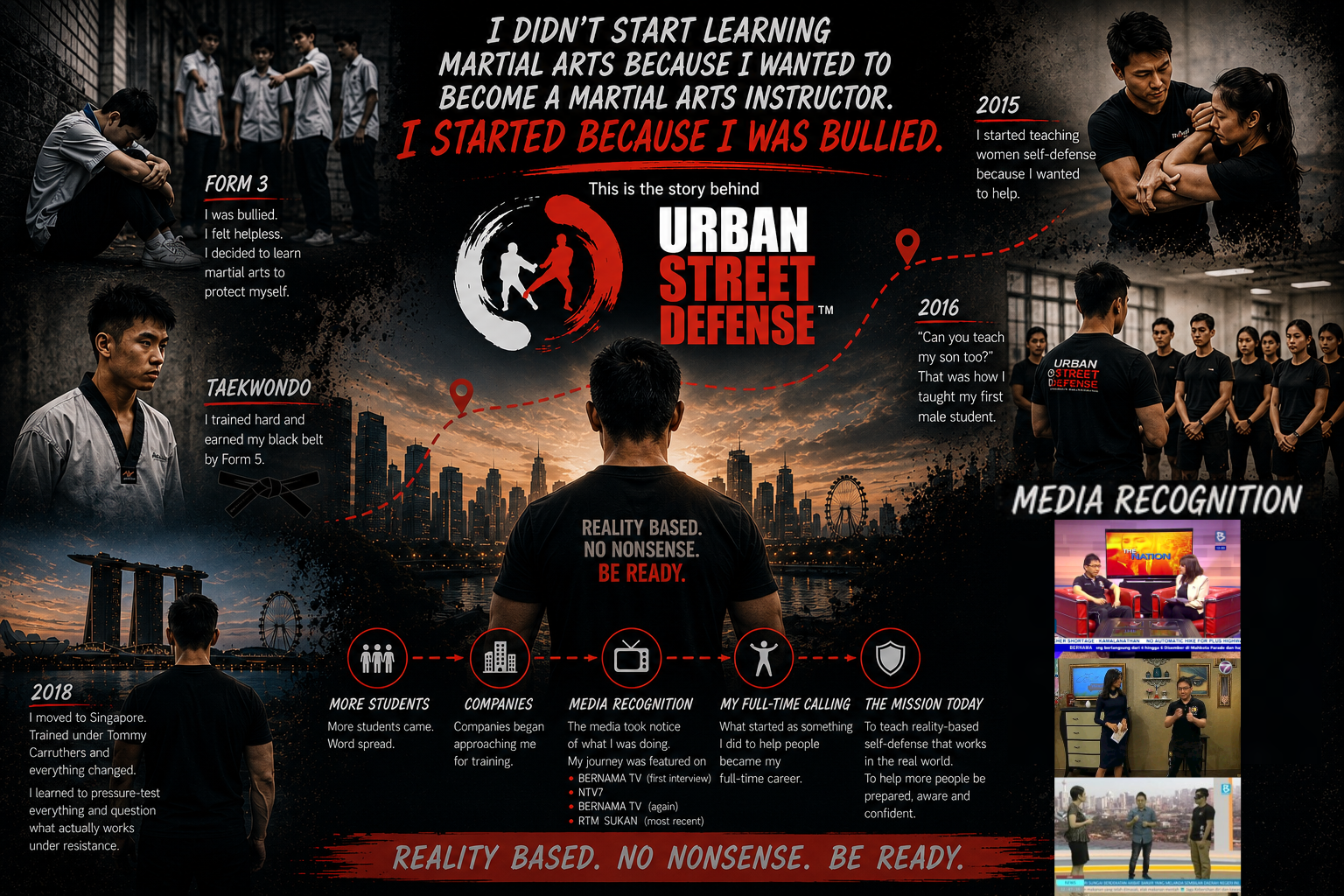
Hi, I’m Joshua, founder of Urban Street Defense. What you’re about to read is something personal.
I want to share with you my journey on how and why I started Urban Street Defense, and how my understanding of self-defense evolved over the years.
I didn’t start learning martial arts because I wanted to become a martial arts instructor. I started because I was bullied.
Urban Street Defense was created in 2015, but the story behind it started much earlier.
1999 — Where It All Started
When I was in Form 3, I experienced bullying at school. I knew what it felt like to feel vulnerable and not know how to protect myself. Towards the end of Form 3, I decided to start learning Taekwondo. I became deeply committed to training and eventually earned my black belt by Form 5. But even after earning my black belt, I felt that something was missing. I had learned techniques, forms after forms, controlled sparring. I had trained hard to achieved the rank I had worked towards.
Yet one question kept coming back to me:
“Would this actually work if someone really attacked me?”
I didn’t have the answer. So I kept searching.
2007–2014 — The Search for Something More
I went on to study different martial arts and trained under two different Wing Chun sifus. Eventually, my journey led me to Bruce Lee’s Jeet Kune Do. I trained with different instructors and eventually learned from two masters with very different areas of expertise. Every stage taught me something new. But more importantly, I began to understand that martial arts isn’t simply about collecting techniques or achieving the next rank. It is about constantly questioning what you think you already know.
The more I trained, the more I wanted to understand one thing:
“What actually works when someone doesn’t cooperate?”
2015 — Why I Started Teaching
In 2015, I started my own training school, Urban Street Defense. At the time, I was primarily teaching Jeet Kune Do, and my teaching approach was still very different from what I teach today.
And I didn’t start teaching because I wanted to make money. There was another reason. My aunt was involved with an NGO, and through her I became aware of many domestic violence cases involving women.
Those stories impacted me, and I kept thinking about how vulnerable these women must have felt and whether I could do something to help. So I decided to start teaching women’s self-defense.
In the beginning, I focused entirely on women.
Then, in 2016, one of the parents asked me:
“Can you teach my son too?”
That was how I ended up teaching my first male student. And from there, everything started to change.
More students came.Word spread.
Eventually, companies began approaching me for training. Then something I never expected started happening.
The Media Began Taking Notice
I was first interviewed on BERNAMA TV, followed by NTV7, then another feature on BERNAMA TV, and most recently, RTM Sukan.
What started as something I was doing simply because I wanted to help people gradually grew into something much bigger.
2016 — My First Training Centre
As the programme grew, I eventually rented my own training space at Sunway Mas Commercial Centre. It was a major milestone. Something that started with me simply wanting to help people had grown into a real business. But the journey wasn’t straightforward. In 2018, I made the decision to close the centre in Malaysia and move to Singapore for work. At the time, I didn’t realise that this would become one of the most important turning points in my martial arts journey.
2018 — Singapore Changed My Perspective
While I was in Singapore, I discovered another Jeet Kune Do school under Sifu Tommy Carruthers (IFO). What I experienced there fundamentally changed the way I looked at martial arts and self-defense. It wasn’t simply about learning more techniques. It was about questioning whether the things I had been practising for years actually held up when someone resisted, moved unpredictably and didn’t cooperate.
So I started pressure-testing. Things that looked good during controlled training didn’t always work the same way when the situation became chaotic.
That forced me to confront an uncomfortable question:
“If a technique only works when the attacker behaves exactly as expected, how useful is it in a real fight?”
That question changed everything.
2019–Present — From Martial Arts to Reality-Based Self-Defense
My focus gradually shifted. I became less interested in collecting techniques and more interested in finding what actually worked. I began looking at self-defense differently.
Real violence doesn’t come with a script.
You don’t know exactly what attack is coming.
You don’t know how the person will react.
You don’t know where you’ll be standing.
You don’t know whether there will be one attacker or more.
You don’t know whether a weapon will appear.
You don’t know whether you’ll freeze, panic or react differently from how you imagined during training.
There are simply too many variables. I started calling this the Infinite Variables of violence. And that became one of the foundations of what I teach today.
I began moving away from fixed scenarios, rehearsed responses and techniques that depended on a predictable attack.
Instead, I became increasingly focused on:
Simplicity. Adaptability. Pressure-testing. And the ability to respond when things don’t go according to plan.
The Journey Continues
Urban Street Defense has come a long way from where it began in 2015. From my original training location in Petaling Jaya, the school eventually expanded to Ipoh and continued to evolve along with my own understanding of self-defense.
After more than 20 years of training, teaching, questioning and pressure-testing, I’ve learned that I don’t have all the answers.
I also have deep respect for all martial arts. After all, martial arts is where my own journey began, and it has shaped who I am today.
But I believe in always asking one question:
“Does what we train actually prepare us for reality?”
That question started my journey. And it continues to drive me today.
From a bullied teenager who simply wanted to protect himself, to building a reality-based self-defense system designed to help others do the same.
A clean technique can look convincing when your partner stands still, waits their turn, and gives you space. Real violence does not work like that. It is sudden, loud, close, confusing, and often over before you have time to think. What is pressure testing? It is training that adds realistic stress so you can find out whether a self-defense response still works when your heart rate rises and your plan starts to fall apart.
Pressure testing is not about proving who is toughest in the room. It is about exposing gaps safely, building usable reactions, and learning to make better decisions when conditions are bad. No fancy moves. No rehearsed victory. Just action that holds up when pressure hits.
What Is Pressure Testing and Why Does It Matter?
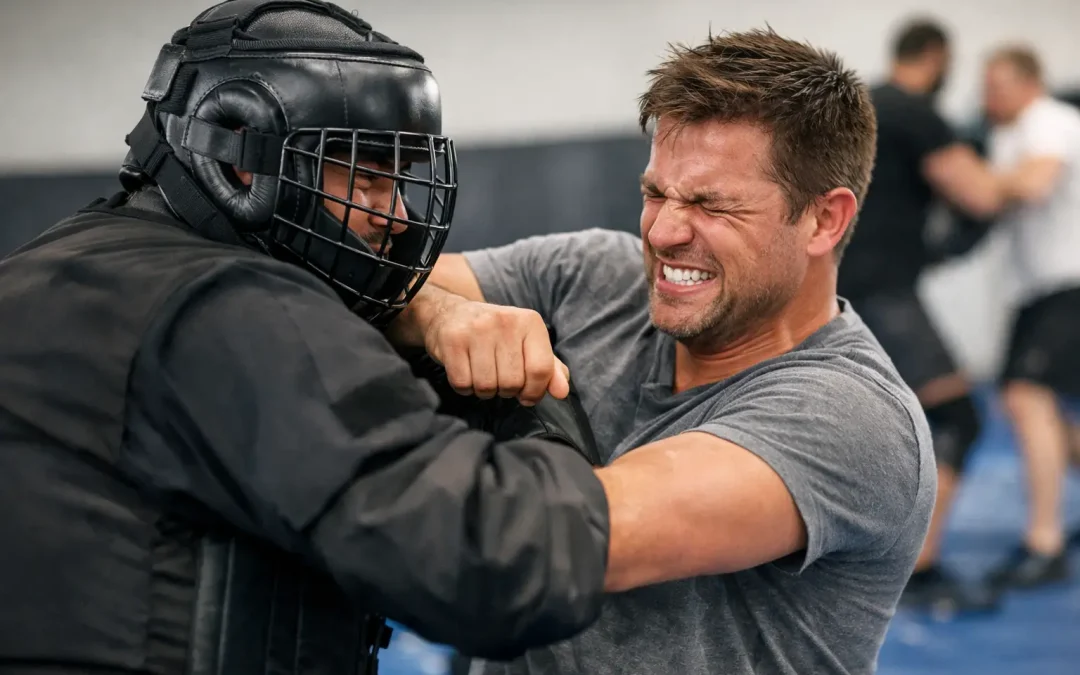
Pressure testing puts a technique, tactic, or decision under controlled resistance. Your training partner may move unpredictably, resist your escape, talk aggressively, crowd your space, or force you to react from an awkward position. The intensity is adjusted to your experience, fitness, and the goal of the drill.
The key word is controlled. Realistic training does not mean reckless training. It means creating enough uncertainty that you cannot simply perform a memorized sequence. You must recognize the problem, protect yourself, create space, act decisively, and leave.
This matters because stress changes behavior. Fine motor skills get worse. Your vision can narrow. You may freeze, rush, hesitate, or forget techniques you could perform perfectly five minutes earlier. A complicated response that needs ideal timing, perfect balance, and a cooperative opponent is a poor bet for personal safety.
Pressure testing helps strip your response down to what is simple, direct, and repeatable. It shows you whether your stance collapses when pushed, whether you can speak firmly under intimidation, whether you notice exits, and whether you can move after contact begins. Those are the questions that matter outside the gym.
Pressure Is More Than Hard Sparring
Many people hear the term and picture two people trading punches at full speed. Sparring can be useful, but pressure testing is broader than sparring. A real self-defense problem may start with someone blocking your path, grabbing your wrist, crowding you in an elevator, confronting you at your car, or escalating after an argument.
A good pressure-tested drill can include verbal boundary setting, awareness, movement, escape routes, physical contact, and the decision to disengage. It can also include scenarios where the correct answer is to leave early rather than fight.
For example, a beginner may start with a partner stepping into their space and using a loud, confrontational voice. The student practices setting a clear boundary, moving to a safer angle, and getting away. Later, the drill may add a grab, protective gear, resistance, and limited striking or escape options. The objective stays the same: get safe, not win points.
Sport training and self-defense training can overlap, but their priorities are not identical. A sport match has rules, a referee, a known start time, and usually one opponent. Street violence may have none of those. Pressure testing should reflect the actual problem you are preparing to handle.
What Good Pressure Testing Looks Like
Good pressure testing has purpose. It is not an excuse for instructors or advanced students to overwhelm beginners. Every drill should answer a practical question: Can you make space from a grab? Can you protect your head while moving? Can you get up safely? Can you recognize when talking is no longer working?
The pressure should also be progressive. Throwing an untrained person into a high-intensity scenario on day one can create panic without teaching useful skills. Start with simple movement and clear roles. Add resistance, speed, noise, surprise, and fatigue as the student develops control.
Equipment matters when contact increases. Gloves, mouthguards, head protection, pads, and appropriate rules help people train with enough intensity to learn without collecting unnecessary injuries. The aim is honest feedback, not damage.
A quality instructor watches closely and changes the drill when needed. Some students need more repetition before intensity. Others need to slow down and regain structure because they are relying on wild swings or tunnel vision. Pressure should reveal behavior, then training should improve it.
Resistance must be realistic
A partner who lets you complete every technique teaches you nothing about resistance. At the same time, a partner who turns every drill into a competition can stop learning entirely. Realistic resistance means the partner makes the task difficult in ways that fit the scenario.
If you are practicing an escape from a wrist grab, the partner should grip with intent, adjust when you move, and make you work for the exit. They should not transform the drill into a surprise takedown unless that is part of the agreed lesson. Clarity keeps training useful and safe.
Decision-making belongs in the drill
Physical skill is only one part of personal safety. Pressure testing should make you think about distance, obstacles, bystanders, exits, and whether you can leave before the situation turns physical.
Sometimes the strongest response is a loud command and immediate movement toward safety. Sometimes you need to use force to break contact long enough to escape. The circumstances matter. Training should build judgment, not a habit of fighting every problem.
Recovery is part of the lesson
You will make mistakes under pressure. Everyone does. You may lose balance, miss a strike, freeze for a second, or use the wrong response. The value is in what happens next.
Can you cover up, regain your position, keep moving, and continue toward escape? Can you review the drill without excuses and identify one correction for the next round? Pressure testing builds resilience when students learn to recover instead of treating every error as failure.
Common Myths About Pressure Testing
The first myth is that pressure testing means full-contact fighting every class. It does not. Intensity is a tool, not the entire program. A beginner can experience pressure through timing, verbal confrontation, limited space, and controlled resistance before heavy contact is appropriate.
The second myth is that pain proves realism. Pain can teach a lesson, but it is not the goal. A training environment that injures people, humiliates them, or ignores consent will eventually reduce attendance and damage learning. You need challenge with standards.
The third myth is that one successful drill proves a technique will always work. It does not. Size, strength, environment, surprise, weapons, multiple attackers, and your own stress level change the situation. Pressure testing does not offer guarantees. It helps you choose higher-percentage actions and recognize when a tactic is failing.
The final myth is that only experienced fighters need this training. Beginners may benefit most because they quickly learn the difference between knowing a move and being able to use it. The process should be scaled, coached, and repeated. Confidence should come from tested ability, not wishful thinking.
How Pressure Testing Builds Real Confidence
False confidence says, “I know what I would do.” Real confidence says, “I have faced resistance before, I know what stress feels like, and I can still take the next useful action.” That is a major difference.
Repeated exposure to manageable pressure helps reduce the shock of confrontation. You become more familiar with close range, loud voices, resistance, and physical effort. You learn that you can breathe, move, protect yourself, and make decisions even when the situation feels uncomfortable.
It also creates humility. You discover that distance disappears quickly, that balance is easy to lose, and that simple techniques need practice. That humility is valuable because it encourages awareness, avoidance, and early action. The best self-defense encounter is still the one you leave before violence begins.
At Urban Street Defense, pressure is introduced with purpose: to help students develop instinctive responses without pretending that real danger follows a script. The training is built around practical movement, direct action, and the ability to adapt when the first plan does not work.
A Better Standard for Self-Defense Training
When you assess a self-defense class, do not only ask what techniques are taught. Ask how those techniques are tested. Are students working against realistic resistance? Do drills include movement, stress, verbal boundaries, and escape? Is the training adjusted for beginners while still progressing toward honest intensity?
Also ask whether the class values safety and control. Effective training should challenge you, not feed someone else’s ego. You should leave with clearer lessons, better awareness, and skills you can build on.
Personal safety is not about collecting moves. It is about being able to act when your body wants to freeze and your environment gives you no perfect answer. Train simply. Train honestly. Then keep showing up until your response becomes harder to shake.
A safety briefing can fill a room, collect signatures, and still leave people frozen when a situation turns hostile. That is the hard truth behind corporate safety program results: attendance is not readiness. A program earns its value when employees can spot danger early, make sound decisions under stress, and take immediate action without waiting for perfect conditions.
For employers, this is not about turning staff into fighters or creating fear around the workplace. It is about giving people practical options when commuting, traveling, working late, meeting the public, or dealing with an escalating confrontation. The right training builds awareness first, confidence second, and physical response only where it is necessary.
What Corporate Safety Program Results Should Actually Show
The easiest numbers to report are completion rates, satisfaction scores, and the number of training hours delivered. They matter, but they do not tell the full story. A team can enjoy a workshop and still fail to apply a single skill when pressure arrives.
Strong results show up in behavior. Employees become more alert to their surroundings in parking areas, elevators, ride-share pickups, and unfamiliar venues. They know how to set boundaries clearly, move toward safer spaces, get attention from others, and report concerns earlier. Managers see more useful incident reporting because staff understand what to look for and believe their observations will be taken seriously.
The final measure is decision-making. Can a participant explain the difference between an awkward interaction and a developing threat? Can they create distance rather than argue? Can they leave without feeling that they must win a confrontation? These are practical outcomes that reduce exposure before a situation becomes physical.
Lagging indicators are not enough
Organizations often judge safety by what did not happen: no reported assaults, no lost-time injuries, no major incident. That can be reassuring, but it can also hide a problem. Threats may go unreported. Employees may change their routines quietly because they do not feel safe. A near miss may be treated as bad luck instead of useful information.
Use lagging indicators, but pair them with leading indicators. Track whether staff report hazards and suspicious behavior, whether managers respond consistently, and whether employees can recall the actions taught in training. Look for changes in confidence, but do not mistake confidence alone for capability.
Why Awareness-Only Training Falls Short
Awareness is the first layer of personal safety, not the whole system. Telling people to stay alert, trust their instincts, or avoid dark places gives broad advice. It does not prepare them for the moment someone blocks their path, invades their space, grabs an arm, or refuses to accept a clear no.
Under stress, people do not rise to the level of a polished presentation. They fall back on what they have practiced. If training has been entirely theoretical, the response is likely to be hesitation, confusion, or a technique too complicated to remember.
That is why realistic corporate training must stay simple. A participant should practice verbal boundary setting, body positioning, escape routes, and basic movement under controlled pressure. The goal is not choreography. The goal is an instinctive response that works while the heart rate rises and the mind is busy.
There is a trade-off. Training that feels more realistic can make some participants uncomfortable, especially if it is delivered without care or clear boundaries. The answer is not to remove all pressure. It is to scale it properly. Start with accessible drills, explain the purpose, allow opt-out choices where appropriate, and increase intensity only when participants are ready.
Measure the Skills That Matter
A useful evaluation begins before the session. Ask employees where they feel exposed: commuting after dark, handling angry customers, traveling alone, working off-site, or entering isolated parking areas. Risks differ between a customer-facing team, a sales force, and an office-based department. One generic lecture will not fit every group.
After training, assess whether people can apply core actions in short scenarios. Keep the test practical, respectful, and focused on safety rather than athletic ability. For example, participants may need to identify an exit, use a firm verbal command, maintain distance, and move toward help. In a more advanced session, they might practice safely breaking contact and leaving an immediate threat area.
Four measures give HR and learning teams a clearer view of progress:
Recall: Can employees name the key actions without prompts a few weeks later?
Recognition: Can they identify early warning signs in realistic workplace and travel scenarios?
Response: Can they use simple verbal and physical safety actions under manageable pressure?
Reporting: Do they know exactly who to contact and what information to provide after an incident or near miss?
These measures should not become a pass-or-fail obstacle course. Their purpose is to expose gaps while there is time to fix them. If most participants struggle with a scenario, the training design needs work. Blaming the employees misses the point.
Turn a One-Time Workshop Into Lasting Readiness
A single workshop can create momentum, especially for teams that have never received practical personal-safety instruction. It cannot carry the entire safety culture. Skills fade when they are not revisited, and policies disappear from memory when nobody talks about them.
The strongest programs use a short initial course followed by brief refreshers. A 15-minute scenario discussion during a team meeting can reinforce a major lesson. A quarterly practical session can revisit movement, verbal responses, and reporting procedures. New hires should receive the same foundation rather than relying on secondhand advice from colleagues.
Managers play a major role. If a manager dismisses a concern as overreacting, staff learn to stay quiet. If a manager responds quickly, documents the issue, and checks whether the employee needs support, the program becomes real. Corporate safety is not only a training-provider responsibility. It is a leadership behavior.
Clear procedures matter too. Employees need to know what happens after they raise a concern, who escorts someone to a vehicle when needed, how travel check-ins work, and when security or emergency services should be contacted. Physical skills are one part of the response. Communication and follow-through keep the system from breaking down.
Build Training Around Real Exposure
The most effective safety programs do not copy sport martial arts classes or rely on ceremonial forms. A corporate team does not need belts, complicated combinations, or impressive-looking moves. It needs actions that are easy to learn, easy to recall, and useful in tight spaces, work clothes, and everyday shoes.
At Urban Street Defense, corporate sessions are built around scenario-based learning and simple, direct responses. That approach suits beginners because it does not demand years of technical training before participants gain useful skills. It also gives experienced martial artists a reality check: what works in a controlled class may not be the best choice in a crowded lobby, a car park, or a tense customer interaction.
Context matters. A frontline retail team may need stronger skills for verbal de-escalation and calling for support. Employees who travel between sites may need more focus on situational awareness and vehicle approach safety. Women-focused groups may want to address boundary violations, unwanted contact, and escape from common grabs. Private instruction can help leaders or at-risk employees work through specific concerns discreetly.
The question is not whether every employee needs the same level of physical training. They do not. The question is whether every employee has a practical safety baseline and whether higher-risk roles receive training that matches their exposure.
The Result That Matters Most
Good corporate safety program results are not measured by how tough a team looks after a workshop. They are measured by whether people feel prepared to act early, leave safely, support one another, and speak up before a warning sign becomes an incident.
Give employees something they can use on the walk to their car, during a difficult conversation, and in the first seconds of an unexpected threat. No fancy moves – just clear thinking, direct action, and practice that holds up when it counts.