
Most threats do not arrive with a warning bell. They happen in a parking area, an elevator, a ride-share pickup point, a late walk from the office, or during an argument that turns physical too fast. Self defense workshops for adults should prepare you for that reality: confusion, close distance, fear, limited space, and the need to act now.
This is not about collecting complicated moves or looking impressive in a training hall. It is about recognizing danger early, creating a chance to escape, and responding with simple actions that still work when your heart rate rises. Good training makes personal safety practical, not theoretical.
What Adults Should Get From a Self-Defense Workshop
A useful workshop gives you more than a few techniques to remember. It teaches a decision-making process. When should you create distance? When do you use your voice? What happens if someone grabs you, corners you, or refuses to let go? Where is the safest exit?
The strongest programs combine awareness, verbal boundary-setting, physical response, and escape. These elements belong together. Awareness may help you avoid a confrontation. Clear verbal commands can draw attention and set a boundary. Physical action becomes necessary when the threat is immediate and leaving is not yet possible.
Adults also need training that respects how stress affects the body. Fine motor skills can disappear under pressure. You may freeze, rush, lose balance, or struggle to remember a sequence. That is why simple, direct movements matter. The goal is not perfection. The goal is to interrupt the attack, protect yourself, and get away.
A one-day workshop can build valuable awareness and give you a starting point. Regular practice builds faster recognition, stronger reactions, and better control under pressure. Both have a place. Choose based on your current needs, time, and the level of readiness you want.
Self Defense Workshops for Adults Must Be Reality-Based
There is a difference between practicing a technique and preparing for resistance. A partner who stands still, offers the same grip every time, and waits for your response can help you learn the basic motion. But real danger does not pause. A real attacker may pull, push, shout, strike, change position, or use the environment against you.
Reality-based training gradually introduces movement, uncertainty, and pressure in a controlled setting. That does not mean throwing beginners into chaos. It means learning safely, then testing whether a response still works when the other person is moving and resisting at an appropriate level.
Look for workshops that explain the purpose behind each action. A release from a wrist grab is not the final answer if the person can grab again. It should create space for a stronger response, movement toward safety, or an exit. Every technique needs a clear outcome.
Be cautious of programs built around long routines, elaborate joint locks, or moves that depend on an attacker staying cooperative. These may be interesting to study, but interest is not the same as usefulness. Under pressure, the best option is often the simplest one you can deliver decisively.
The Skills That Matter Before Physical Contact
Physical defense is only one layer of personal safety. The earlier you spot trouble, the more options you have.
A practical workshop should teach you to pay attention without becoming paranoid. Notice blocked exits, people who are closing distance without a reason, repeated unwanted attention, isolated areas, and situations where alcohol, anger, or crowd behavior is changing the risk. Trusting discomfort is not weakness. It is information.
You should also practice setting boundaries with your voice. A firm command such as “Stop,” “Back up,” or “Don’t touch me” can be more effective than a polite explanation. It gives a clear message, may attract witnesses, and helps shift you from passive surprise into action.
De-escalation matters when it is safe and possible. Sometimes the smartest choice is to leave, hand over property, call for help, or avoid arguing with someone who wants conflict. There is no prize for winning a confrontation. Personal safety is the objective.
What Physical Training Should Feel Like
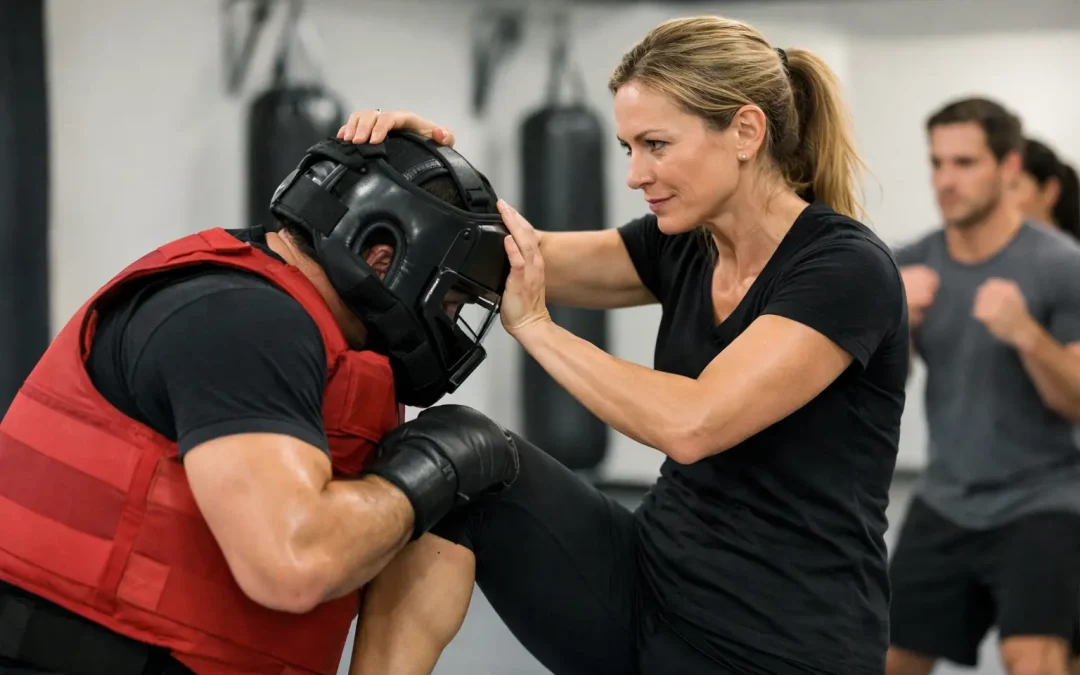
Expect controlled contact, not empty choreography. You may work on protective positioning, striking targets, breaking grabs, defending against common close-range attacks, creating distance, and moving toward an exit. You should also learn how your body responds when someone invades your space.
For beginners, good instructors explain the drill, demonstrate it clearly, and build intensity in stages. They correct unsafe habits without making people feel foolish. The training environment should be supportive, but it should not pretend that danger is comfortable.
Some discomfort is normal. You may feel awkward using your voice, hitting pads with commitment, or dealing with a partner who applies real pressure. That is part of the learning process. You are replacing hesitation with a more useful response.
Training should never require you to ignore injury, pain, or personal boundaries. A professional workshop offers appropriate safety equipment, clear rules, supervision, and options to adapt drills for physical limitations. Effective does not mean reckless.
How to Choose the Right Workshop
Before you book, ask what the session is designed to deliver. A women-focused crash course, a private group session, a corporate safety program, and an ongoing class can all be valuable, but they serve different needs.
For a first workshop, ask whether the curriculum addresses common urban threats and whether participants practice against realistic movement. Find out how large the group will be. Smaller classes usually mean more coaching, more repetitions, and more time to ask questions.
Ask whether the instructor has a clear approach to pressure training. “Realistic” should not mean unsafe or intimidating. It should mean that drills are tested progressively rather than practiced only in slow motion.
Consider your own context. A commuter may want awareness and close-range escape skills. Someone who travels for work may need strategies for hotels, parking areas, and unfamiliar locations. A corporate team may benefit from workplace boundary-setting, situational awareness, and scenario-based response. Private instruction can be useful if you want focused coaching or have a specific concern to address.
At Urban Street Defense, training is built around simplicity, directness, adaptability, and effectiveness under pressure. The standard is clear: no ornamental forms, no pauses for an imaginary attacker, and no false confidence from techniques that have never been tested against resistance.
Why Repetition Beats a Big Technique Collection
People often assume better self-defense means learning more moves. Usually, it means building a smaller set of reliable responses and practicing them until they become easier to access under stress.
A workshop may introduce the core tools, but retention comes from repetition. Practice your stance, movement, verbal commands, protective cover, and escape responses. Revisit them after weeks, not just hours. A skill you can recall when startled is more valuable than ten skills you can describe from memory.
This is also why sparring and pressure drills, when taught responsibly, matter. They reveal problems that static practice hides: stepping too close, dropping your hands, freezing after the first action, or failing to look for the exit. These are not failures. They are useful lessons before the stakes are real.
Make Training Part of Your Safety Plan
Self-defense works best alongside practical habits. Keep your phone accessible rather than buried in a bag. Tell someone when you are meeting a stranger or arriving home late. Avoid being absorbed by your screen in isolated places. Know where you can move if a situation feels wrong.
None of these habits guarantee safety, and responsibility always belongs to the person choosing to threaten or harm another person. But preparation gives you more choices. It helps you act earlier, move with purpose, and avoid the shock of having no plan.
The right workshop does not promise invincibility. It gives you something more honest: a clearer mind, stronger boundaries, and practical actions you can use when seconds matter. Start before you feel fully ready. Readiness is built through action.