
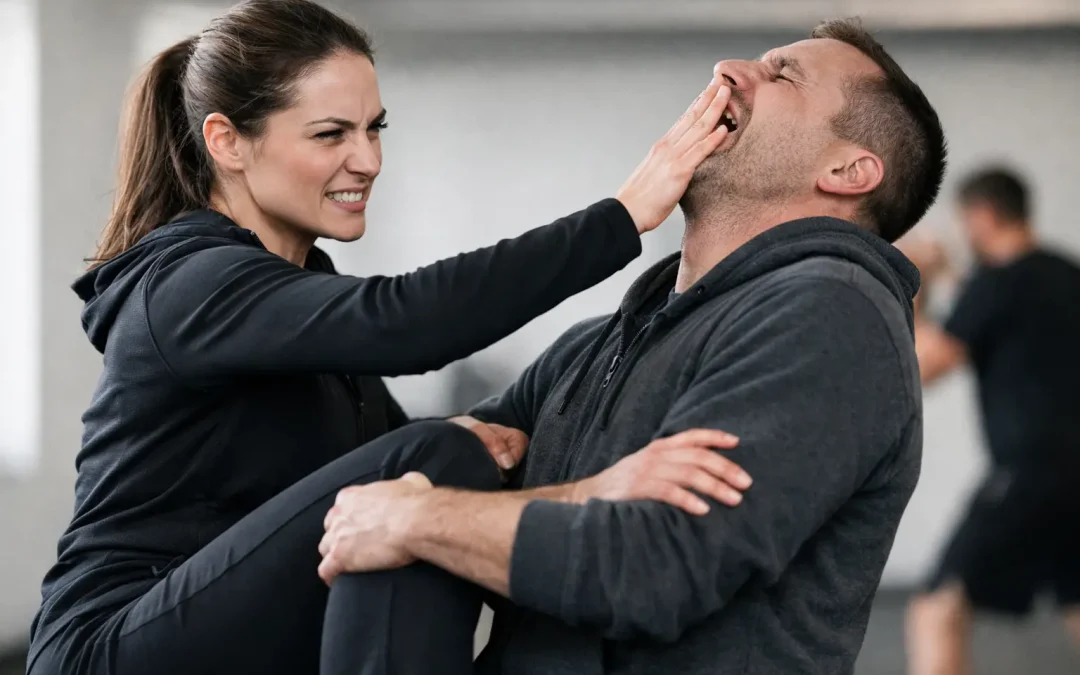
A threat rarely announces itself with a clean stance and plenty of space. It happens near your car, in an elevator lobby, on a quiet street, or during an argument that suddenly changes tone. That is why simple self defense techniques matter. Under stress, your fine motor skills drop, your thinking narrows, and complicated moves disappear.
The goal is not to win a fight or look impressive. The goal is to recognize danger early, create space, break contact when necessary, and get to safety. No fancy moves. No routines performed in slow motion. Just actions built around what your body can still do when your heart rate spikes.
What Makes a Technique Useful in Real Danger?
A useful self-defense response should be direct, easy to remember, and reliable when the situation is messy. Real attacks do not come with a referee, a predictable opening, or a guarantee that the other person will stop after one move.
Simple techniques work because they rely on large, natural movements: stepping, turning, pushing away, using your voice, protecting your head, and moving toward an exit. They do not depend on perfect timing or a memorized sequence.
That does not mean every situation calls for physical action. Often, the strongest response is leaving before a confrontation becomes physical. Self-defense starts with judgment. If you can avoid, de-escalate, or escape, do it. Physical action is for the moment when you cannot safely do otherwise.
Simple Self Defense Techniques Start Before Contact
Your first layer of defense is awareness. This is not about walking around scared or suspicious of everyone. It is about staying present enough to notice what is changing around you.
Keep your phone down when moving through parking areas, transit platforms, building entrances, and isolated walkways. Notice who is close, where the exits are, and whether someone is matching your pace or trying to close distance. If something feels wrong, trust that signal early. Change direction, enter a busy store, call someone, or move toward security.
Distance is your next advantage. The closer someone gets, the fewer options you have. If a person is making you uneasy, do not stand still and hope the conversation improves. Step back, angle your body slightly, and keep your hands up around chest level as if you are calmly explaining something. This looks non-threatening, but it also puts your hands between you and the other person.
Your stance should be stable, not dramatic. Put one foot slightly behind the other, keep your knees soft, and avoid crossing your feet as you move. You should be able to move backward, sideways, or toward an exit without tripping over yourself.
Use Your Voice Early and Clearly
A clear verbal boundary can interrupt a person who is testing you. It can also draw attention from people nearby. Speak loudly enough to be heard, but do not waste time arguing.
Use short commands: “Stop.” “Back up.” “Do not touch me.” “Stay away.” The words matter less than the delivery. Your voice should be firm, direct, and repeated if needed.
Avoid over-explaining. You do not need to justify why you are leaving, declining help, refusing a ride, or refusing to continue a conversation. A person who respects boundaries will give you room. A person who ignores them is giving you useful information about the risk.
If Someone Closes In or Grabs You
When physical contact happens, panic is a natural reaction. Training helps replace panic with a simple priority: protect yourself, make space, and leave.
First, protect your head and balance. Bring your arms close to your body, keep your chin down, and widen your stance. Do not lean backward with your weight on your heels. That makes you easier to pull, shove, or knock down.
If someone grabs your wrist or clothing, do not try to out-muscle their grip. Move your whole body. Step toward open space, turn your body, and use the strength of your legs and shoulders to pull free rather than relying only on your arm. The instant you create separation, move away. Do not stay to prove the technique worked.
If you are being crowded from the front, use your forearms and open hands to frame against the person’s upper body and create room. The purpose is not to trade blows. It is to prevent them from smothering your movement, regain your footing, and disengage.
When someone is driving forward aggressively, a strong, direct push to create distance can be more useful than a complicated strike. Push, move at an angle, and leave. Straight backward movement can work, but angling off often helps you avoid being chased in a direct line or trapped against a wall.
If you fall, protect your head, get your feet under you, and stand as soon as you can. Staying on the ground is a serious disadvantage, especially if there may be more than one person involved. Your priority is not grappling. It is getting upright and getting out.
Keep the Response Simple Under Pressure
The biggest mistake beginners make is collecting too many techniques. They learn a defense for every possible grab, punch, push, and weapon scenario, then freeze because they cannot choose one fast enough.
A better approach is to build a small set of repeatable responses. Think in principles instead of choreography: maintain distance, protect your head, use your voice, create space, escape.
These principles adapt. They work whether the threat begins with verbal intimidation, unwanted touching, a shove, or a grab. They also keep your attention on the outcome that matters: reaching safety.
This is why pressure matters in training. A move that feels easy when a cooperative partner pauses in front of you may fall apart when someone is resisting, talking over you, grabbing with force, or forcing you to make decisions quickly. Good training introduces resistance gradually, so you can test what you can actually use without being thrown into chaos on day one.
At Urban Street Defense, the standard is practical response, not ceremonial performance. Students learn to work from natural movement, then pressure-test those movements until the actions become more instinctive. The point is not to memorize a show. It is to respond when you least expect to need it.
Do Not Ignore the Environment
Urban self-defense is not only about your hands. Your surroundings can either trap you or help you.
Move toward people, light, cameras, staffed counters, locked doors, and visible exits. If you are near a vehicle, do not let it become a corner. If you are in a hallway, avoid being pinned against the wall. In a crowded place, use your voice to direct attention: “Call security!” or “Call the police!” is more effective than a vague cry for help because it tells bystanders what to do.
Items in your hands can also be a problem. A coffee, shopping bag, laptop, or phone may limit your ability to move and protect yourself. If danger is immediate, do not cling to property. Your safety matters more than an object that can be replaced.
The same applies to ego. Insults, arguments, and challenges can pull people into situations they could have left. If walking away feels embarrassing, remember the real measure of self-defense is whether you get home safely.
Train for Decisions, Not Just Movements
A technique is only one part of personal safety. You also need practice recognizing when to act, when to leave, and how to manage adrenaline.
Scenario-based training is valuable because it gives context to the movement. Where are your hands? Is there an exit? Is the person blocking your path? Are you carrying a bag? Can you use your voice before contact happens? These questions make training more realistic than practicing a sequence in isolation.
It also helps to train with different body types, different levels of resistance, and realistic pacing. A smaller person may need to rely more on positioning, movement, and immediate escape. A stronger person still needs awareness and restraint because size does not remove the risk of surprise, multiple attackers, or legal consequences.
There is no technique that guarantees safety. The right choice depends on distance, environment, the number of people involved, your physical condition, and whether escape is available. That is exactly why simple, adaptable actions are worth learning.
The best time to decide how you will respond to danger is before fear takes over. Build your awareness. Practice your voice. Learn how to make space and move. Then keep one principle close whenever you are out in the world: create an opening, leave it behind you, and get home safe.