
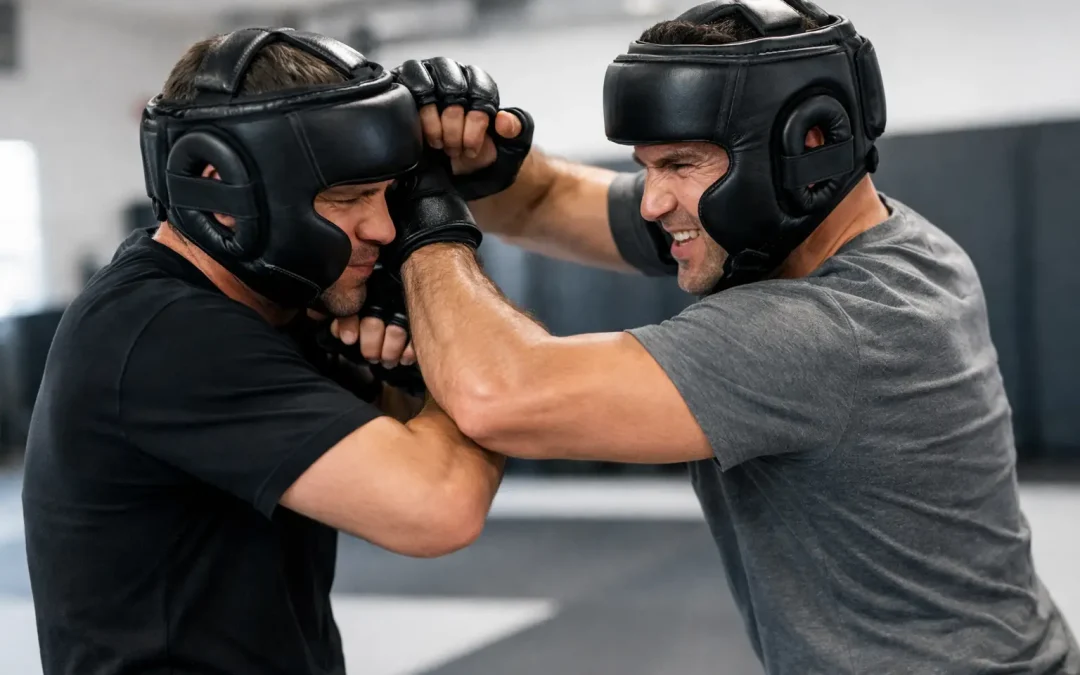
A threat does not wait for you to settle into a stance, remember a sequence, or agree on the rules. That is why realistic self defense sparring matters. It exposes the gap between knowing a move and being able to act when someone is crowding you, grabbing you, shouting, or driving forward with real intent.
This does not mean training should become reckless. Good sparring is controlled, progressive, and built around one goal: developing simple responses that still work when your heart rate rises. No fancy moves. No point-scoring habits. Just practical action under pressure.
What Realistic Self Defense Sparring Actually Means
Realistic sparring is not a staged fight where both people trade clean punches from a polite distance. It uses resistance, unpredictability, and scenario-specific problems to test whether your movement, awareness, and decisions hold up.
The pressure has to be honest. Your partner should not freeze after your first technique. They should move, cover, clinch, push, pull away, or keep advancing within the safety rules of the drill. If every attack arrives slowly and every defense succeeds on cue, you are rehearsing cooperation, not building a usable response.
At the same time, realism has limits. A street assault can involve concrete, weapons, multiple attackers, surprise, and legal consequences. Training cannot safely reproduce every risk. It can, however, prepare you to recognize danger earlier, protect yourself under stress, create space, and escape.
That distinction matters. The win condition in self-defense is not looking dominant. It is getting away safely.
Why Technique Changes Under Pressure
Many techniques look convincing when both people know what comes next. Add speed, resistance, confusion, and fatigue, and the picture changes fast. Fine motor movements become less reliable. Long combinations get interrupted. Distance disappears. Your plan may last one second.
This is where sparring earns its place. It teaches you what your body actually does when pressure arrives. You may blink, back straight up, hold your breath, reach for the attacker, or turn away. None of that is a character flaw. It is useful information.
Once you can see your default reaction, you can improve it. You learn to keep your hands active, protect your head, manage range, use direct strikes when appropriate, and move toward an exit instead of staying planted. You also learn when a technique is not working and when it is time to disengage.
The best self-defense methods are usually not complicated. They are simple enough to access when your mind is overloaded. That is the Jeet Kune Do principle in practical terms: remove what does not serve the moment.
Start With Progressive Resistance
Throwing beginners into hard sparring is not realistic. It is poor coaching. Panic does not automatically create skill, and repeated overwhelming experiences can teach people to freeze even more.
Pressure should build in stages. First, learn a movement or response against a cooperative partner. Then add light resistance. Next, make the timing less predictable. Add verbal stress, limited space, awkward starting positions, and the need to identify an exit. As confidence and control improve, intensity can rise.
A useful drill might begin with a partner reaching for a wrist. Later, that same partner can grab, shove, crowd, or use deceptive movement while the defender must protect their balance, respond decisively, and move away. The core idea stays simple, but the problem becomes more alive.
Progressive resistance lets you make mistakes without paying the full price for them. It also prevents a common trap: confusing exhaustion with effective training. You should leave a hard session challenged, not injured or unable to learn next time.
The Right Level of Contact
Contact is necessary, but more contact is not always better. Light and controlled contact can teach distance, defensive reactions, and composure. Protective equipment can allow harder rounds when the training objective calls for it. Yet equipment is not permission to abandon control or turn class into an ego contest.
The appropriate intensity depends on experience, body size, the scenario, and the drill’s purpose. A new student learning to break contact from a grab needs a different level of pressure than an experienced student working on close-range striking and escape.
Good partners make each other better. They apply believable resistance without trying to prove who is tougher.
Train the Problems Urban People Actually Face
Street defense is often messy and close. The attacker may be within talking distance before you realize the situation has changed. You may be carrying a bag, standing beside a car, leaving an elevator, walking through a parking area, or squeezed into a narrow corridor.
Realistic self defense sparring should reflect these constraints. Begin some rounds from non-fighting positions. Practice using your voice. Learn to manage a person who is too close without automatically escalating to strikes. Work from walls, chairs, doorways, and other common environmental barriers when it is safe to do so.
Verbal boundary setting belongs in the training. A clear command can draw attention, create distance, or give you a moment to leave. It will not stop every aggressor, but silence is not a strategy either. You need practice speaking while your body is under stress.
Scenario training should also teach judgment. A stranger asking a question is not automatically an attacker. A shove is serious, but it may still be possible to leave. The goal is not to treat every encounter as a fight. The goal is to identify danger, avoid unnecessary conflict, and act fast when avoidance fails.
Do Not Let Sport Habits Take Over
Combat sports build valuable attributes: timing, fitness, distance control, resilience, and the ability to function against resistance. Those are real advantages. But sport has rules, referees, rounds, gloves, weight classes, and shared expectations that do not exist in an assault.
Self-defense sparring must account for this without disrespecting sport training. A stance designed for a match may expose you when you are surprised. Chasing a knockout may keep you in danger longer than necessary. Going to the ground may be technically effective against one person but a bad decision if there are others nearby.
Use what works. Drop what depends on a controlled sporting environment. Your training should repeatedly return to awareness, balance, protecting vulnerable targets, creating space, and leaving.
What to Look for in a Training Partner and Coach
The atmosphere in the room matters as much as the drill. You need people who can apply pressure responsibly, communicate clearly, and respect safety boundaries. A training partner who ignores the purpose of the exercise to land hard shots is not making you more prepared. They are making training less useful.
A capable coach should explain why a drill exists, set clear rules, and adjust intensity for the student in front of them. They should challenge you without feeding fear or false confidence. Watch for classes that rely only on choreographed attacks, as well as classes that celebrate uncontrolled aggression as realism.
At Urban Street Defense, the focus is on building instinctive responses through pressure-oriented, scenario-based training. The standard is not how impressive a technique looks. The standard is whether it helps you protect yourself and get home.
Train for the Exit, Not the Applause
The strongest lesson from sparring is humility. You learn that even a smaller, simpler drill can become difficult once another person resists. That is not discouraging. It is exactly why you train.
You do not need a library of techniques. You need awareness, direct movement, emotional control, and enough pressure-tested skill to act when the moment is ugly and fast. Practice hard, train smart, and make every round point toward the same result: creating the chance to leave safely.