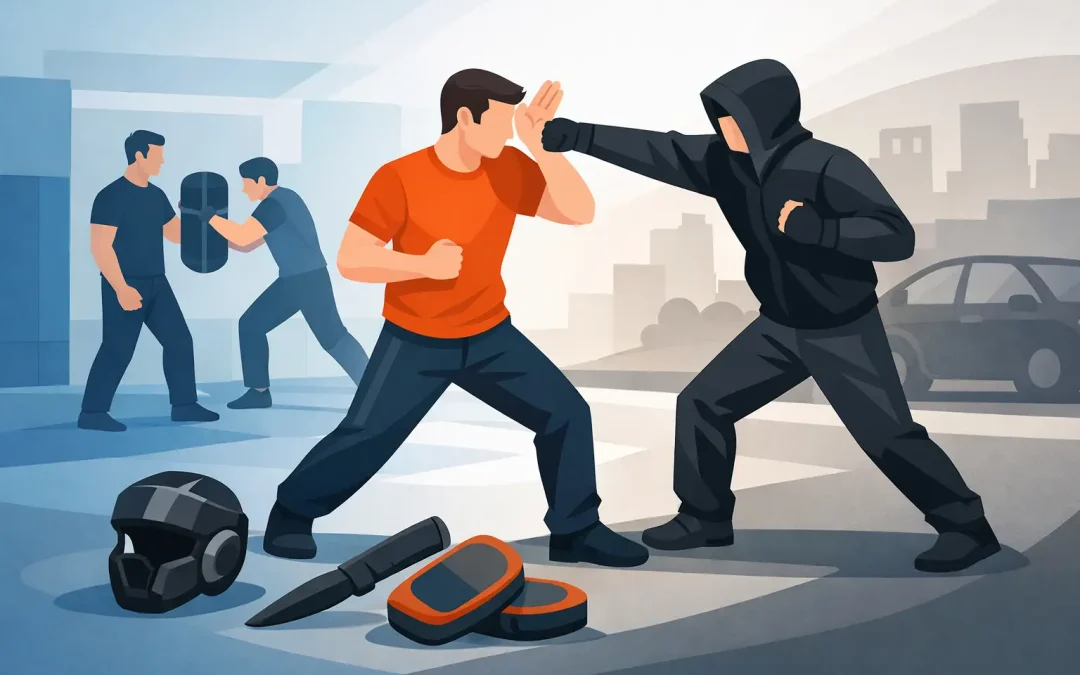
Reality Based Self Defense Training That Works

Reality Based Self Defense Training That Works

A confrontation rarely announces itself. It may begin in a parking garage, a crowded lift, outside a workplace, or during the walk from public transit to your car. Reality based self defense training prepares you for that uncertainty: the stress, close distance, confusion, and split-second decisions that make real danger very different from a controlled martial arts class.

The goal is not to look skilled. The goal is to recognize danger earlier, create an opportunity to get away, and act decisively when there is no safer option. No fancy moves. No memorized routine that depends on an attacker standing still. Just practical habits that can hold up when your heart rate climbs and your thinking becomes less clear.

What Reality Based Self Defense Training Means

Reality-based training starts with an honest question: what is likely to happen in an urban personal-safety situation? Usually, it is fast, close, awkward, and unexpected. You may be carrying a bag, wearing work clothes, standing in a tight space, or trying to protect a friend or family member. The other person may be bigger, aggressive, intoxicated, or trying to intimidate you before any physical contact begins.

That changes how you should train. A useful program does not build around complicated sequences, ceremonial forms, or techniques that require perfect timing. It builds around simple movement, awareness, verbal boundaries, balance, escape, and direct action under pressure.

This does not mean every situation ends physically. In fact, avoiding a fight is usually the best outcome. Good self-defense training teaches you to spot problems, manage distance, use your voice, leave early, and seek help. Physical skills are there for the moments when avoidance has failed and immediate action is necessary.

Real Pressure Exposes What You Can Use

A technique can feel easy when a partner is cooperative. That is not the test. The test is whether you can access a simple response when someone is moving, resisting, crowding you, and creating stress.

Under pressure, fine motor control drops. People freeze, rush, lose balance, or forget a long sequence of moves. That is why practical training favors gross, natural movements and repeatable principles over a large collection of techniques. You need options that are direct enough to remember and adaptable enough to work from imperfect positions.

Pressure-oriented sparring and scenario work matter because they reveal the gap between knowing and doing. You may understand what to do while watching an instructor, then discover that distance, noise, adrenaline, and surprise change everything. That discovery is valuable. It gives you a chance to build a calmer, faster response in training instead of learning the lesson during a real incident.

The point is not to prove who is toughest in class. It is to practice making decisions when conditions are uncomfortable. Can you keep moving? Can you protect your space? Can you disengage when an opening appears? Can you stop trying to win an exchange and start trying to get home safely?

The Skills That Matter Before Contact

Self-defense begins long before physical action. Awareness is not paranoia. It is noticing your environment well enough to make better choices. Keep your attention off distractions when entering isolated areas. Know where the exits are. Trust behavior that feels wrong, even if you cannot immediately explain why.

Distance is another major advantage. The closer a potential aggressor gets, the fewer options you have. A trained person learns to notice crowding, blocking, unwanted touching, and attempts to isolate them. Clear verbal boundaries can be powerful here. A firm, audible command may attract attention, disrupt an aggressor’s plan, and give you a moment to move.

These skills are especially relevant for commuters, shift workers, students, travelers, and professionals who spend long hours moving through city spaces. They also apply in workplaces. Personal safety is not only about strangers. Boundary violations, intimidation, and conflict can happen around people you know.

Why Simple Beats Impressive

Complicated techniques are often impressive in demonstrations because every movement happens at the right moment. Real situations do not offer that kind of cooperation. Your footing may be poor. Your vision may be blocked. You may be startled or off-balance.

Simplicity is not a lack of skill. It is disciplined selection. You train responses that are direct, efficient, and flexible enough to use when conditions are messy. Jeet Kune Do-inspired principles are useful here: take what is functional, remove what is unnecessary, and adapt to the situation in front of you.

There is a trade-off. Training only a few simple ideas does not make anyone invincible, and no responsible instructor should promise that. But a smaller set of well-practiced responses is more likely to be available under stress than dozens of techniques learned once and never pressure-tested.

A Good Program Trains the Mind Too

Fear changes behavior. Some people freeze. Others become overly aggressive. Both reactions can make a bad situation worse. Reality-based self-defense should help students recognize their stress response and continue making useful decisions anyway.

That includes permission to act. Many people hesitate because they are worried about being rude, making a scene, or misreading someone’s intentions. Training can help you set boundaries earlier and understand that creating distance is not an overreaction when someone ignores a clear request.

It also includes restraint. The purpose of self-defense is safety, not punishment. Once you can leave, leave. Once immediate danger has ended, seek help, contact the relevant authorities, and document what you can safely remember. Good judgment is part of capability.

What to Look for in Reality-Based Self Defense Training

Choose training that respects beginners without treating them as fragile. You should be able to start with no martial arts background, learn in a controlled environment, and progress at a pace that develops confidence rather than false bravado.

Look for instructors who explain why a drill matters and who allow students to experience realistic resistance gradually. Ask whether the class addresses verbal boundaries, awareness, escape, and decision-making, not just physical techniques. Small class sizes and private coaching can be especially useful if you want more feedback or have specific concerns about commuting, travel, workplace safety, or a past experience.

Be cautious of programs that make guarantees, rely only on choreography, or present every threat as a fight to be won. Safety training should make you more aware, more prepared, and more capable of leaving danger. It should not encourage reckless confidence.

For organizations, the same standard applies. Corporate personal-safety training should be practical, inclusive, and relevant to the environments employees actually use. A useful session gives people clear actions they can remember after the workshop, whether they commute late, travel for work, meet clients, or work in public-facing roles.

Train for the Life You Actually Live

The best self-defense training fits real schedules and real concerns. A busy professional may need focused sessions that build core skills quickly. A private group may want training tailored to the places and situations they share. Women-focused courses can address common boundary and personal-safety concerns without assuming women need a separate set of rules for becoming capable.

Urban Street Defense approaches training with this standard: build functional responses through scenario-based practice, direct movement, and pressure-tested learning. The aim is not to collect techniques. It is to become harder to intimidate, harder to isolate, and better able to act when a situation turns wrong.

You do not need to wait for a frightening experience to take your safety seriously. Start with awareness. Practice clear boundaries. Put yourself in a training environment that challenges you safely. Confidence is not pretending danger will never happen. It is knowing you have prepared to respond when it does.
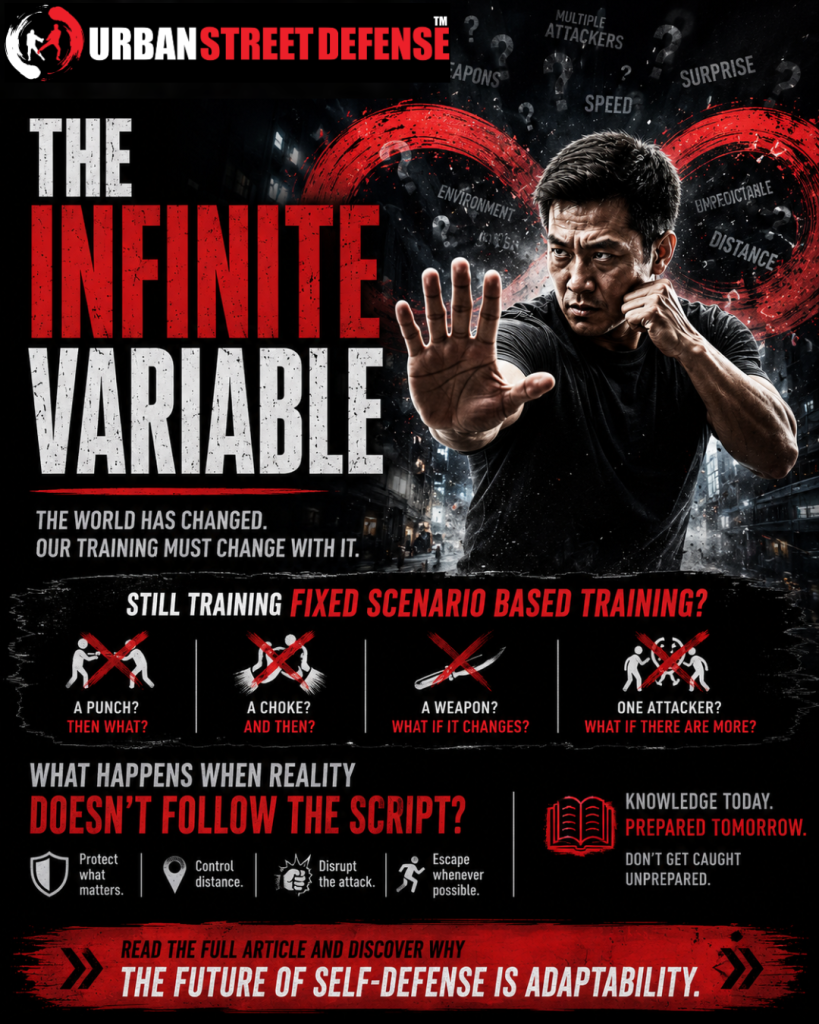
The Infinite Variable: Why Self-Defense Training Must Evolve

What Is the Infinite Variable?

Violence is not a fixed event.

It is a constantly changing series of unpredictable variables that no instructor, no syllabus, and no technique library can ever fully anticipate.

I call this The Infinite Variable.

Fixed Scenario Based Techniques

For decades, self-defense training has largely been built around one concept: Fixed scenario-based techniques.

“What do you do if someone grabs your wrist?”
“What is the defense against a front choke?”
“How do you counter a haymaker punch?”
“What is the defense against a knife attack?”

Students are taught a specific response to a specific attack. While this approach may help beginners understand basic movements, it no longer reflects the reality of violence today.

The world has changed.

The Problem with FIXED Scenario-Based Training

Real violence is unpredictable.

No two assaults are ever identical. An attacker may throw a punch, grab your shirt halfway through, push you against a wall, pull out a weapon, or be joined by another attacker within seconds.

Every encounter contains an almost infinite number of variables.

  • Different attackers.
  • Different body sizes.
  • Different environments.
  • Different emotional states.
  • Different speeds.
  • Different intentions.
  • Different combinations of attacks.

No instructor can realistically prepare a student for every possible scenario.

If your training depends on remembering a different technique for every attack, eventually reality will present you with a situation you’ve never practised before.

That is where many traditional training methods begin to fail.

The Infinite Variable Principle

Instead of asking:

“What technique should I use against this attack?”

We should instead ask:

“What principles work regardless of the attack?”

Violence changes.

Human biomechanics do not.

Under stress, the body loses fine motor skills. Decision-making becomes slower. Tunnel vision develops. Adrenaline takes over.

Complex techniques become difficult to execute.

Simple principles survive.

Stop Memorising. Start Responding.

A punch is not the problem.

A choke is not the problem.

A grab is not the problem.

The real problem is managing chaos in the first critical seconds.

Instead of creating hundreds of techniques, self-defense should develop a student’s ability to instantly:

  • Protect vital targets.
  • Create structure.
  • Control distance.
  • Disrupt the attacker’s balance or intent.
  • Regain initiative.
  • Escape whenever possible.

These responses remain effective regardless of whether the attacker punches, pushes, grabs, tackles, or suddenly changes tactics.

The response adapts because it is based on principles, not memorised sequences.

Reality Doesn’t Pause

  • Real assaults do not happen one technique at a time.
  • The attacker doesn’t wait while you identify the attack, recall Lesson 27, and execute the correct defence.
  • Violence is continuous.
  • A shove becomes a punch.
  • A punch becomes a tackle.
  • A tackle becomes a choke.
  • A choke becomes a weapon assault.
  • Everything changes within seconds.

Your response must therefore be instantaneous, adaptable, and simple enough to function under extreme stress.

The Future of Self-Defense

The future does not belong to schools with the largest collection of techniques.

It belongs to schools that produce students who can adapt.

Students who understand timing.

Students who understand positioning.

Students who understand pressure.

Students who can solve problems rather than recall techniques.

This is the direction modern self-defense must move toward.

A Reminder to the Martial Arts Community

This is not a criticism of tradition. Traditional martial arts have contributed enormously to discipline, fitness, culture, and character development.

However, if the objective is real-world personal protection, we must continually evaluate whether our training reflects today’s reality.

The violence we face today is faster, more unpredictable, and more chaotic than the scripted attacks often seen in training halls.

As instructors, we have a responsibility to prepare our students for reality—not for rehearsed demonstrations.

Perhaps it is time to ask ourselves:

Are we teaching students to memorise techniques…

…or are we teaching them to survive the infinite variables of real violence?

The answer to that question may determine whether our students can perform when it matters most.

The world has changed.

Our training should change with it.

Beyond Styles: The Importance of Training Focus for Effective Self-Defense

Beyond Styles: The Importance of Training Focus for Effective Self-Defense

 Which Style is the best? 

 When it comes to self-defense, there is a plethora of martial arts styles to choose from, but the question is whether Wushu, Jiu Jitsu, Karate, Taekwondo, or any particular style is effective for self-defense. Let’s explore this topic further. Throughout my years of teaching self-defense, I often come across questions such as, “Is Wushu good for self-defense?” “Is Karate good for self-defense?” “Is Jiu Jitsu good for self-defense?” “Is bjj good for self defense?” and “Is boxing or MMA better for self-defense?” Although these are valid questions, the effectiveness of any martial art style for self-defense depends on various factors.

Training Objectives

Martial art styles are like any other form of exercise or sport. They have techniques, training methods, and objectives, but what matters most is the application of these techniques in a self-defense situation. As Bruce Lee famously said, “Styles separate men. It’s a process of continuing growth.” This quote highlights the issue of people sticking to one style and ignoring other forms of martial arts. Styles may differ in their approach, but the end goal is the same – self-defense.

Superiority

Having particular style does not make one superior or weaker than another. No style is superior to another, but the learning objectives can make a difference in a person’s skillset. WE just need to ask ourselves, what are my learning objectives? Is it to win in competitions, to perform, or strictly defend oneself during times of crisis? Once we can identify our reason for picking up a particular martial arts, then we have to see whether that particular style is training you to achieve what you wanted to achieve.

Expectations Vs Reality

For instance, my primary purpose for learning self-defense is to protect myself and loved ones. However, the training school I enrolled in focuses 80% of the curriculum on teaching memorization of Forms and patterns, primarily for winning competitions and achieving higher ranking belts. Consequently, this emphasis may cause me to neglect the practicality of the techniques in real-life situations, rendering my learning objectives misaligned with the training school’s approach. Therefore, this training approach is unlikely to help me achieve my ultimate goal and objectives.

Another example. Mr. Alex’s goal for learning self-defense was to win a competition that was bound by fixed rules. However, his school taught techniques that were not bound by rules. Despite this, Mr. Alex went ahead and participated in the competition, only to lose to an opponent who had been training specifically for years with those competition rules. In light of this situation, can we say that Mr. Alex’s school taught a less superior style than the other?

Based on the given examples, it becomes apparent that the effectiveness of self-defense training is not dependent on the style but rather on the alignment between the individual’s objectives and the focus of the training school.

Category based on training objectives

Therefore. training schools can be categorized based on their focus into four types:

    1. Performance-Based – Training focuses on the aesthetic aspect of the martial art. It involves choreographed moves, displays, and exhibitions.
    2. Art-Based – Training emphasizes the history, culture, and philosophy of the martial art. The objective is to learn the art form and appreciate its values.
    3. Sports-Based -Training involves competition and rules. It is more geared towards winning tournaments and medals.
    4. Reality-Based – Training focused on practical self-defense techniques that work in real-life situations. Most of the training will be stress tested based on how real situation will happen. The objective is to train for scenarios one may face in the streets.

Conclusion

After gaining insights from this article, if someone were to ask you, “Is jiu-jitsu the best self-defense?” Will your answer be a simple YES or NO? The effectiveness of any martial art for self-defense depends on how the training school focuses on training its students. If a BJJ or jiu-jitsu training school solely emphasizes grappling techniques on the mats, it may not be practical in real-life street attacks. It is unrealistic to think that one can roll around on the pavement during an attack. Not only can this result in serious injuries, but the attacker’s accomplices may also kick or hurt the person on the ground while they are focusing on a single opponent. It is crucial to find a style that suits your needs and tailor your training accordingly. Remember, no style is superior to another, and the ultimate goal is to learn practical self-defense techniques that work in real-life situations.