
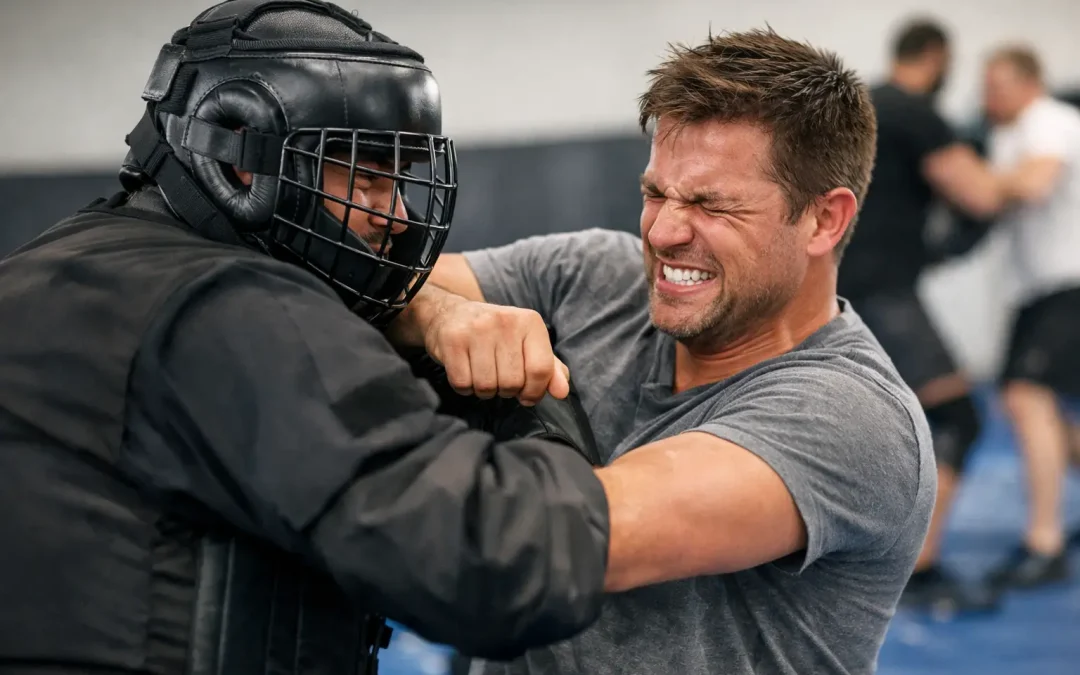
A clean technique can look convincing when your partner stands still, waits their turn, and gives you space. Real violence does not work like that. It is sudden, loud, close, confusing, and often over before you have time to think. What is pressure testing? It is training that adds realistic stress so you can find out whether a self-defense response still works when your heart rate rises and your plan starts to fall apart.
Pressure testing is not about proving who is toughest in the room. It is about exposing gaps safely, building usable reactions, and learning to make better decisions when conditions are bad. No fancy moves. No rehearsed victory. Just action that holds up when pressure hits.
What Is Pressure Testing and Why Does It Matter?
Pressure testing puts a technique, tactic, or decision under controlled resistance. Your training partner may move unpredictably, resist your escape, talk aggressively, crowd your space, or force you to react from an awkward position. The intensity is adjusted to your experience, fitness, and the goal of the drill.
The key word is controlled. Realistic training does not mean reckless training. It means creating enough uncertainty that you cannot simply perform a memorized sequence. You must recognize the problem, protect yourself, create space, act decisively, and leave.
This matters because stress changes behavior. Fine motor skills get worse. Your vision can narrow. You may freeze, rush, hesitate, or forget techniques you could perform perfectly five minutes earlier. A complicated response that needs ideal timing, perfect balance, and a cooperative opponent is a poor bet for personal safety.
Pressure testing helps strip your response down to what is simple, direct, and repeatable. It shows you whether your stance collapses when pushed, whether you can speak firmly under intimidation, whether you notice exits, and whether you can move after contact begins. Those are the questions that matter outside the gym.
Pressure Is More Than Hard Sparring
Many people hear the term and picture two people trading punches at full speed. Sparring can be useful, but pressure testing is broader than sparring. A real self-defense problem may start with someone blocking your path, grabbing your wrist, crowding you in an elevator, confronting you at your car, or escalating after an argument.
A good pressure-tested drill can include verbal boundary setting, awareness, movement, escape routes, physical contact, and the decision to disengage. It can also include scenarios where the correct answer is to leave early rather than fight.
For example, a beginner may start with a partner stepping into their space and using a loud, confrontational voice. The student practices setting a clear boundary, moving to a safer angle, and getting away. Later, the drill may add a grab, protective gear, resistance, and limited striking or escape options. The objective stays the same: get safe, not win points.
Sport training and self-defense training can overlap, but their priorities are not identical. A sport match has rules, a referee, a known start time, and usually one opponent. Street violence may have none of those. Pressure testing should reflect the actual problem you are preparing to handle.
What Good Pressure Testing Looks Like
Good pressure testing has purpose. It is not an excuse for instructors or advanced students to overwhelm beginners. Every drill should answer a practical question: Can you make space from a grab? Can you protect your head while moving? Can you get up safely? Can you recognize when talking is no longer working?
The pressure should also be progressive. Throwing an untrained person into a high-intensity scenario on day one can create panic without teaching useful skills. Start with simple movement and clear roles. Add resistance, speed, noise, surprise, and fatigue as the student develops control.
Equipment matters when contact increases. Gloves, mouthguards, head protection, pads, and appropriate rules help people train with enough intensity to learn without collecting unnecessary injuries. The aim is honest feedback, not damage.
A quality instructor watches closely and changes the drill when needed. Some students need more repetition before intensity. Others need to slow down and regain structure because they are relying on wild swings or tunnel vision. Pressure should reveal behavior, then training should improve it.
Resistance must be realistic
A partner who lets you complete every technique teaches you nothing about resistance. At the same time, a partner who turns every drill into a competition can stop learning entirely. Realistic resistance means the partner makes the task difficult in ways that fit the scenario.
If you are practicing an escape from a wrist grab, the partner should grip with intent, adjust when you move, and make you work for the exit. They should not transform the drill into a surprise takedown unless that is part of the agreed lesson. Clarity keeps training useful and safe.
Decision-making belongs in the drill
Physical skill is only one part of personal safety. Pressure testing should make you think about distance, obstacles, bystanders, exits, and whether you can leave before the situation turns physical.
Sometimes the strongest response is a loud command and immediate movement toward safety. Sometimes you need to use force to break contact long enough to escape. The circumstances matter. Training should build judgment, not a habit of fighting every problem.
Recovery is part of the lesson
You will make mistakes under pressure. Everyone does. You may lose balance, miss a strike, freeze for a second, or use the wrong response. The value is in what happens next.
Can you cover up, regain your position, keep moving, and continue toward escape? Can you review the drill without excuses and identify one correction for the next round? Pressure testing builds resilience when students learn to recover instead of treating every error as failure.
Common Myths About Pressure Testing
The first myth is that pressure testing means full-contact fighting every class. It does not. Intensity is a tool, not the entire program. A beginner can experience pressure through timing, verbal confrontation, limited space, and controlled resistance before heavy contact is appropriate.
The second myth is that pain proves realism. Pain can teach a lesson, but it is not the goal. A training environment that injures people, humiliates them, or ignores consent will eventually reduce attendance and damage learning. You need challenge with standards.
The third myth is that one successful drill proves a technique will always work. It does not. Size, strength, environment, surprise, weapons, multiple attackers, and your own stress level change the situation. Pressure testing does not offer guarantees. It helps you choose higher-percentage actions and recognize when a tactic is failing.
The final myth is that only experienced fighters need this training. Beginners may benefit most because they quickly learn the difference between knowing a move and being able to use it. The process should be scaled, coached, and repeated. Confidence should come from tested ability, not wishful thinking.
How Pressure Testing Builds Real Confidence
False confidence says, “I know what I would do.” Real confidence says, “I have faced resistance before, I know what stress feels like, and I can still take the next useful action.” That is a major difference.
Repeated exposure to manageable pressure helps reduce the shock of confrontation. You become more familiar with close range, loud voices, resistance, and physical effort. You learn that you can breathe, move, protect yourself, and make decisions even when the situation feels uncomfortable.
It also creates humility. You discover that distance disappears quickly, that balance is easy to lose, and that simple techniques need practice. That humility is valuable because it encourages awareness, avoidance, and early action. The best self-defense encounter is still the one you leave before violence begins.
At Urban Street Defense, pressure is introduced with purpose: to help students develop instinctive responses without pretending that real danger follows a script. The training is built around practical movement, direct action, and the ability to adapt when the first plan does not work.
A Better Standard for Self-Defense Training
When you assess a self-defense class, do not only ask what techniques are taught. Ask how those techniques are tested. Are students working against realistic resistance? Do drills include movement, stress, verbal boundaries, and escape? Is the training adjusted for beginners while still progressing toward honest intensity?
Also ask whether the class values safety and control. Effective training should challenge you, not feed someone else’s ego. You should leave with clearer lessons, better awareness, and skills you can build on.
Personal safety is not about collecting moves. It is about being able to act when your body wants to freeze and your environment gives you no perfect answer. Train simply. Train honestly. Then keep showing up until your response becomes harder to shake.