
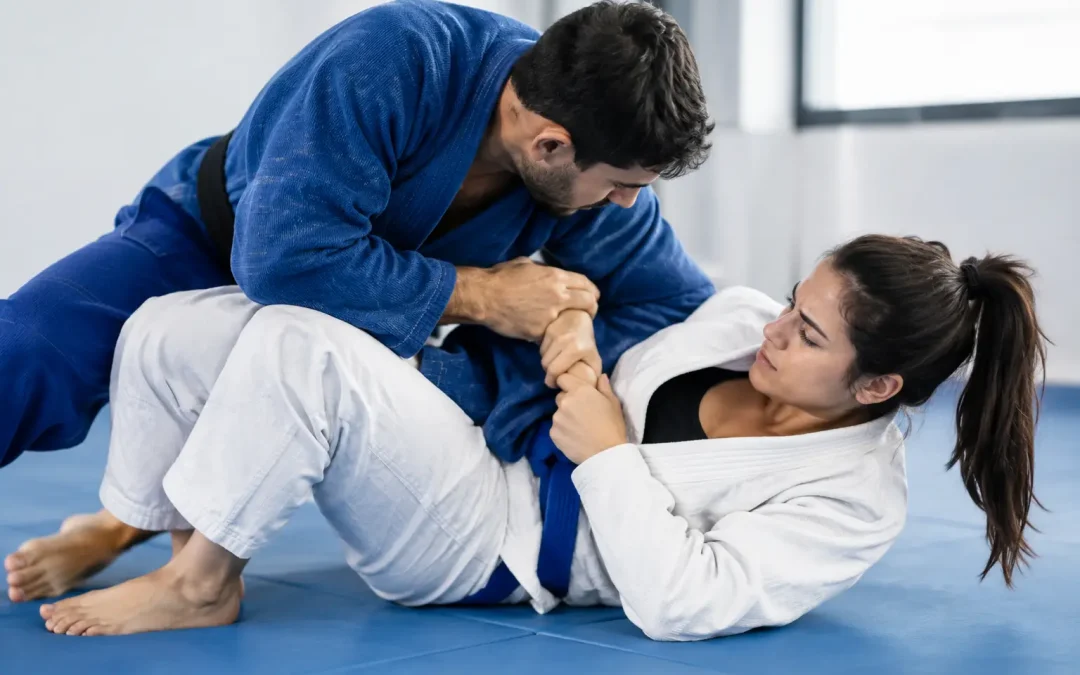
A ground escape is not about winning a wrestling match. It is about surviving the worst moment of an assault: you are down, disoriented, and someone is still close enough to hurt you.
Concrete, curbs, furniture, parked cars, broken glass, and a second attacker change everything. Staying on the ground for even a few extra seconds can expose your head, limit your movement, and make it harder to see what is happening around you. Your priority is simple: protect yourself, create space, get up safely, and leave.
That sounds obvious. Doing it while someone is grabbing, striking, crowding, or pinning you is different. This is why practical ground-defense training must be pressure-tested. No slow-motion routines. No waiting for a cooperative partner to pause in the exact position you practiced.
Why a ground escape matters in real violence
Most people do not plan to fight on the ground. They get there because they slipped, were shoved, lost balance while backing away, or were tackled during a sudden assault. A bag strap, uneven pavement, heels, alcohol, fatigue, and panic can make a bad situation worse fast.
The ground removes the advantages you normally rely on. You cannot move away easily. Your vision may be blocked. Your hands may be occupied protecting your head or controlling distance. If the attacker is bigger, their body weight can become a serious problem.
There is also no guarantee that the person in front of you is the only danger. On the ground, you may not see a friend joining in, a weapon being drawn, traffic approaching, or an opening to escape. That is why self-defense has a different objective from sport grappling. Position matters, but escape matters more.
A useful mindset is this: do not accept the ground as the place where the fight happens. Treat it as a temporary problem to solve.
The ground escape priorities
A reliable response needs to work when fine motor skill disappears. Under stress, complicated sequences fade. The body falls back on what has been trained repeatedly.
A practical ground escape follows four priorities:
- Protect your head and vital targets from immediate strikes.
- Use your limbs and body position to keep the attacker from closing in freely.
- Create enough distance or disruption to stand.
- Get up in a way that keeps you aware and ready to move.
These are principles, not a scripted routine. The exact movement depends on whether you are on your back, side, stomach, seated, trapped against a wall, or facing someone who is standing over you. It also depends on whether the person is striking, grabbing clothing, trying to hold you down, or simply blocking your path.
The goal stays the same. Make room. Regain your feet. Leave.
Protect before you counter
When people panic on the ground, they often reach blindly for the attacker or throw uncontrolled punches. This can leave the face open and pull the attacker closer. If strikes are coming, first reduce the damage. Cover vulnerable areas, turn your body when appropriate, and avoid lying flat and passive beneath the threat.
Your legs can be valuable tools for managing distance. They are longer and stronger than your arms, and they can help keep a standing aggressor from stepping directly into range. But do not confuse this with a kicking contest. Wild kicks can leave you off-balance, expose you to having a leg controlled, and waste the moment you need to stand.
The purpose is not to look impressive. It is to deny easy access long enough to move.
Create space, not a perfect finish
A common mistake is waiting for the perfect technique. Real attackers resist. They move unpredictably. Their weight shifts. Clothing catches. The surface underneath you may be wet or rough. A move that looked clean in a demonstration can fail when timing and resistance are real.
Instead, look for a usable opening. A frame with your arms, a turn of the hips, a forceful push at the right time, or a sharp movement that disrupts their balance may be enough. You do not need total control over the attacker. You need enough separation to stand and go.
This is where simple, direct movements are more dependable than elaborate answers. If a method needs perfect hand placement, exact timing, and a calm partner, it is not built for the reality of a sudden assault.
Stand without giving up your awareness
Getting up carelessly can put you straight back into danger. Turning your back, rising with your head down, or using both hands on the floor while the attacker is close can leave you exposed.
A safer stand-up keeps your eyes on the threat as much as possible, uses your body as a barrier, and gets your feet underneath you without sacrificing balance. Once you are standing, do not stay there to prove a point. Move toward safety, create distance, call for help, and get to other people if you can.
Escape is a decision. Make it early.
Why technique alone is not enough
Watching a ground escape video can help you understand the idea. It cannot teach you what the position feels like when another person puts real pressure on you.
Pressure changes breathing. It changes your sense of direction. It changes how much strength you think you have. A person who can perform a movement smoothly with a friendly partner may freeze when someone heavier traps their hips, crowds their face, or drives them into the floor.
This is not weakness. It is a training gap.
Effective training closes that gap gradually. Beginners should first learn safe body positioning, movement, and how to fall without injuring themselves. Then they need controlled resistance. Then they need to make decisions while tired, surprised, and dealing with realistic verbal pressure. The intensity must be scaled responsibly, but it must eventually become uncomfortable enough to reveal what actually works for that individual.
At Urban Street Defense, the point is never ceremonial movement. Training is built around functional responses that can be recalled when your heart rate rises and the situation stops being neat.
The trade-offs people need to understand
Ground skills are necessary, but they are not a reason to seek the ground. If you can avoid a physical confrontation, do that. If you can run before contact happens, run. If you can stay upright, use movement, awareness, and verbal boundaries to do so.
Even a well-trained person faces serious risks on the ground. There may be multiple attackers. A weapon may be involved. The surface may cause injury. Legal consequences may follow if you use more force than needed after an opportunity to escape appears.
This means your training should not create false confidence. You are not learning how to dominate every person in every situation. You are building a better chance of protecting yourself during a sudden, ugly, close-range problem.
For some people, the biggest benefit is physical. They learn to recover from a fall, move under pressure, and stand with balance. For others, it is mental. They stop seeing the ground as an instant defeat. Both matter.
How to train ground escape skills safely
Start with qualified instruction and appropriate mats. Your early sessions should emphasize safe falling, posture, distance management, and controlled standing rather than aggressive sparring. Rushing into hard resistance before you understand how to protect your body is how people get hurt in training.
As your movement improves, train from awkward positions. Begin seated. Begin on your back. Begin with your vision partially distracted. Have a partner apply manageable resistance and make you solve the problem rather than perform a memorized answer. Train in normal clothing sometimes. Jackets, bags, restrictive workwear, and footwear affect movement more than people expect.
Do not train only one version of the problem. An attacker may be between your legs, beside you, over you, or standing just outside reach. You may have room to move, or your shoulder may be against a wall. Variety builds adaptability.
Most importantly, train the exit. Every drill should end with distance, awareness, and movement away from the threat. If practice ends with you holding a position on the floor, it can quietly teach the wrong habit.
The right question to ask
Do not ask, “What is the best ground technique?” There is no single answer that survives every size difference, surface, attack, and level of resistance.
Ask better questions. Can I protect my head? Can I prevent easy access to my body? Can I make enough room to stand? Can I leave before the situation gets worse?
Those questions keep training honest. They also keep the focus where it belongs: not on collecting moves, but on getting home safely.
A ground escape does not need to be pretty. It needs to buy you the seconds required to get back on your feet, see the danger clearly, and choose the safest way out.