
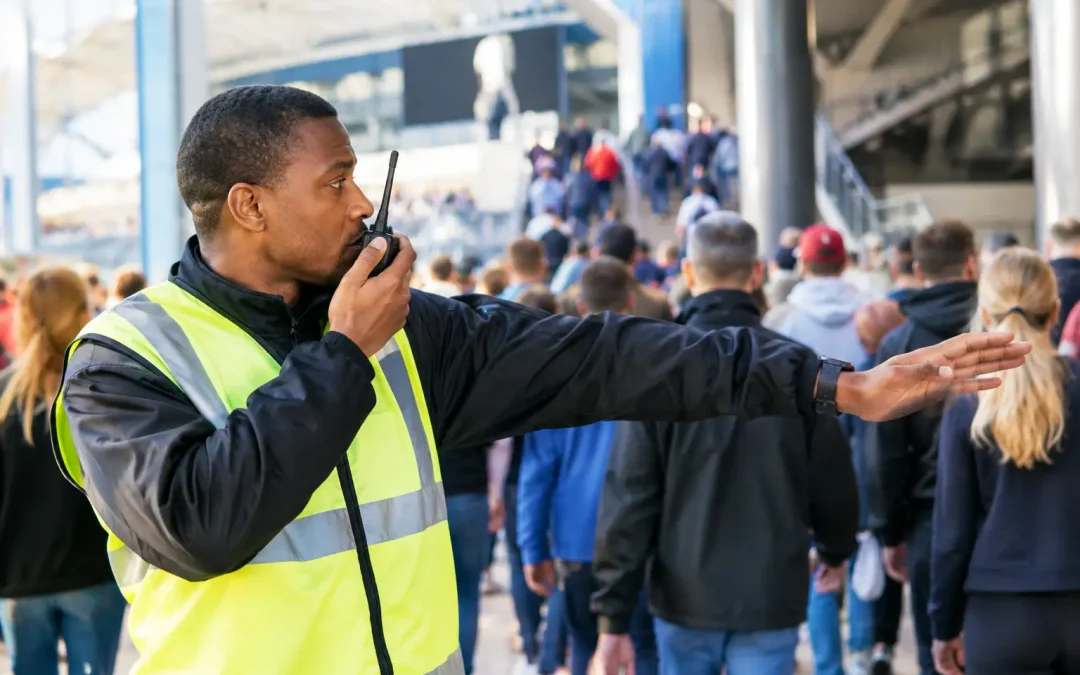
A crowded venue safety example is not about winning a fight in a packed concert, train platform, festival, or nightclub. It is about seeing danger early, keeping your footing, protecting the people with you, and getting out before a tight crowd turns into a trap. No fancy moves. No heroic speeches. Just action that gives you space and options.
The crowded venue safety example that matters
You are leaving a sold-out event with two friends. The exit corridor is narrow, the crowd is moving slowly, and people behind you keep pushing forward. Ahead, an argument starts near a doorway. A few people stop to watch. Others keep pressing in because they cannot see what is happening.
Within seconds, the crowd changes character. It is no longer a group of people walking toward an exit. It is a body of pressure moving in different directions.
This is where many people make the wrong move. They stare at the argument. They pull out a phone. They freeze because they do not want to look rude or overreact. Meanwhile, the open space around them disappears.
The smart response is simple: recognize that the environment has changed, turn your attention toward escape, and move before the crowd decides your direction for you.
You do not need to know whether the argument will become violent. You only need to know that congestion, panic, aggression, and poor visibility create a bad situation. Leave the area while leaving is still easy.
Read the crowd before it becomes dangerous
Crowds are not automatically unsafe. Most people attend public events, commute, shop, and celebrate without a problem. Risk rises when movement becomes restricted, emotions run high, or people cannot see a clear way out.
Watch for a sudden stop in forward movement. If people behind you continue moving while the people ahead have stopped, compression can build quickly. Notice changes in body language too: heads turning toward one point, people filming, raised voices, security running, or a wave of people moving away from something they cannot explain.
Your instincts may tell you to find out what is happening. Ignore that urge. You are not there to investigate. You are there to get yourself and your group home safely.
Position matters. Avoid standing directly in front of a closed door, at the bottom of stairs, beside barriers, or in the center of a dense flow of people. These are pressure points. If movement surges, they are places where people can lose balance and have little room to recover.
If you are arriving at a venue, take ten seconds to locate more than one exit. If you are with friends, agree on a meeting point outside before the event begins. That is not paranoia. It is preparation.
Create space without starting a confrontation
In a crowd, your first tool is your voice. Use it early, clearly, and loudly enough for people immediately around you to hear: “Move back.” “Stop pushing.” “Let us through.” “Emergency.” Short commands work better than polite, complicated explanations when people are stressed.
Keep your hands up around chest level with open palms when space is tight. This looks non-aggressive, but it also gives you a working frame between your body and another person. Your elbows should stay close enough to protect your ribs and prevent your arms from being pinned.
Do not lock your knees. Keep a staggered stance if the space allows, with one foot slightly behind the other. This gives you a stronger base if someone bumps or shoves you. Leaning backward makes you easier to knock down. Standing tall but slightly forward helps you stay balanced.
If someone is pressing into you from behind, do not spin around angrily. Turning your back toward an unknown person in a tightly packed space can cost you awareness and balance. Look over your shoulder when you can, use your voice, and continue moving toward an exit or an area with less pressure.
There is a trade-off here. Pushing hard may create temporary room, but it can also trigger a fight or knock someone down. Use controlled movement to make space, not wild force. Your goal is escape, not dominance.
If the crowd surges, protect your ability to breathe
A crowd surge can happen at a gate, stairway, entrance, stage area, transit platform, or exit. Once you are compressed, your priorities narrow fast: stay upright, protect your chest, and move toward the edge of the crowd when an opening appears.
Bring your forearms across your chest in a protective frame, with your hands near your collarbones. This can help maintain breathing room if bodies press against you. Keep your feet beneath you. Take small steps in the direction the crowd is moving rather than fighting the entire force head-on.
Look for the perimeter. The edge of a crowd is usually safer than the middle because there may be walls, aisles, open seating areas, staff access points, or side exits nearby. A wall can be useful only if it gives you a route out. Do not allow yourself to be pinned flat against it.
If you fall, curl onto your side, protect your head and neck, and get back up as quickly as possible. Shout for help, but do not wait passively for someone to notice. In a packed environment, people may not realize you are down.
If you are holding a bag, shopping, or anything that affects your balance, let it go if it prevents you from moving safely. Property can be replaced. Your footing cannot.
Keep your group from becoming a liability
Being with friends or family can improve safety, but only if the group has a simple plan. The biggest mistake is everyone trying to make decisions at once.
Choose one person to lead movement toward an exit. Keep children, older adults, or anyone with mobility concerns close and slightly in front of the stronger person in the group. Use a firm verbal cue such as “Stay with me” or “This way.” Do not tug people unpredictably from different directions.
If your group becomes separated, do not push against a dense flow to reunite immediately. Move to a safer edge or outside meeting point first. Then contact each other. Trying to force your way back through a moving crowd can turn one problem into several.
This is especially relevant after events in busy city centers, where ride-share pickup zones, transit entrances, and sidewalks can become more crowded than the venue itself. The show may be over, but the risk has simply moved outdoors.
Physical self-defense still has a place
Most crowded venue problems are solved by awareness, movement, and decisive escape. But sometimes another person uses the crowd as cover to grab, grope, threaten, steal from, or assault someone. In that moment, passivity is not a safety strategy.
Create distance with direct, simple actions. Use your voice. Break the grip. Strike only as necessary to stop the immediate threat and open an escape route. Then leave. Do not stay to prove a point, trade insults, or wait for a second attack.
Reality-based training matters because a crowded environment does not give you room for choreographed techniques. Your arms may be trapped. Your view may be blocked. You may be off-balance, carrying a bag, protecting a child, or trying to move through noise and confusion. Practical training builds simple responses that still function when conditions are messy.
At Urban Street Defense, the focus is not ceremonial forms or sport points. It is learning to recognize pressure, respond under stress, and act with purpose when the situation is not clean or predictable.
Train the decision, not just the technique
The strongest safety skill is the ability to decide early. You decide not to enter a visibly unstable crowd. You decide to leave when people begin shoving. You decide that filming an argument is not worth getting trapped behind it. You decide that a stranger grabbing you in a crowd requires immediate action.
That decision becomes faster when you practice it. Scenario-based self-defense training can help you use your voice, maintain balance, protect your personal space, and move with intent under pressure. The techniques matter, but your willingness to use them at the right moment matters more.
When a venue feels wrong, trust the signal. Create space. Find the edge. Move toward an exit. The best time to act is while you still have room to move.