by Founder of USDC | 29th September 2026 | General Safety Topics
A crash on the way home. A colleague who suddenly collapses. A child choking during dinner. First aid in Malaysia is not about looking calm or remembering a long checklist. It is about making the next right move while emergency help is on the way.
The first minutes are unforgiving. Panic, crowds, traffic, and uncertainty can turn a manageable incident into a worse one. Practical first aid gives you a simple operating system: make the area safe, call for help, deal with immediate threats to life, and stay with the person until trained responders take over.
First Aid in Malaysia Starts With Scene Safety
Do not rush blindly into an emergency. A victim may be in danger, but so might you. Look for moving traffic, fire, exposed electrical wires, broken glass, an aggressive person, or any other active threat. If you become injured, you cannot help anyone.
This is where personal safety and first aid meet. If violence is still happening, create distance, move toward people and light, and call for help. Do not turn medical aid into a second victim situation. Once the threat has stopped or the area is safe, assess the injured person.
Speak clearly: “Can you hear me?” Check whether they are conscious and breathing normally. If they can respond, keep them still and reassure them. If they are unresponsive, get someone to call 999 and ask another person to find an automated external defibrillator, or AED, if one is nearby.
Be specific when asking bystanders for help. “You in the blue shirt, call 999.” “You, bring the AED.” Vague requests often produce no action because everyone assumes someone else has taken charge.
The Priorities That Matter Most
You do not need to diagnose every injury. Your job is to identify the problems that can kill quickly: an unsafe scene, no normal breathing, severe bleeding, or a blocked airway. Work in that order.
If They Are Not Breathing Normally
If an adult is unresponsive and not breathing normally, start CPR immediately. Occasional gasps are not normal breathing. Place the heel of one hand in the center of the chest, put your other hand on top, lock your arms, and push hard and fast. Aim for 100 to 120 compressions a minute and allow the chest to rise fully between compressions.
Continue until emergency responders arrive, the person begins breathing normally, or you are physically unable to continue. If an AED is available, switch it on and follow its voice prompts. AEDs are designed to guide ordinary people. Do not wait for someone “more qualified” if nobody else is acting.
Training matters here. Reading instructions after a collapse is better than doing nothing, but hands-on practice builds the confidence to act without freezing.
If There Is Severe Bleeding
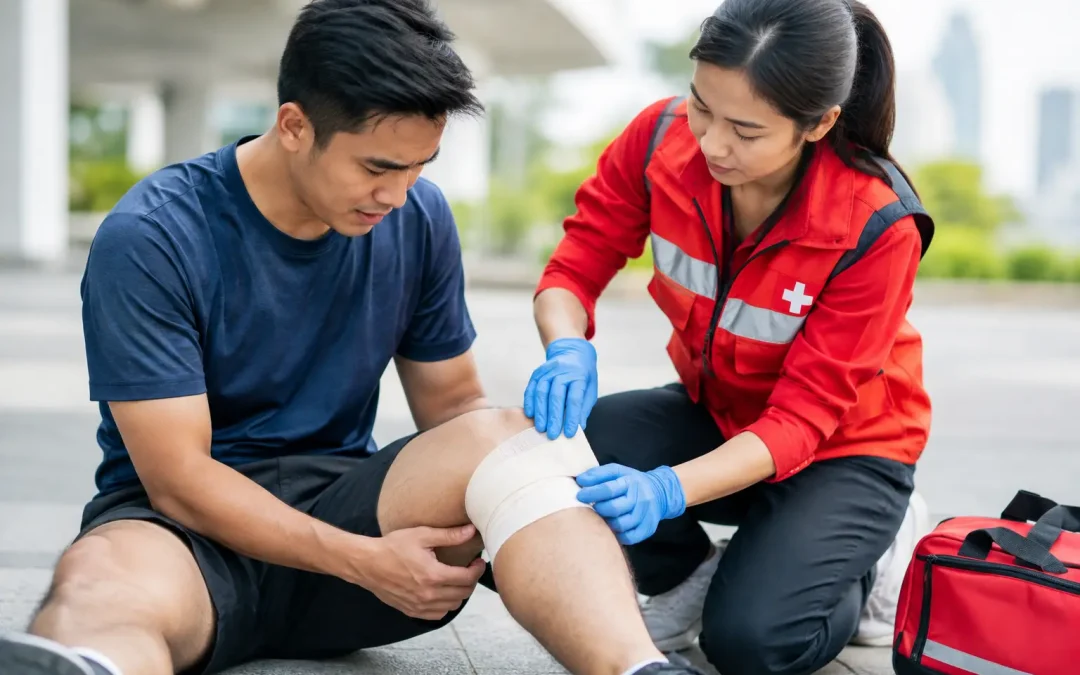
Heavy bleeding can become life-threatening fast. Apply firm, direct pressure to the wound with gauze, a clean cloth, or clothing if that is all you have. Keep the pressure steady. Do not keep lifting the cloth to check whether it has stopped. If blood soaks through, add more material on top and continue pressing.
Call 999 for severe, spurting, or uncontrolled bleeding. If you have been trained to use a tourniquet and the bleeding is from a limb, use it when direct pressure cannot control the bleed. Note the time it was applied and do not remove it yourself.
Forget movie logic. Do not put coffee, toothpaste, powders, or random substances into a wound. Control the bleeding. Keep the person warm. Watch their breathing and level of consciousness.
If Someone Is Choking
A person who can cough or speak may still be moving air. Encourage them to keep coughing and monitor them closely. Do not strike their back while they are coughing effectively.
If they cannot speak, breathe, or cough, act. Give firm back blows between the shoulder blades, then abdominal thrusts for an adult or child where appropriate. Repeat until the blockage clears or they become unresponsive. If they collapse, call 999, begin CPR, and check the mouth for a visible object before giving breaths if you are trained to do so. Never blindly sweep a finger into the mouth.
If There Is a Burn, Fall, or Road Crash
For a heat burn, cool the affected area under cool running water for 20 minutes as soon as possible. Remove rings, watches, or tight items before swelling starts, but do not pull away clothing stuck to the skin. Cover the burn loosely with a clean, non-fluffy dressing or clean plastic wrap. Ice, butter, oils, and toothpaste do not belong on burns.
After a serious fall or a road crash, avoid moving the person unless there is immediate danger such as fire or traffic. Head, neck, and spinal injuries are not always obvious. Keep them still, support the head in a comfortable neutral position if you can, and monitor their breathing until help arrives.
What a Useful First Aid Kit Looks Like
A first aid kit should help you control a problem, not become a box of expired items nobody understands. Keep one at home, in the car, and in workplaces or training spaces where people gather. Check it twice a year.
A practical kit should include:
- Disposable gloves, sterile gauze, dressings, adhesive bandages, and medical tape
- Trauma shears, a CPR face shield, and a thermal blanket
- Antiseptic wipes and saline for minor wound cleaning
- A written emergency contact list and any personal medical information relevant to your household or team
The kit is only one part of readiness. Gloves do not replace judgment. If you have gloves, use them when blood is present. If you do not, use a barrier where possible and wash thoroughly afterward. Never delay urgent care while searching for the perfect item.
First Aid Is Not a Substitute for Medical Care
Some injuries look minor before they become serious. Seek urgent medical assessment for chest pain, signs of stroke, difficulty breathing, loss of consciousness, seizures, deep wounds, suspected fractures, major burns, severe allergic reactions, or any injury caused by violence.
With a possible stroke, remember sudden facial drooping, arm weakness, and speech difficulty. Note when symptoms began and call 999. With suspected poisoning, keep the container or substance information available, but do not force vomiting unless instructed by a qualified medical professional.
For workplace leaders, first aid is also a systems issue. Staff need to know where kits and AEDs are located, who calls emergency services, how visitors are accounted for, and who meets responders at the entrance. A policy sitting in a folder does not help during a collapse. Rehearsed roles do.
Pressure Changes What You Can Do
Knowledge feels simple when you are sitting down. It feels different when somebody is bleeding, a crowd is shouting, or your hands are shaking. That is why practical training should include decision-making under pressure, not just a certificate and a photo opportunity.
The same principle applies to personal safety. You may need to recognize danger, get away, call for help, and then provide aid once it is safe. Urban Street Defense teaches people to respond decisively to real-world threats, because hesitation has consequences. But physical self-defense and medical response are separate skills. Train both.
Take a recognized first aid and CPR course. Practice the fundamentals often enough that you can recall them on a bad day, not just immediately after class. Tell your family, coworkers, or training partners where the nearest AED is. A few minutes of preparation can give someone else their next birthday, their next commute, or their next chance to go home.
When an emergency happens, you do not need perfect words or perfect technique. You need a safe scene, a clear call for help, and the willingness to take useful action.
by Founder of USDC | 28th September 2026 | General Safety Topics
A self-defense class should never make you feel like the next lesson could put you in the hospital. Yet if you are asking, “are self defense classes safe,” you are asking the right question. Real training deals with violence, stress, impact, and uncomfortable scenarios. That does not mean it should be reckless. It means safety must be designed into every drill.
The right class builds your ability to act under pressure without throwing beginners into uncontrolled sparring, dangerous holds, or ego-driven competition. You should leave challenged, alert, and more capable – not injured, intimidated, or ashamed.
Are Self Defense Classes Safe? It Depends on How They Are Run
Self-defense training has a different purpose from a martial arts demonstration, a fitness boot camp, or a combat sport. The goal is not to win points or perform a perfect sequence. It is to recognize danger, create space, escape, and get home safely.
Because the subject is serious, the training needs structure. A qualified instructor does not start a new student with full-force strikes, chaotic grappling, or surprise attacks. They teach simple movements, defensive positioning, verbal boundaries, awareness, and escape options first. Intensity increases only when the student has the control and confidence to handle it.
A safe program also distinguishes between discomfort and danger. Feeling your heart rate rise during a scenario drill can be useful. Being pressured to continue through sharp pain, dizziness, fear, or a clear injury is not. Training should stretch your limits without ignoring them.
Realistic Does Not Mean Reckless
Some schools promise “real street fighting” and confuse aggression with realism. That is a red flag. Actual violence is unpredictable, fast, and ugly. Preparing for it requires judgment, control, and a clear progression – not instructors trying to prove how tough they are.
Pressure training has value when it is controlled. A student may practice getting off a wall, protecting their head, moving away from a grab, or responding after a verbal confrontation. Protective equipment, agreed intensity, clear start and stop signals, and close coaching turn these drills into useful learning rather than a free-for-all.
The safest training is often the most honest. It acknowledges that no technique works every time, size and strength matter, multiple attackers change the situation, and the best outcome is usually escape. It teaches you to use your voice, your environment, your movement, and direct physical action when there is no safer choice.
That is very different from memorizing long routines or relying on a single disarm. No fancy moves. No false promises. Just practical decisions under pressure.
What a Safe Self-Defense Class Looks Like
Look closely at the first session. You can learn a great deal before you ever throw a strike.
A responsible instructor explains the purpose of each drill, demonstrates it at a manageable speed, and checks that students understand the boundaries. They pair people thoughtfully, particularly when there are major differences in size, experience, or confidence. They correct unsafe behavior immediately instead of treating it as part of the culture.
Good classes also use progressive resistance. You may first learn a movement with a cooperative partner. Then you add light resistance. Later, you work with more speed, more uncertainty, and controlled pressure. This gives your body time to build coordination and your mind time to make decisions without freezing.
Equipment matters, but it is not a substitute for good supervision. Pads, gloves, mouthguards, and appropriate flooring can reduce injury risk. So can trimming nails, removing jewelry, warming up properly, and following hygiene standards. More importantly, the instructor must know when to slow a drill down, change an exercise, or stop it altogether.
A safe environment is also one where “stop” means stop. You should be able to decline a drill, request a different partner, or tell an instructor about an old injury without being mocked. Consent is not a soft extra. It is part of disciplined training.
The Risks You Should Expect
Even well-run classes carry some physical risk. Bruises, muscle soreness, minor strains, and accidental contact can happen, especially in hands-on training. The question is whether those risks are minimized and proportionate to what you are learning.
There can also be an emotional element. Scenario-based drills may bring up fear, previous experiences, or anxiety around being grabbed, cornered, or shouted at. A capable instructor does not force a student to disclose personal history. They offer options, explain what is coming, and allow people to step back or modify a drill.
If you have a medical condition, recent injury, pregnancy, or concerns about anxiety or trauma, speak with a healthcare professional when appropriate and tell the instructor before class. A good program can often adapt training. The answer is rarely to do nothing. It is to train intelligently.
Warning Signs to Walk Away From
Trust what you see, not just the marketing. Leave if a school shows any of these patterns:
- Students are pressured to spar hard before they understand basic defense and control.
- Instructors dismiss injuries, pain, or fear as weakness.
- There are no clear rules on contact level, protective gear, or stopping a drill.
- Experienced students use beginners as targets to feed their own ego.
- Techniques are taught as guaranteed answers to weapons, multiple attackers, or any situation.
You should also be cautious of classes built around humiliation. Self-defense requires confidence, but confidence does not grow from being bullied by the people meant to teach you. It grows through repeated, achievable practice in a supportive group.
How to Choose a Class That Builds Real Readiness
Ask direct questions before you join. How are beginners introduced to contact? What safety gear is used? How do instructors handle injuries? Can you observe a class? Is there a clear way to opt out of a drill? The answers should be straightforward, not defensive.
Watch the room if you can. Are students attentive when the instructor speaks? Do partners check in with each other? Does the instructor actively coach, or do they spend most of the class watching people collide? A disciplined room is usually a safer room.
Also consider whether the training matches your real needs. A commuter may need awareness, boundary-setting, escape movement, and defenses against common grabs. A corporate team may need practical personal-safety habits that fit workplace and travel situations. Someone seeking deeper capability may want controlled sparring and private coaching after building a foundation.
At Urban Street Defense, the standard is practical progression: simple movements, direct action, realistic scenarios, and pressure introduced with control. The point is not to turn students into performers. It is to help them respond when the situation is sudden, close, and confusing.
Your First Class Should Feel Challenging, Not Chaotic
Expect to move, think, communicate, and make mistakes. You may discover that simple actions are harder under pressure than they look. That is normal. A good instructor will break the skill down, let you repeat it, and show you how to make it work when the other person is not standing still.
You should not need prior martial arts experience, exceptional fitness, or a tough-guy attitude. Beginners need clear instruction and room to learn. As you improve, training can become more demanding, but the rules and respect should remain constant.
Choose a class that treats your safety as seriously as the dangers it prepares you for. The right training does not make you fearless. It gives you better options when fear shows up – and the discipline to use them.
by Founder of USDC | 27th September 2026 | General Safety Topics
A student who suddenly stops taking the usual route to school, asks to stay home with vague stomachaches, or goes silent when a phone notification appears may be signaling more than a bad week. School bullying in Malaysia is not a harmless rite of passage. It can change how a young person moves through classrooms, friendships, public spaces, and family life.
The first job is not to tell them to toughen up. It is to take the signal seriously, establish what is happening, and make a plan that works when pressure hits. Awareness posters are not enough if a child still has no safe way to leave a confrontation, call for help, or report repeated harm without being dismissed.
What School Bullying in Malaysia Can Look Like
Bullying is repeated behavior intended to intimidate, isolate, humiliate, control, or hurt someone. It may be physical, but it does not need bruises to cause real damage. A student can be targeted through insults, threats, exclusion, extortion, harassment, unwanted touching, damage to belongings, or cruel content circulated in group chats.
The online and offline sides often feed each other. A student may be mocked in a classroom, filmed during lunch, then face hundreds of comments after school. Telling them to simply log off misses the point when the same people are waiting at the gate the next morning.
Not every argument is bullying. Students disagree, friendships break down, and tempers flare. The difference is pattern and power. If one student or group has social, physical, digital, or seniority-based power and repeatedly uses it to make another person feel unsafe, adults should treat it as a safety issue.
Warning signs vary. Some students become withdrawn, unusually angry, anxious, or guarded about their devices. Others begin missing school, losing belongings, changing routes, eating alone, or showing an unexpected drop in concentration. These signs do not prove bullying, but they justify a calm, direct conversation.
Start With Safety, Not Shame
A child who shares what happened has already taken a risk. Do not interrogate them like they are on trial. Do not lead with, “Why didn’t you fight back?” That question can teach them that asking for help creates another problem.
Start with simple questions: What happened? Who was there? Where does it usually happen? Has anyone been hurt or threatened? Is there a message, video, photo, or witness? Ask what would help them feel safer tomorrow, not only what they think should happen to the other student.
Write down dates, times, locations, names, injuries, damaged items, and exact words where possible. Save screenshots, usernames, voice notes, and images before content disappears. Documentation does not replace action, but it turns a vague complaint into a clear record of a repeated pattern.
If there is an immediate threat, physical assault, sexual harassment, weapon, extortion, or credible threat of serious harm, treat it as urgent. Get the student away from danger, inform school leadership, and contact emergency services or the police when necessary. Do not wait for a “perfect” amount of evidence while someone is at risk.
A Plan for the Next School Day
A good plan is specific. “Be careful” is not a plan. “Ignore them” may work for a one-off insult, but it can be dangerous advice if intimidation is escalating.
The student should know where to go if approached: a staffed office, counselor’s room, library desk, teacher’s classroom, or other agreed safe point. They should identify at least two adults at school who know the situation and can respond. They also need a way to move between vulnerable places, such as stairwells, bathrooms, bus stops, parking areas, or isolated corridors, without being alone.
A trusted friend can help, but no student should be made responsible for physically protecting another student. Use the buddy system to reduce isolation, get help quickly, and provide a witness. Arrange check-ins before school, after dismissal, and after any known risk period.
Students also need short, usable language. Under stress, long speeches disappear. Practice a firm boundary such as, “Stop. Do not touch me.” Then leave toward people and authority. The goal is not to win an argument or prove courage. The goal is to create distance, draw attention, and get safe.
What Schools Must Do Beyond a Talk
Schools carry a duty to respond consistently. A single assembly on kindness will not protect a student if reports disappear into a drawer or staff treat violence as normal student behavior.
A serious response starts with a named point of contact, a clear reporting route, prompt fact-finding, and communication with the affected student’s family. The school should address both the immediate safety plan and the behavior driving the harm. Separating students temporarily may be needed, but it should not punish the targeted student by forcing them to lose activities, classes, or access to support.
Confidentiality matters, but it should not become silence. Families may not be able to receive every detail of disciplinary action involving another child. They can still expect confirmation that the report was received, that safety steps are in place, and that follow-up will happen on a stated timeline.
Staff also need to watch the predictable gaps: changing rooms, buses, bathrooms, hallways, dismissal areas, and online spaces connected to school life. Bullying thrives where supervision is assumed but not actually present.
Why “Fight Back” Is the Wrong Default
Physical self-protection has a place, but it must be taught honestly. Telling a scared student to hit first can intensify violence, create legal and disciplinary consequences, and leave them facing several aggressors rather than one. It is not a strategy. It is a gamble.
At the same time, telling students to never resist under any circumstances ignores reality. If someone is being grabbed, trapped, assaulted, or unable to leave, they may need to use reasonable force to break free and escape. The purpose is not punishment. It is escape.
Practical self-defense training should reinforce that distinction. It should teach awareness, verbal boundary-setting, movement, balance, escape from common holds, and decisions under pressure. It should also teach students to recognize when escape is possible and when calling for adults is the smarter move. Fancy techniques and choreographed responses are not useful when panic narrows attention and timing disappears.
For older teens, parents, educators, and organizations, reality-based training can build confidence without selling false certainty. Urban Street Defense focuses on simple, direct responses that help people create space and get away when a situation turns physical. Training is one layer of safety, not permission to seek confrontation.
Bystanders Can Change the Outcome
Many bullying incidents depend on an audience. Silence can feel like approval to the aggressor and abandonment to the person being targeted. Bystanders do not need to become heroes or step into a fight. They need a safer response.
They can interrupt with a distraction, bring an adult immediately, walk the targeted student toward a safer area, refuse to share humiliating content, and save evidence if doing so does not put them at risk. A private message afterward also matters: “I saw what happened. It was not okay. I can go with you to report it.”
Parents should teach this directly. Children often know bullying is wrong but freeze because they fear becoming the next target. Give them permission to leave, report, and seek help rather than demanding a dramatic confrontation.
Build Confidence Before a Crisis
The strongest safety culture is built before the next incident. Families can rehearse how to make a report, whom to call, and what routes feel unsafe. Schools can train staff to respond without minimizing, blaming, or forcing instant face-to-face reconciliation. Students can learn that confidence is not loudness. It is the ability to make a clear decision under stress.
A young person should never have to earn protection by being tougher, quieter, more popular, or more physically capable. Make the next step simple: listen, document, report, create a safety plan, and keep following up. Fast action tells a student the most important thing they need to hear: you are not alone, and this does not get to continue.
by Founder of USDC | 26th September 2026 | General Safety Topics
A threat does not give you time to remember a long sequence, find the perfect stance, or wait for a referee. It may happen in a parking area, an elevator, a commute, or a workplace confrontation that turns physical without warning. That is why Jeet Kune Do principles matter: they cut away what looks impressive and focus on what gives you the best chance to act, create space, and get safe.
Jeet Kune Do is often associated with Bruce Lee, but its value is not in copying his movements or collecting famous quotes. Its value is a way of thinking about training. Keep what works. Remove what does not. Adapt to the person, the environment, and the moment in front of you.
For real self-defense, that mindset is more useful than a fixed syllabus of flashy techniques. No fancy moves. No routines that collapse the moment someone resists. Just practical decisions built for pressure.
The Core Jeet Kune Do Principles
The principles are simple to say and demanding to develop. Simplicity, directness, adaptability, and economy of motion are not slogans. They are filters. Every movement, drill, and response should pass through them.
Simplicity beats complexity
Under stress, your body does not become more coordinated. Your heart rate rises, fine motor control drops, your vision narrows, and your thinking can become slow or scattered. A complicated defense that works only when both people cooperate is not a dependable answer to a real attack.
Simplicity means using natural, repeatable actions. Protect your head. Manage distance. Strike or disrupt when necessary. Break contact. Move toward safety. These actions can be trained until they become more automatic, even when you are startled or tired.
Simple does not mean easy. A direct palm strike, elbow, knee, forearm cover, escape from a grab, or verbal boundary needs correct timing, body position, and repetition. But each has a clear purpose. You are not performing. You are solving an immediate problem.
Directness saves time
In self-defense, time is not neutral. The longer an attacker controls the distance, traps you against a wall, grabs your clothing, or takes you to the ground, the fewer options you may have.
Directness means choosing the shortest practical path to interrupt the threat. If someone is closing in, do not add unnecessary motion before protecting yourself. If an exit is open, leaving is more direct than proving you can win an exchange. If a loud command draws attention and creates space, use it.
This is where people misunderstand self-defense. Directness is not about charging forward or trying to dominate every situation. It is about acting decisively when action is required. Sometimes the most effective response is a physical counter. Sometimes it is movement, awareness, de-escalation, or getting behind a barrier. It depends on the danger, the space, and whether you can safely leave.
Economy of motion preserves your advantage
Big, looping movements take longer, reveal your intention, and can pull you off balance. Jeet Kune Do favors movements that do enough, without doing too much.
That matters when the environment is cramped. In a crowded train, beside a car, in a narrow hallway, or while carrying a bag, you may not have room for high kicks or wide swings. Close-range tools and protective positioning become more realistic. A compact response can also help you recover faster if the first attempt does not work exactly as planned.
Economy is not about being passive. It is about avoiding waste. Wasted movement costs time. Wasted energy slows you down. Wasted attention can stop you from seeing a second person, an obstacle, or your nearest exit.
Adaptability is the real test
A method is only useful if it can change when the situation changes. Attackers do not follow scripts. They may be larger, aggressive, intoxicated, armed, accompanied by others, or simply unpredictable. The ground may be wet. The lighting may be poor. You may be wearing office clothes, carrying a child, or dealing with an injury.
Adaptability means you do not become attached to one technique. If a strike misses, you regain position. If a grip release fails, you protect yourself, disrupt balance, and look for another route out. If escape is possible, you take it. If there are multiple threats, you avoid getting surrounded and move toward people, light, security, or an exit.
This is why realistic training matters. You need more than a memorized answer. You need the ability to recognize pressure, make a fast choice, and continue moving when the first plan fails.
Jeet Kune Do Principles Are Not an Excuse to Be Reckless
Real self-defense is not a fight you seek out. It is an emergency response when avoidance and de-escalation have failed. The objective is not to punish someone, win a contest, or stay long enough to demonstrate skill. The objective is to get home safely.
That distinction changes how you train. You learn awareness before conflict: noticing unusual behavior, avoiding isolated routes where possible, keeping your phone and keys accessible, and trusting the feeling that something is wrong. You learn to use your voice early and clearly. A firm “Back up” or “Don’t touch me” can set a boundary, attract attention, and prepare your body to move.
You also learn the trade-off between engagement and escape. Running may be the best choice if there is a clear path. It may not be possible if you are trapped, grabbed, protecting another person, or knocked down. Practical training prepares you for both realities without pretending there is one universal answer.
Use only the force needed to stop the immediate danger and create an opportunity to leave. Once you are safe, contact the appropriate emergency services, seek medical attention if needed, and document what happened. Responsible self-defense includes what you do after the physical moment ends.
Pressure Testing Turns Ideas Into Reactions
You can understand every Jeet Kune Do principle and still freeze when someone moves at you fast. Knowledge is not the same as usable skill.
Pressure testing closes that gap. It starts in a controlled way: verbal boundary drills, surprise cues, distance-management exercises, pad work, grip escapes with progressive resistance, and scenario training. As confidence and safety allow, the intensity increases. The goal is not to create chaos for its own sake. The goal is to expose weak assumptions before a real threat does.
Good pressure-oriented training teaches you to function while tired, startled, and uncomfortable. You learn that a clean technique on a cooperative partner may look different against resistance. You learn to keep your hands up, breathe, regain balance, and make the next decision instead of stopping because the first one was imperfect.
This is also where sparring has value, with the right expectations. Sparring does not recreate every street situation, and sport rules can create habits that do not transfer directly to self-defense. But controlled resistance can improve timing, composure, distance, and your ability to handle someone who is actively trying to stop you. It is one tool, not the entire answer.
What Beginners Should Train First
You do not need years of martial arts experience before you can build useful safety habits. Start with a stable, mobile stance and a protective hand position. Learn how to manage distance, move off line, use your voice, and recognize when you are too close to react comfortably.
Then train a small set of high-percentage responses against common problems: unwanted grabs, close-range aggression, being pressed backward, and attempts to control your upper body. Work on getting up safely from the ground and creating space before trying to stand. Add fitness that supports movement, balance, and recovery, because fatigue makes every decision harder.
Most of all, train consistently. One intense workshop can show you what is possible, but repetition builds instinct. Private coaching can help if you want focused work on a specific concern, while group training gives you exposure to different body types, energy levels, and reactions. The right format depends on your schedule, comfort level, and goals.
At Urban Street Defense, the focus is not on collecting forms or waiting for perfect conditions. It is on practical, scenario-based training that helps ordinary people respond when life gets messy.
Build a Response You Can Use
The strongest lesson behind Jeet Kune Do principles is not that one style has every answer. It is that your training should remain honest. If it only works slowly, with a willing partner, in open space, and after a detailed explanation, it needs to be tested harder.
Train for awareness. Train for decisive action. Train to escape, not to impress. A safer future is built through small, repeatable habits practiced before you need them – until protecting yourself feels less like a theory and more like a response.
by Founder of USDC | 25th September 2026 | General Safety Topics
An elevator ride can turn uncomfortable before the doors even close. Someone follows too closely, ignores your attempt to create space, or stands between you and the control panel. To protect yourself in elevators, you need awareness before the doors shut, clear decisions under pressure, and simple actions that help you get out.
This is not about looking for a fight. It is about recognizing when a situation feels wrong and refusing to get trapped in it. In a confined space, there is little room to move, limited visibility, and no easy exit until the doors open. Your best defense starts early.
Protect Yourself in Elevators Before You Step In
The strongest move is often not entering. If someone gives you a bad feeling, is acting aggressively, appears intoxicated, or follows you into a quiet lobby without a clear reason, wait for the next elevator. Walk back toward security, a staffed counter, or a busier area. You do not owe a stranger politeness at the cost of your safety.
Trust behavior, not appearances. A well-dressed person can be dangerous. Someone who looks rough may be harmless. Watch for actions: invading your space, watching your floor selection, blocking a route, making sexual comments, refusing to take no for an answer, or becoming angry when you create distance.
If you enter with someone you do not know, stand near the control panel rather than deep in the back corner. This gives you access to the door-open button, alarm, and emergency call function. It also puts one less person between you and the exit.
Keep your phone accessible but do not let it consume your attention. Headphones, scrolling, and looking down can make you slower to notice movement and slower to act. If you are carrying bags, keep at least one hand free. Convenience matters, but mobility matters more.
Control the Space Without Creating a Scene
You do not need to act paranoid. You need to be positioned well. Face generally toward the doors, keep your feet stable, and maintain enough space to move your arms. Avoid standing with your back against a side wall if another passenger is close enough to pin you there.
If someone enters after you and stands uncomfortably close, move first. Press another floor if necessary and step out at the next stop. A small inconvenience is a good trade for getting back into an open, visible space.
Use your voice early when a boundary is crossed. Keep it short, firm, and loud enough for nearby people or building cameras to capture the urgency: “Stop.” “Stay back.” “Do not touch me.” “I’m getting out.”
Do not explain, negotiate, or try to manage an aggressor’s emotions. Clear commands do two things. They may interrupt the person’s behavior, and they alert anyone outside the elevator that something is wrong. Silence can make a dangerous person feel they have control. Your voice can take some of it back.
If Someone Tries to Follow You In
Do not allow yourself to be shepherded into the elevator. If a person closes distance as you approach the doors, let them take the elevator first. Stay in the lobby and wait. If they hold the door and insist that you enter, decline and move away.
If you are already inside and the person enters behind you, do not automatically continue to your intended floor. Exit at the next available floor, especially if it is populated or has security. If they follow, move toward people and state clearly that you do not know them and want help.
What to Do When the Doors Close and Something Feels Wrong
Once the elevator is moving, your priorities become simple: create space, draw attention, operate the controls, and exit at the first safe opportunity.
If possible, press the door-open button as the elevator reaches a floor. Press the alarm or emergency call button if you are being threatened. In many elevators, pressing multiple floor buttons can also increase the chance of stopping at an occupied level sooner. The goal is not to solve the entire situation inside the car. The goal is to get the doors open.
Keep moving toward the control panel and the doors. Do not let an aggressor position themselves directly between you and both. If they try to block you, angle your body rather than backing straight into a corner. A stable stance – feet under you, knees slightly bent – makes it harder to shove you off balance.
Your words should stay direct: “Move.” “Open the door.” “Help.” If the elevator stops at a floor, yell before the doors fully open. People in the hallway are more likely to react when they hear a clear command than vague panic.
If Physical Contact Starts
There are no fancy moves in a cramped elevator. Tight spaces punish complicated techniques, high kicks, elaborate holds, and anything that depends on perfect timing. Under fear, your body will default to what you have trained repeatedly.
Your immediate objective is not to win an exchange. It is to protect your head and airway, stay on your feet, make enough space to reach the controls or doors, and escape. Use a strong frame with your forearms and hands to keep a person from collapsing into you. Lower your center of gravity. Turn toward the exit whenever an opening appears.
If you must use physical force, use only what is necessary to break contact and get out. Simple, direct actions are more reliable than complicated sequences: push away to create distance, strike if needed to stop an immediate assault, then move. Do not stay to prove a point. Do not chase someone when they retreat. Leave, get help, and call emergency services.
If you are knocked down, protect your head with your arms, keep your knees between you and the attacker where possible, and use your legs to create distance long enough to stand or reach the door. This is difficult, which is exactly why practical training should include pressure, close-range movement, and recovery from bad positions – not just rehearsed techniques with a cooperative partner.
Do Not Confuse a Mechanical Problem With an Attack
Getting stuck in an elevator is stressful, but it is usually a maintenance issue, not an immediate personal-safety threat. Use the emergency call button, contact building management if possible, and wait for trained assistance. Do not force the doors open or try to climb out.
The situation changes if another passenger becomes threatening while the elevator is stalled. Create distance, stay near the panel if it is safe, call for help, and make noise. If you can safely contact someone, give the building name, elevator location if known, and a brief description of the threat.
Build Habits That Reduce Your Risk
Personal safety is not a single technique. It is a chain of small choices made before danger becomes unavoidable. When using elevators in parking structures, apartment buildings, hotels, or office towers, avoid walking in distracted. Notice who is nearby. Know where security or busy common areas are located. If a route feels isolated, choose a safer one when you can.
When traveling alone, tell a trusted person where you are headed if the situation warrants it. In a workplace, report broken lights, malfunctioning access doors, damaged cameras, or repeated suspicious behavior. These are not minor inconveniences. They are conditions that can make people easier to isolate.
For employers and building managers, elevator safety is also a people-safety issue. Clear emergency instructions, working intercoms, accessible security contacts, reliable lighting, and staff training can make a critical difference. A good response plan should cover both technical emergencies and interpersonal threats.
Train for the Reality, Not the Performance
Reading safety advice helps you make better decisions, but physical response requires practice. Under pressure, fine motor skills fade. Your heart rate rises, your hands shake, and your thinking can narrow. That is why self-defense training should teach you to use your voice, manage distance, break contact, and move toward exits while someone creates realistic resistance.
At Urban Street Defense, the focus is simple: no forms, no choreography, and no pretending an attacker will stand still. Practical training develops usable responses for close-range danger, including the awareness and mindset needed to act before a confined space becomes a trap.
The next time elevator doors open, do not just step in because they are there. Scan the space, keep your options open, and remember this: your safety is worth a delayed ride.
by Founder of USDC | 24th September 2026 | General Safety Topics
A threat rarely begins with a punch. It often starts with a person closing distance too quickly, blocking your path, watching you after you change direction, or refusing to accept a simple “no.” If you can recognize threat signals early, you gain the one advantage that matters most in a real confrontation: time to move.
This is not about living scared or judging everyone around you. It is about paying attention to behavior, position, and intent before a situation turns physical. Street safety starts long before self-defense techniques are needed.
Threat Signals Are Usually a Pattern
One awkward behavior does not automatically mean danger. Someone may be distracted, intoxicated, upset, or simply unaware of personal space. The mistake is either ignoring your instincts completely or treating every stranger as an attacker.
Look for clusters. A person who stares for a moment may mean nothing. A person who stares, tracks your movement, approaches repeatedly, and tries to isolate you is giving you a different picture. Context matters, but patterns matter more.
Your job is not to prove that someone is dangerous. Your job is to make a practical safety decision before you are trapped in a bad position.
Notice What Happens Before Contact
Most people focus on hands and weapons. Those matter, but the earlier signals are often found in movement and interaction. Watch how a person uses space around you.
They Close Distance Without a Reason
Unnecessary proximity is one of the clearest warning signs. Someone may move close to intimidate you, distract you, restrict your escape route, or set up a grab. In a crowded train, elevator, or queue, close distance can be unavoidable. In an open area, it deserves more attention.
Create space early. Step off line rather than backing yourself into a wall, parked car, corner, or doorway. Keep your hands naturally between you and the person, as if you are calmly setting a boundary. This is not a fighting stance. It is a position that lets you move, protect yourself, and react faster.
They Try to Control Where You Go
A person who blocks your path, directs you toward a quieter place, or pressures you to get into a vehicle is not making a normal request. Do not debate it. Do not let politeness override common sense.
Use a clear voice: “No.” “Step back.” “I’m not going with you.” Then move toward people, staff, security, a well-lit business, or an exit. If you are with friends, say what is happening out loud. Attention disrupts many predatory situations because it removes privacy and control.
Their Words and Body Language Do Not Match
Threats are not always loud. A person can smile while invading your space, speak softly while making demands, or apologize while continuing the behavior that caused concern. Listen to the words, but trust the full message.
Watch for clenched fists, hidden hands, bladed body positioning, repeated glances around, sudden silence, jaw tension, exaggerated movements, or pacing. None of these signs guarantees an attack. Together, especially when paired with hostile language or blocked movement, they should raise your alert level.
They Use Questions to Test Your Boundaries
Predators often begin with small tests. They may ask for your name, where you live, whether you are alone, where you are headed, or why you will not help them. They may ask again after you have already answered.
You do not owe strangers personal details. Keep answers short or give none at all. A firm boundary is useful information: safe people generally respect it. A person who becomes angry, mocking, demanding, or persistent after a reasonable boundary is showing you something.
Learn to Recognize Threat Signals in Common Urban Situations
Awareness is not about scanning every sidewalk like a security guard. It is about staying mentally present where risk can change quickly.
At a parking area, look up before you reach your car. Notice who is nearby, where the exits are, and whether someone is waiting or moving in parallel with you. Keep your keys ready before you arrive at the vehicle, not while standing beside it with your head down.
On public transportation, be cautious when someone repeatedly changes seats to remain close, follows you off at an unexpected stop, or uses crowding as an excuse to touch or pin you. Change carriages, move near other passengers, alert staff, or exit where there are visible people and services.
At social events, pay attention when a person pushes drinks, ignores your refusal, separates you from friends, or creates a reason to get you alone. Tell someone directly that you want to leave. Do not disappear quietly if you believe you are being followed or pressured.
At work, threat signals can look different. Angry messages, fixation on a colleague, refusal to leave, stalking behavior, intimidation, or threats framed as jokes should not be brushed aside. Report concerns through the appropriate workplace process. Personal safety and workplace safety are connected.
Use Distance, Voice, and Movement First
Physical self-defense is a last resort, not a first response. The best outcome is leaving before you need to fight. That requires decisiveness, not perfect manners.
When something feels wrong, act early. Move toward safety. Call someone. Ask staff for help. Make noise. Trust the discomfort before it becomes certainty. Waiting for absolute proof can cost you the space and time you need.
A simple response sequence is effective:
- Notice the behavior and your surroundings.
- Create distance and keep an exit available.
- Set a clear verbal boundary.
- Move toward people, light, staff, or security.
- Call emergency services if the threat continues or escalates.
Your voice should be direct and loud enough to draw attention when necessary. “Back up.” “Do not touch me.” “I need help.” These are not rude statements. They are protective statements.
Do Not Let Fear Freeze You
Freezing is a normal stress response. It does not mean you are weak or unprepared as a person. Under sudden pressure, the brain can struggle to process what is happening, especially when the threat comes from someone who appears friendly or familiar.
This is why realistic training matters. You need more than a list of warning signs. You need to practice seeing them, making decisions, using your voice, moving under pressure, and responding when a situation becomes physical. Fancy routines do not prepare you for confusion, adrenaline, poor lighting, tight spaces, or an attacker who does not cooperate.
At Urban Street Defense, the focus is simple: no ornamental moves, no false confidence, just practical responses built for real conditions. Training should help you make faster choices, not make you dependent on complicated techniques.
Stay Alert Without Becoming Paranoid
Good awareness is calm. It lets you enjoy a night out, commute, travel, and live independently without being careless. Keep your phone available, but do not let it steal your attention in transition areas such as parking lots, entrances, stairwells, and ride-share pickup points.
Avoid assumptions based on appearance alone. Threat assessment is about conduct. A well-dressed person can ignore boundaries. A nervous-looking person may be harmless. Focus on what people do: whether they respect distance, accept “no,” allow you to leave, and behave consistently.
Trust intuition, but give it practical support. If your gut says something is off, change your route, enter a shop, call a friend, or seek help. You do not need permission to protect your own safety.
The earlier you respond to a signal, the less force you may need later. Stay aware, keep space, and act when your instincts tell you the situation is changing. Better. Faster. Stronger.