
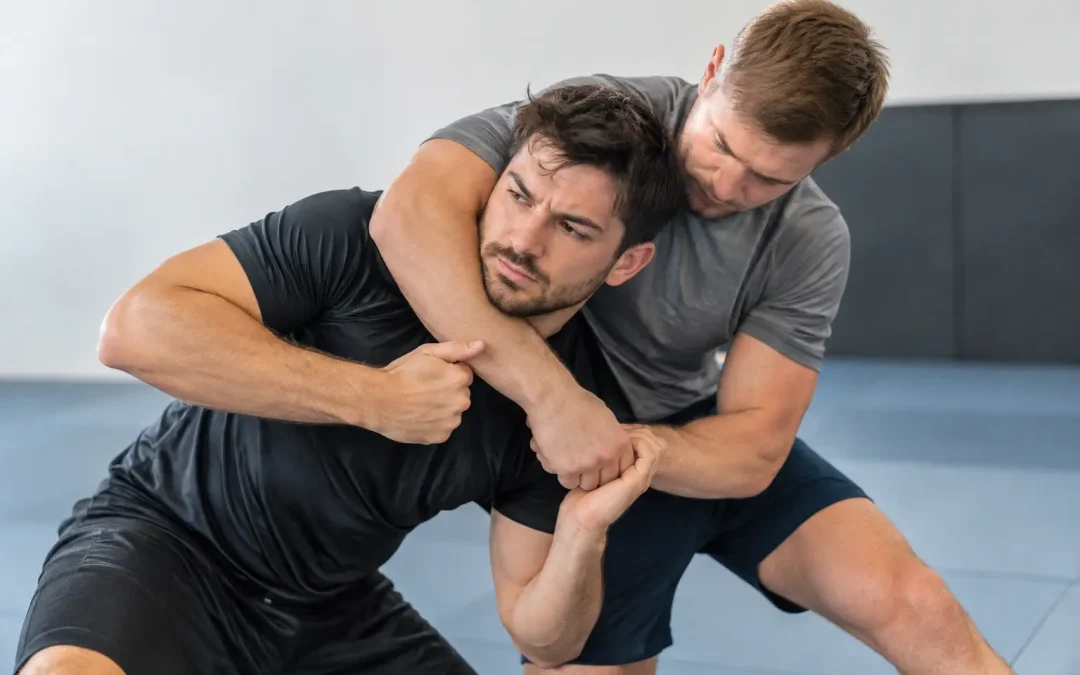
A headlock does not look complicated. That is exactly why it catches people off guard. One moment you are talking, walking, or trying to leave. The next, your posture is broken, your vision is blocked, and someone is pulling your head into their body. To break free from headlocks, you need a response that works while your heart rate is up – not a polished sequence you can only remember in a calm training hall.
The priority is not winning a fight. It is protecting your airway, staying on your feet if possible, creating enough space to move, and getting away. No fancy moves. No pauses. Just action that gives you a chance to escape.
Why Headlocks Create Real Danger
A headlock can become dangerous fast, even when it begins as a grab rather than a deliberate choke. Your attacker can control your posture, drag you into a wall or vehicle, force you to the ground, or use the hold to move you away from public view. If their forearm is pressing across your throat or neck, breathing and blood flow can become immediate concerns.
The situation changes based on the position. A side headlock, a rear choke, and a headlock on the ground are not the same problem. Trying to apply one memorized answer to all three is how people freeze or make the hold tighter.
This is why practical self-defense starts with principles. You must recognize what is happening, protect what matters most, and respond to the opening that is actually there.
Break Free From Headlocks With the Right Priorities
When someone controls your head, your first instinct may be to pull your head straight back. Resist that urge. Pulling away often tightens their grip, strains your neck, and puts you off balance.
Instead, think in a clear order: protect, base, disrupt, escape.
Protect your airway and neck first. Tuck your chin where possible. Use your hands to create space at the attacking arm, your own jawline, or the area that is compressing your neck. Do not waste both hands trying to pry at a stronger person’s grip if that leaves your throat exposed.
Next, fix your base. Bend your knees, lower your center of gravity, and widen your stance enough that you cannot be easily dragged or tipped over. A stable body can generate movement. A person standing tall and stiff is easier to control.
Then disrupt the attacker’s balance or attention. This may mean turning toward the weaker side of the hold, using your body position to reduce pressure, or delivering a simple, immediate counter only when necessary to create an exit. In a real assault, short and direct actions are more useful than complicated strikes that require room, timing, and perfect accuracy.
The moment space appears, leave. Do not stay to prove that your technique worked. Move toward people, light, security, an open business, or any place that makes continued violence harder for the attacker.
The Mistakes That Make a Headlock Worse
Most failed escapes are not caused by a lack of strength. They happen because people choose an answer that does not match the pressure of the moment.
One common mistake is fighting the hold with the neck alone. Twisting wildly, yanking backward, or trying to force your head out can increase the pressure and damage your neck. Your whole body needs to be involved.
Another mistake is standing upright. A high posture gives the attacker leverage. Dropping your weight and getting your feet under you makes it harder for them to steer, lift, or throw you.
People also make the mistake of searching for a perfect technique. Under stress, fine motor control drops. Your hands may shake. Your thinking narrows. You may not know exactly where the attacker’s arms are. That is why simple gross-motor actions matter: protect the neck, establish a base, turn, create space, and move.
Finally, do not assume a hold is harmless because it began as a joke, an argument, or a rough grab. If someone ignores your attempt to disengage, forces your head down, cuts off your breathing, or tries to move you to another location, treat the threat seriously.
Standing Side Headlocks: Position Before Power
In a standing side headlock, the attacker often traps your head under their arm and tries to pull you sideways or downward. Your body may be close enough that long strikes are unrealistic. The useful question is not, “What impressive move can I do?” It is, “Where is their balance, and where can I make room?”
Keep your feet active. Step to keep your balance rather than allowing your legs to cross or trail behind you. Bring your hips under your body. Use a hand to reduce pressure around the head and neck while the other hand helps control distance, monitor the attacker’s body, or protect against further assault.
Turning your body toward the attacker rather than hanging away from them can reduce the mechanical advantage of the hold. The exact direction depends on how their arm is positioned and where their weight is going. This is not something you should guess at in a crisis. It needs live practice with a qualified training partner who gradually increases resistance.
If a simple counter creates a moment of release, use it to get your head free and go. Staying attached to the attacker to apply a follow-up technique is usually the wrong choice in a public-space assault. There may be friends nearby, weapons you have not seen, or hard ground waiting if you lose your balance.
Rear Chokes Require Faster Decisions
A rear choke or head-and-arm restraint can feel instantly disorienting because you may not see the attacker. If pressure is across the throat or neck, time matters. Protect your airway immediately, lower your weight, and work to turn your body instead of allowing yourself to be pulled straight backward.
Avoid reaching blindly behind your head. It is slow, often ineffective, and can leave you more exposed. Focus on the arm causing pressure, your body position, and creating a path to turn and escape. If you are being dragged, use your feet and body weight to resist being moved while looking for an opportunity to break the attacker’s control.
A choke is not a situation for a prolonged technical exchange. Your goal is to interrupt the pressure and get out. Once free, create distance and call for help. If you lose consciousness, seek medical evaluation afterward. Neck compression can cause injuries that are not obvious in the first few minutes.
If You Are Taken to the Ground
The ground changes everything. Concrete, curbs, furniture, traffic, and additional attackers can turn a manageable struggle into a serious emergency. Your first job is to protect your head from impact and avoid being flattened under the attacker’s weight.
Do not rely on a single ground escape learned from a cooperative demonstration. If someone has you in a headlock on the ground, the available response depends on whether they are beside you, above you, behind you, or transitioning to another attack. You need positional awareness, a way to protect breathing, and the ability to get back to your feet as soon as space appears.
Getting up safely is a self-defense skill in its own right. Do not simply stand with your back turned. Keep your hands between you and the threat, use distance, and move out with your eyes on the attacker. The goal is escape, not a ground-fighting match.
Pressure Training Is What Makes the Difference
Watching an escape is not the same as being able to use it. A cooperative partner will hold still, leave obvious openings, and release when you move correctly. A real attacker may be heavier, moving, shouting, squeezing, pulling, or striking. Your response must survive that pressure.
Good training builds intensity progressively. You start by understanding the position and learning safe mechanics. Then you add movement, resistance, noise, fatigue, confined spaces, and decision-making. You learn when an escape is available, when you need to protect yourself first, and when running is the best answer.
At Urban Street Defense, that reality-based approach matters. Techniques should be simple enough to recall under stress, adaptable enough for different body types, and tested honestly with control and safety. Forms do not prepare you for someone trying to force your head down. Experience does.
Build the Habit Before You Need It
Prevention still comes first. Keep distance from escalating people. Do not let someone close enough to control your head if you can avoid it. Use your voice early, leave arguments before they become physical, and pay attention when someone tries to isolate you from friends, coworkers, or the public.
But personal safety also means being prepared for the moment prevention fails. Practice protecting your neck, maintaining your balance, and moving with purpose. Train responses that are direct, repeatable, and honest about chaos.
The best headlock escape is not the one that looks good in a video. It is the one that gives you breathing room, gets your feet moving, and gets you home.