
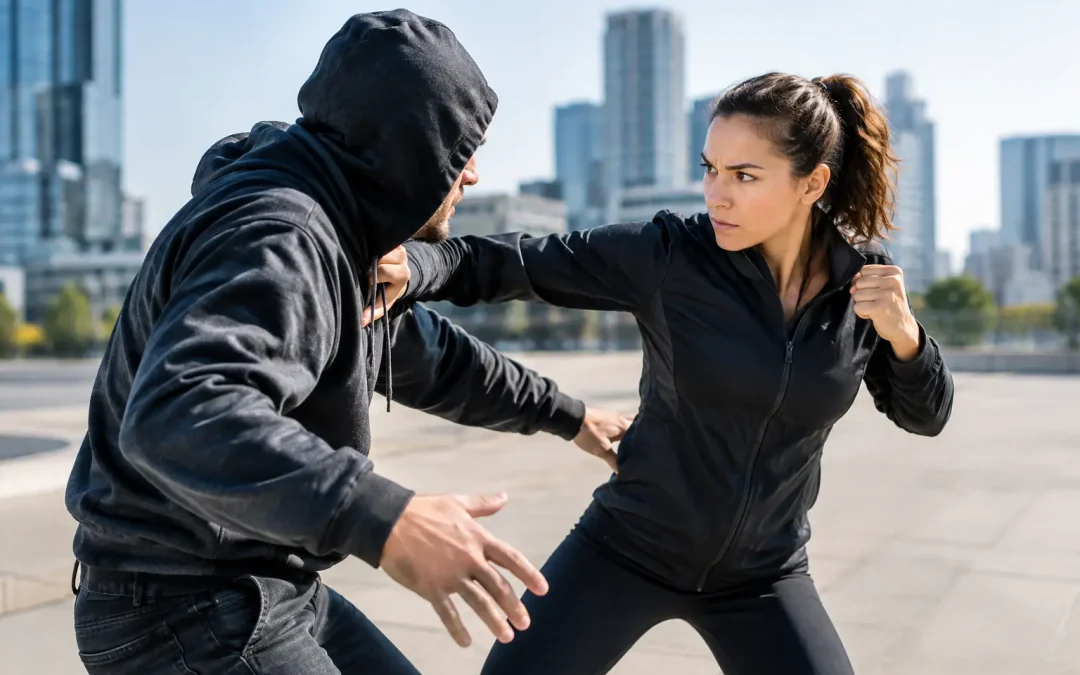
A crowded parking area. A stranger standing too close. An argument that changes tone before you have time to process it. Street defense is not about looking impressive or collecting techniques. It is about recognizing danger early, making clear decisions, and creating a chance to get away when a situation turns physical.
That requires more than memorizing a sequence in a calm room. Under stress, your heart rate rises, your vision narrows, and fine motor skills can disappear. The response you rely on must be simple enough to access when fear, surprise, and confusion are all working against you.
What Street Defense Is Really For
Realistic self-defense has one job: improve your odds of getting home safely. It is not a contest. It is not about proving who is tougher. It is not about winning an exchange or staying to teach someone a lesson.
The priority is awareness, avoidance, escape, and only then physical action if there is no safer option. A good street-defense class teaches this order clearly. Physical skills matter, but they sit inside a bigger safety mindset: notice what is happening, use your voice, manage distance, find an exit, and act decisively when you must.
That distinction matters because public violence is unpredictable. There may be uneven ground, poor lighting, other people nearby, a bag in one hand, or more than one threat. You cannot assume fair rules, a clean start, or time to prepare. Training has to acknowledge the messiness of real life.
Why Simple Responses Beat Fancy Moves
Complicated techniques often look convincing when both people know what is coming next. Reality does not pause for perfect positioning. An attacker may grab, shove, rush, or swing without warning. Your response needs to work from uncomfortable positions, at close range, and while your body is under pressure.
Simplicity does not mean weak or incomplete. It means choosing movements that are direct, natural, and repeatable. A solid stance, a strong verbal boundary, movement toward safety, basic strikes when necessary, and ways to break contact can be more useful than a long catalog of advanced maneuvers.
The test is not whether a technique looks good in demonstration. The test is whether a beginner can apply it with balance, urgency, and control after being startled or fatigued. If it takes ten steps to remember, it may be ten steps too many.
This is where Jeet Kune Do-inspired thinking remains useful. Keep what is functional. Remove what is not. Adapt to the person, the environment, and the moment. No rigid routine can predict every threat, but strong principles can help you respond when the situation is unclear.
Pressure Changes Everything
Training without resistance can create false confidence. A cooperative partner gives you the timing, distance, and reaction you expect. A real threat does not.
Pressure-oriented practice closes part of that gap. It might begin with verbal confrontation drills, boundary-setting exercises, and controlled scenarios involving grabs, pushes, or close-range aggression. As skill and confidence develop, training can add safe, supervised resistance and sparring. The goal is not to frighten students for entertainment. The goal is to make stress familiar enough that panic does not take over.
Good training teaches you to keep moving after the first response. One action may create an opening, but the next decision matters just as much: disengage, move toward people or light, call for help, and leave the area. Stopping to see whether your technique worked is a mistake you cannot afford.
Pressure also reveals habits. Do you freeze? Do you back straight into a wall? Do you drop your hands while talking? Do you hold your breath? These are not personal failures. They are training opportunities. A useful class gives you the space to identify them and build better responses through repetition.
The Street Defense Skills That Matter Before Contact
The best physical confrontation is the one you avoid. That is why practical training should not begin and end with striking. It should improve the choices you make before a situation reaches that point.
Start with position. Keep enough space to react when someone makes you uncomfortable. Avoid allowing an unknown person to trap you against a vehicle, doorway, elevator, or wall. When possible, place an object between you and the person, and keep an exit in mind.
Use your voice early and clearly. A firm command can draw attention, establish a boundary, and interrupt someone testing your compliance. You do not need a clever line. Short words are stronger under stress: “Stop.” “Back up.” “Don’t touch me.”
Pay attention to behavior rather than appearances. Someone may be intoxicated, angry, persistent, overly familiar, or ignoring your requests for distance. Your instincts are allowed to act on that information. You do not owe a stranger politeness at the expense of your safety.
For commuters, travelers, and professionals leaving work late, small routines matter. Stay alert when moving between buildings and vehicles. Limit distractions in isolated spaces. Know where you can go if you feel followed. These are not guarantees, and responsibility always belongs to the person causing harm. They are practical ways to give yourself more time and options.
What to Expect From a Realistic Class
A worthwhile class should feel focused, not theatrical. You should understand why you are practicing each movement, when it may be appropriate, and what its limitations are. The instructor should be able to explain the difference between training for sport and training for personal safety.
Look for instruction that includes realistic distance, movement, verbal boundaries, and controlled resistance. You should not be thrown into hard sparring on day one, especially as a beginner. But you also should not spend every session performing choreographed patterns against a passive partner.
Class size matters. In a smaller setting, an instructor can correct your posture, footwork, awareness, and decision-making. Private training can be especially useful for people with specific concerns, such as regular travel, workplace risk, or rebuilding confidence after a frightening experience.
Ask whether the class is designed for ordinary people. You do not need to be athletic, flexible, or experienced to start. Effective instruction builds from natural movement and develops capability progressively. The right environment challenges you without humiliating you.
Urban Street Defense trains this way: with direct, scenario-based instruction that puts function ahead of forms, rank, and performance. The aim is clear – help people build safer instincts they can use under pressure.
Train for Decisions, Not Just Techniques
A technique is only one part of a response. You also need to decide whether to speak, leave, resist, seek help, or protect someone with you. Those decisions are shaped by context, local laws, available exits, and the level of danger you face.
No instructor can promise that any move will work every time. Size, surprise, fitness, environment, and the aggressor’s actions all affect the outcome. That is why realistic street defense avoids guarantees. It gives you better tools, more practiced choices, and a stronger ability to act when hesitation could cost you.
For organizations, this approach has value beyond personal confidence. Corporate safety training can help teams discuss situational awareness, travel safety, workplace boundaries, and emergency responses in practical terms. The best sessions do not treat safety as a policy document. They give people usable actions they can remember after the training room is empty.
Build Capability Before You Need It
Waiting for a bad experience is the wrong time to start learning how you respond to stress. Training now does not mean living in fear. It means refusing to be unprepared.
Choose practice that is simple, direct, and honest about real-world uncertainty. Train your awareness. Practice your voice. Learn to move with purpose. Build physical responses that work without perfect timing or perfect conditions.
The goal is not to become someone looking for a fight. The goal is to become harder to control, quicker to act, and more ready to get yourself to safety. Better. Faster. Stronger.