
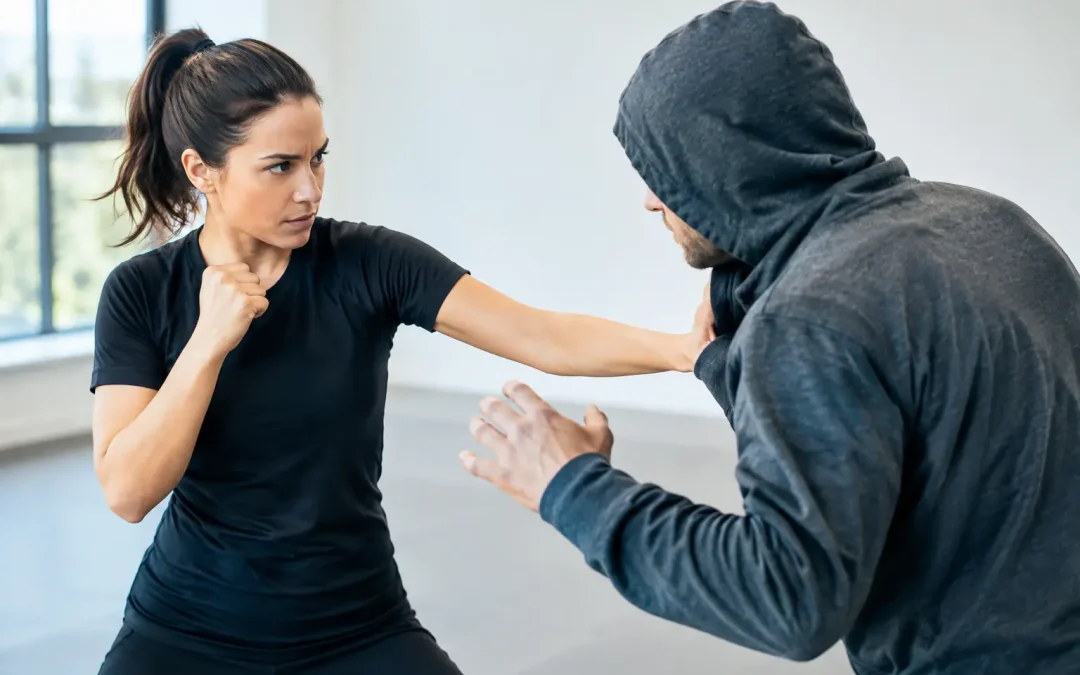
A person grabs your wrist in a parking lot. Someone corners you near an elevator. An argument suddenly turns physical. There is no referee, no clean floor, no time to remember a long sequence. The real question in self defense versus martial arts is not which looks more impressive. It is which training helps you recognize danger, act fast, create space, and get home safely.
Martial arts can build fitness, discipline, confidence, and valuable fighting ability. But not every martial art is designed around personal safety in an unpredictable public setting. Self-defense training starts with a different objective: survive the encounter, escape the danger, and avoid a second problem afterward.
Self Defense Versus Martial Arts: Different Jobs
Martial arts are broad. They include traditional systems, combat sports, cultural practices, and modern mixed methods. Some train for competition. Some preserve forms and traditions. Some focus on technical development over many years. All can have real value, but their goals vary.
Self-defense training has a narrower, more urgent job. It prepares you for unwanted contact, sudden violence, intimidation, attempted restraint, and close-range attacks when conditions are messy. You may be carrying a bag, wearing work clothes, tired after a long day, or caught in a crowded space. You may not see the threat coming.
That changes what should be practiced. A self-defense class should spend time on awareness, verbal boundaries, movement, escaping grabs, protecting the head, striking when necessary, dealing with panic, and leaving safely. It should not assume both people agreed to fight or that the other person will follow rules.
The difference is not that martial arts are useless and self-defense is magic. The difference is purpose. A boxing gym may make you sharper under pressure. Judo can teach balance, grips, and control. Brazilian jiu-jitsu can improve your ability to survive on the ground. Those are meaningful skills. Yet a class built for sport has rules, a defined environment, and often a one-on-one contest. Real violence may involve surprise, hard surfaces, weapons, multiple people, or an attacker who does not stop when you fall.
What Real-World Training Must Include
Practical training does not begin with a complicated technique. It begins with decision-making. Can you spot a problem early? Can you trust discomfort before it becomes danger? Can you use your voice clearly, move toward an exit, and refuse to be isolated?
These are not soft skills. They are the first layer of self-defense. The best fight is the one you avoid before contact happens. That may mean changing direction, stepping into a public area, calling for help, or setting a firm boundary before somebody gets close enough to grab you.
When avoidance fails, simplicity matters. Under stress, fine motor skills drop. Your heart rate rises. Your vision narrows. A technique that works only when both people stand still and cooperate is not enough. Training should favor natural, direct actions that can be repeated under pressure: protecting yourself, hitting vulnerable targets when justified, breaking contact, moving off line, and escaping.
Pressure testing matters too. You do not need to be thrown into a chaotic sparring session on day one. Beginners need a safe learning environment. But training must gradually add resistance, speed, noise, surprise, and realistic positioning. Without that progression, it is easy to confuse memorizing a move with being able to use it.
At Urban Street Defense, the focus is not ceremonial routines or collecting techniques. It is learning simple, adaptable responses and testing them responsibly against pressure. No fancy moves – just what works when your safety is on the line.
Why Forms and Perfect Techniques Can Mislead
Forms can develop posture, coordination, concentration, and an understanding of a system’s vocabulary. They are not automatically bad training. The problem begins when a student is told that performing a sequence neatly is the same as handling resistance.
An attacker does not pause so you can take the correct stance. They may shove, pull, swing wildly, cling to you, or drive you into a wall. You may have only a second to react. Training that relies on a long chain of precise movements can fail when the first movement does not land perfectly.
The same caution applies to highly technical disarms and complicated counters. A weapon changes the situation dramatically. Your priority is distance, escape, and survival, not proving you can perform a movie-style disarm. Sometimes compliance, running, or calling attention to the situation is the safer decision. There is no single response that fits every threat.
Reality-based self-defense teaches this judgment. Physical action is one tool, not the only tool. A good instructor should explain when to disengage, when to use force, and when the risk is too high to attempt a particular response.
Does Martial Arts Experience Help?
Yes, often. People with martial arts backgrounds may already have better balance, timing, coordination, body awareness, and comfort with contact than a complete beginner. A fighter who has trained hard against resisting opponents has a major advantage over someone who has never felt pressure.
But experience should not create complacency. Sport habits can become risky outside the gym. Going to the ground against one opponent may expose you to another. Trading punches may work in a ring but is a poor plan on concrete. Turning your back after a break may be normal in a rule-based exchange, while in public it can leave you vulnerable.
The strongest approach is not to argue that one discipline defeats another. It is to identify gaps honestly. If you train a martial art, add scenario training, verbal boundary work, escape tactics, and awareness. If you only train self-defense, build your fitness, striking mechanics, and ability to function under controlled resistance. Better. Faster. Stronger. That is the standard.
How to Choose Training That Serves You
Ask what the class is preparing you to do. If the answer is win medals, earn belts, preserve a tradition, or perform forms, that may be a good fit for your goals. If your goal is personal safety during commuting, travel, late work hours, or daily city life, look for training that addresses those situations directly.
Watch how students train. Are they practicing against a partner who provides realistic but safe resistance? Do instructors explain positioning, exits, awareness, and de-escalation? Are scenarios adapted for smaller people, beginners, work clothing, confined spaces, and the stress of surprise? Is there a clear culture of control and respect?
Also consider how quickly the training gives you usable habits. Personal safety should not require years before you learn how to protect your head, break a grip, create distance, or move toward safety. Long-term practice will deepen those abilities, but the fundamentals should be accessible now.
For workplaces and private groups, relevance is equally important. Corporate safety training should not be a passive lecture with a few staged demonstrations. Teams need practical boundaries, situational awareness, conflict response, and simple physical options tailored to the environments they actually use.
Train for the Moment You Hope Never Comes
No class can promise invincibility. Size, numbers, weapons, surprise, and environment all matter. The point of self-defense is not to guarantee control over every outcome. It is to improve your options before, during, and after danger.
Choose training that respects reality. Build awareness before contact. Practice direct actions under pressure. Learn to escape instead of trying to win. Then keep training until your response is not a theory you remember, but an action you can use when it counts.