
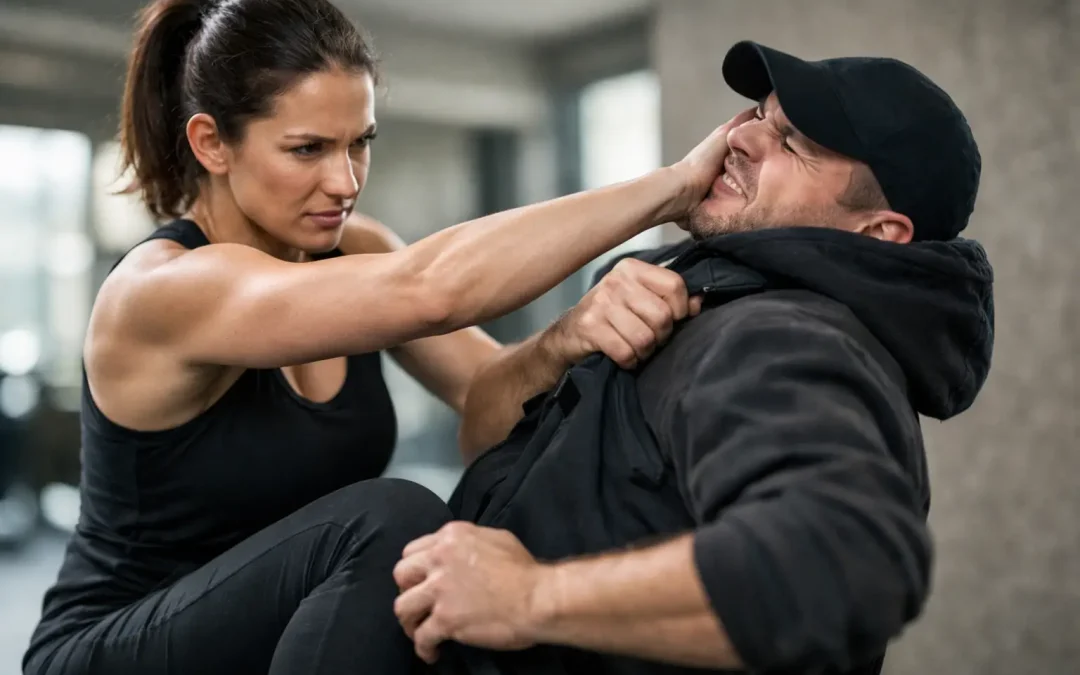
A bigger, stronger attacker has physical advantages. Pretending otherwise is dangerous. But can women overpower attackers? Sometimes, yes. More often, the goal is not to win a prolonged fight. It is to disrupt the attack, create a gap, break contact, and get to safety.
That is not a lesser goal. It is the real goal.
An attacker does not get to choose the conditions perfectly. Surprise, movement, noise, resistance, positioning, terrain, and decisive action all change what happens next. Practical self-defense teaches you to use those variables immediately, before an attacker can settle into control.
Can Women Overpower Attackers? The Honest Answer
Strength and body weight matter in a physical confrontation. A trained woman may be able to overpower an untrained attacker of similar size, or even a larger person in a short, chaotic exchange. But self-defense cannot be built on the assumption that you will outmuscle someone who may be heavier, stronger, intoxicated, armed, or determined to hurt you.
That is why effective training focuses on usable advantages rather than fantasy outcomes. You need skills that work when your heart rate spikes, your space is limited, and the situation is ugly.
The better question is: can a woman make an attacker lose control long enough to escape? Absolutely. A committed response can interrupt an attacker’s plan. It can damage their ability to see, breathe, move, balance, or continue holding on. It can attract attention. It can give you the seconds that matter.
Self-defense is not a contest scored on points. There is no prize for staying engaged. If you get away, call for help, and reach a safer place, you have done what you needed to do.
Why Size Is Not the Whole Story
Attackers rely on more than strength. They often rely on shock. They expect fear, hesitation, politeness, and compliance. A person who freezes or tries to negotiate after physical contact has begun may give an attacker time to establish a grip, force a direction, or isolate them from help.
That is why the first response matters so much. A loud verbal boundary before contact may stop someone testing limits. Strong movement away from a threat may prevent the fight entirely. If physical contact is unavoidable, explosive resistance can make the attacker reassess quickly.
This does not mean every person will react the same way, and it does not mean resistance is risk-free. Circumstances matter. If an attacker demands property and leaving is possible, property can be replaced. If they attempt to force you into a vehicle, a secluded area, or a second location, the danger can escalate sharply. That is the moment to resist, create chaos, and fight for distance.
Your environment matters too. A crowded train platform, parking structure, elevator, office corridor, or apartment entrance each creates different hazards and opportunities. Walls can trap you, but they can also prevent an attacker from circling behind you. A bag may be a barrier. A parked car may block movement. Nearby people may become witnesses once you make enough noise to break the silence.
What Practical Self-Defense Actually Trains
No fancy moves. No long combinations that require perfect timing. No choreography that falls apart once someone grabs, shoves, or panics.
Practical self-defense begins with awareness and decision-making. You learn to recognize suspicious behavior, manage distance, use your voice, and move toward exits or people. These skills are not glamorous, but they prevent many confrontations from becoming physical.
Then comes physical response. Good training uses simple actions based on natural movement: protecting your head, breaking a grip, striking vulnerable targets, maintaining balance, making space, and escaping. The techniques must be direct enough to remember under pressure and adaptable enough to work from poor positions.
A useful class also addresses common situations rather than teaching moves in isolation. What do you do when someone blocks your path? Grabs your wrist? Pins you against a wall? Pulls you from behind? Tries to force you into a car? The answer is never one magic technique. You need principles that let you respond when the situation is moving fast.
Pressure testing is where many programs fall short. A technique that works on a cooperative partner may fail when someone resists, crowds your space, shouts, or keeps moving. Training must gradually introduce realistic pressure so your body and mind learn to function when calm is no longer available.
The Priorities That Give You a Better Chance
Your first priority is prevention. Stay aware without living in fear. Notice who is around you, avoid unnecessary isolation, keep your phone accessible, and trust discomfort early. If someone makes you uneasy, create distance before you need to explain why.
Your second priority is position. Distance gives you time. Angles make you harder to grab. Keeping your hands between yourself and another person provides a protective barrier while still looking non-aggressive. Avoid letting a suspicious person close enough to control your body, bag, or movement.
Your third priority is decisive action. When a threat turns physical, half-committed movements are unlikely to create the space you need. Use your voice. Move with purpose. Strike only to stop the immediate threat and escape. Continue moving toward safety rather than waiting to see whether the attacker will recover.
Finally, understand that escape is not always a straight run. You may need to push through a doorway, move around obstacles, get into a business, return to a crowd, lock yourself in a room, or call out to a specific person for help. “Help” can be ignored. “You in the blue shirt, call emergency services” gives bystanders a clear job.
Confidence Is Built Through Repetition, Not Motivation
Many women are told to be confident, but confidence without practice can disappear the moment someone grabs you. Real confidence comes from knowing you have tested simple responses against resistance.
That does not require becoming a competitive fighter. It requires regular exposure to controlled discomfort. You should practice making noise, setting verbal boundaries, moving under pressure, escaping holds, and responding after a surprise. You should learn what it feels like when an adrenaline surge makes your hands shake and your memory narrow.
A supportive training environment matters. Beginners need room to make mistakes, ask direct questions, and build intensity safely. At the same time, training cannot stay soft forever. If every drill pauses after one perfect move, it teaches false confidence. The attacker will not pause for you.
Look for instruction that explains the purpose behind each action. Why are you moving this way? What happens if the first attempt fails? Where do you go next? When training answers those questions, students learn to adapt rather than memorize routines.
Avoid These Dangerous Self-Defense Myths
The biggest myth is that technique removes all risk. It does not. Even experienced fighters can be injured, surprised, or overwhelmed. Self-defense improves your odds. It does not offer a guarantee.
Another myth is that you need years of martial arts before you can protect yourself. A beginner can learn valuable skills quickly when training is focused: awareness, boundary setting, basic striking, grip escapes, movement, and escape decisions. Deeper ability takes time, but the first practical gains should not.
There is also the myth that self-defense means staying to prove you can win. It does not. If you can leave before contact, leave. If you can run after creating distance, run. If you can lock a door, call for help, and stay behind it, do that. Survival is practical, not performative.
Train for the Moment You Hope Never Comes
The question is not whether women are capable of fighting back. Women are capable of learning, responding, resisting, and escaping. The question is whether those actions have been practiced enough to appear when stress takes over.
At Urban Street Defense, the focus is simple: train responses that are direct, adaptable, and built for pressure. Your size may affect your options, but it does not erase them. Learn to recognize danger early, act without hesitation when necessary, and make your safety the only outcome that matters.