
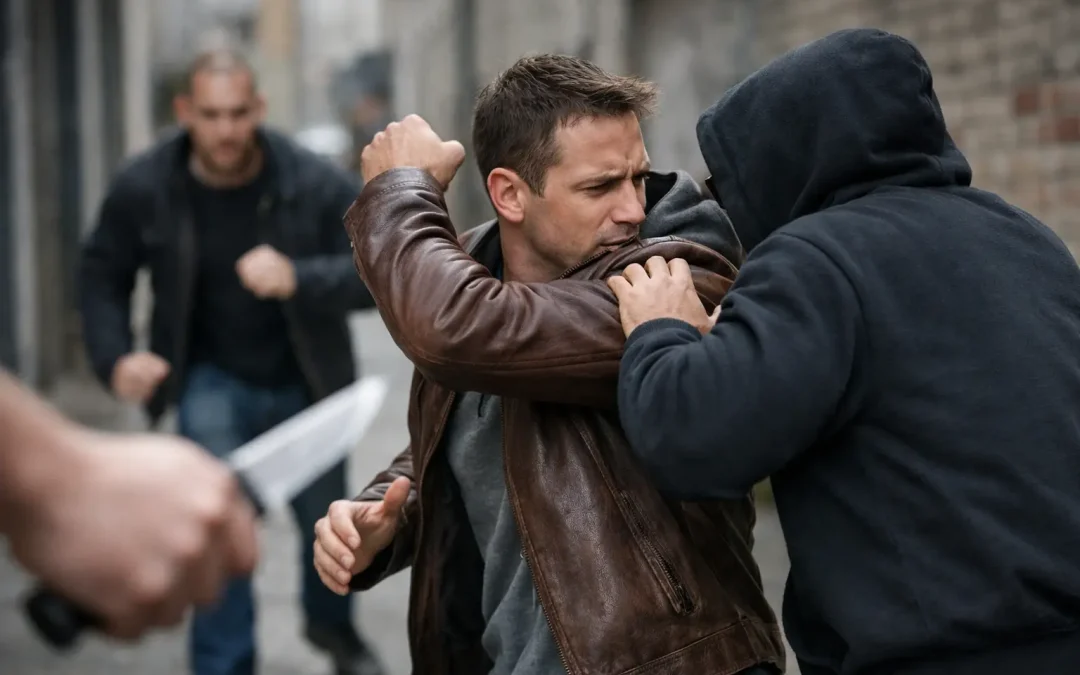
A real threat does not announce itself with a bell, a referee, or time to choose a perfect move. It may begin with someone standing too close, blocking your path, grabbing an arm, following you from a parking area, or refusing to respect a clear no. This beginner street defense guide starts where reality starts: your first job is to notice danger early, create space, and get away.
Self-defense is not about looking tough or collecting techniques. It is about making fast, useful decisions while your heart rate rises and your thinking narrows. The goal is simple: protect yourself, break contact, and reach safety.
A Beginner Street Defense Guide Starts Before Contact
Most people picture self-defense as a physical fight. That is the last part of the problem, not the first. Good personal safety habits reduce the chance that you will need physical skills at all.
Pay attention to changes around you. A person matching your pace, a vehicle slowing beside you, an argument becoming louder, or someone repeatedly closing distance are signals worth taking seriously. Do not wait for absolute proof that something is wrong. If your instincts say the situation feels off, act early.
That may mean crossing the street, entering an open business, moving toward a group, calling someone, or changing your route. None of these choices are weak. They are practical. The safest confrontation is the one you avoid.
Your phone can help, but do not let it steal your awareness. Walking while absorbed in a screen, using both earbuds, or searching for keys at your car door creates an easy opportunity for someone looking to exploit distraction. Have your keys ready before you reach your vehicle. Look around before you unlock it. If something feels wrong, keep moving rather than forcing yourself into a bad position.
Use Your Voice and Your Space
Personal boundaries are not polite suggestions. They are safety tools.
When someone gets too close, move first if you can. Put an object, a table, a car, a bench, or another person between you and the problem. Keep your hands visible in front of your body in a natural position. This can look non-aggressive while giving you a better chance to protect your head and create distance if contact happens.
Use short, direct commands. “Stop.” “Back up.” “Don’t touch me.” “I said no.” You do not owe a stranger a long explanation, a smile, or a debate. A clear voice can draw attention, establish a boundary, and help you commit to action.
Volume depends on the situation. If you are in public and need help, be loud and specific: “Call security!” “Call the police!” “This person is following me!” Specific words cut through bystander hesitation better than a vague scream. If you believe escalating noise could make a situation worse, prioritize movement toward an exit, people, or a secure area.
Do Not Train for a Fair Fight
Street violence is not a match. The other person may be bigger, armed, intoxicated, with friends, or willing to ignore rules. Ground conditions may be slippery. Space may be tight. Your bag, work clothes, fatigue, or panic may affect what you can do.
That is why beginners should be cautious about training that depends on complicated sequences, fixed stances, or an opponent who attacks exactly as instructed. A technique that works only when both people pause and cooperate is not a reliable answer to an unexpected assault.
Start with principles that hold up under stress: protect your head, maintain balance, control distance, use simple natural movement, and leave when an opening appears. You are not trying to win points or prove courage. You are trying to interrupt danger long enough to escape.
This also means accepting that there is no guaranteed move. Size, strength, surprise, environment, and the attacker’s behavior all matter. Training does not make anyone invincible. It improves your options, your reactions, and your ability to act instead of freezing.
Build Skills That Work Under Pressure
A beginner needs more than a collection of moves. You need repetition in situations that feel uncomfortable enough to reveal what you actually do under stress.
Start slowly to understand position, timing, and safety. Then add realistic resistance in a controlled environment. A training partner who gives no resistance teaches you choreography. A partner who moves, pushes back, crowds your space, and creates uncertainty teaches you how difficult real contact can feel.
Pressure training should be structured, supervised, and scaled to your level. It is not about being hurt or humiliated. It is about learning to keep breathing, protect yourself, make decisions, and continue moving when a plan does not work perfectly.
Look for training that includes common urban problems, such as unwanted grabbing, close-range pressure, being pinned against an obstacle, verbal intimidation, and dealing with limited space. It should also teach the moment after contact: how to disengage, where to move, when to seek help, and why chasing or continuing a conflict is usually a bad decision.
At Urban Street Defense, the focus is not ceremonial forms or flashy routines. Students train practical responses based on simplicity, directness, adaptability, and effectiveness under pressure. That matters for beginners because complicated answers disappear quickly when adrenaline takes over.
Practice the Mental Response
Fear can cause tunnel vision, shaky hands, confusion, and a freeze response. These are normal survival reactions, not personal failures. The answer is not to pretend you will never be afraid. The answer is to give yourself a simple plan you can recall under pressure.
Think in a short sequence: notice, move, use your voice, protect yourself, escape, get help. Rehearse it mentally when you enter a parking garage, wait for a ride, travel alone, or walk to your car after work. You are not feeding paranoia. You are building readiness.
Know where your exits are. Choose well-lit routes when possible. Tell someone when you are meeting an unfamiliar person. Meet in public places. If a date, colleague, client, or stranger ignores a boundary, treat that behavior as useful information. You do not need to stay to avoid seeming rude.
After a serious incident, get to a safe location and contact emergency services or local authorities as appropriate. Seek medical attention even if injuries seem minor, especially after a fall, impact, or choking-related assault. Adrenaline can hide pain. If you can do so safely, record key details while they are fresh, including the location, description, direction of travel, and any witnesses.
Choose Training That Respects Your Time
You do not need years of martial arts experience before you can improve your personal safety. Beginners can make meaningful progress by learning a small number of reliable responses and practicing them consistently.
The right class should make you work, think, and ask questions. It should explain why a response is used, where it may fail, and how to adapt when the situation changes. It should not sell fantasy, promise guaranteed outcomes, or pressure you to perform beyond a safe level.
A useful first step is committing to regular practice, even if your schedule is busy. One focused class is better than endlessly watching technique videos without ever testing movement, distance, timing, or stress. Private instruction can help if you have a specific concern, while group training adds the unpredictability of working with different people and body types.
For people in Kuala Lumpur, Petaling Jaya, or Ipoh, practical scenario-based instruction can turn general concern into usable habits. The aim is not to make daily life feel dangerous. It is to help you move through it with more awareness, stronger boundaries, and a plan when things go wrong.
Start small, train honestly, and keep your goal clear: no fancy moves, no ego, just the best chance to get home safely.