
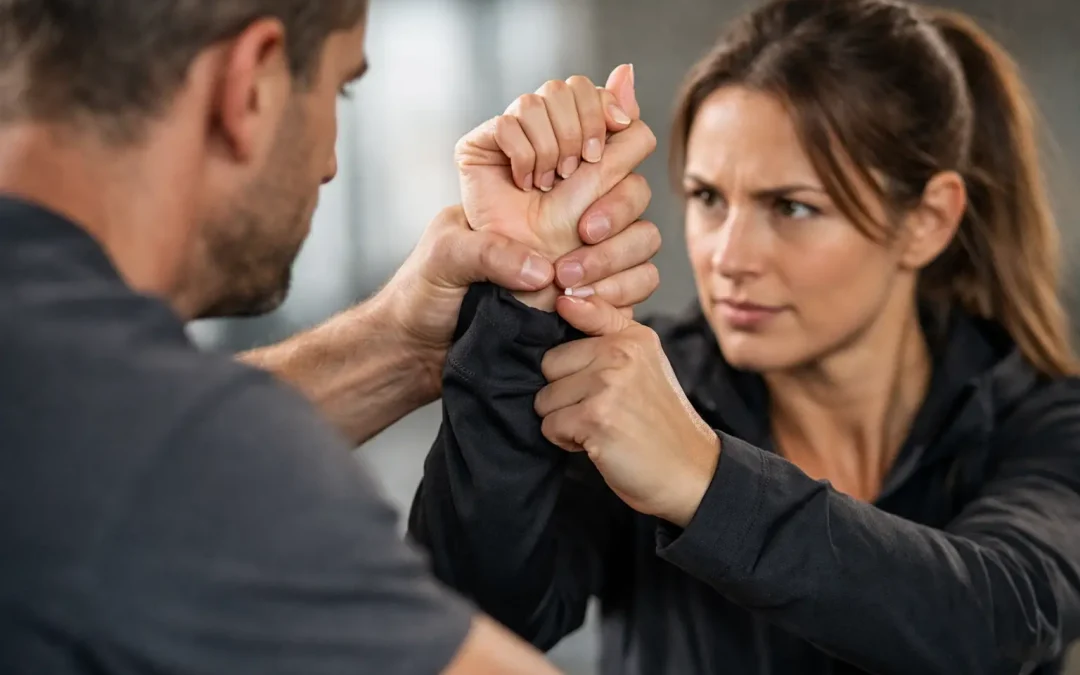
Wrist Grab Self Defense: Don’t Fight the Grip, Deal With the Threat
A wrist grab can happen before your brain has caught up. Someone catches your arm in a crowd, blocks you from leaving, pulls you toward a vehicle, or tries to control where you go.
The goal is not to win a grip-fighting contest.
In a chaotic situation, you may not have the time or mental capacity to identify a specific wrist grab, remember a particular technique, and perform a sequence perfectly. Your balance may be compromised, the attacker may be moving, and adrenaline can affect your coordination and decision-making.
That changes how you should train.
Instead of memorising different wrist grab escape techniques for different grips, focus on a simple principle: deal with the person, not the grip.
The First Rule: Do Not Let the Grab Become Control
A wrist grab can quickly become more than a wrist grab. The person may be trying to stop you from leaving, pull you closer, isolate you, or set up another attack.
The mistake is becoming too focused on getting your wrist free.
If someone grabs you, your attention should not be trapped on their hand. Stay on your feet, stay aware of your surroundings, and recognise the threat.
If necessary, use your voice. A clear command such as “Let go!” or “Back off!” can attract attention and make your intentions clear.
But remember: your objective is not to win the argument or the grip.
Your objective is to stop being controlled and get away.
Don’t Fight the Grip
Most people instinctively pull their wrist away when someone grabs them.
That can quickly turn into a tug-of-war.
Instead of trying to overpower the person’s grip or spending valuable time peeling fingers away, look at the bigger problem: the person who is controlling you.
If the situation requires a physical response, simple and direct actions toward vulnerable areas may create the opportunity you need to break contact.
You are not trying to perform a complicated combination.
You are not trying to prove that you can break someone’s grip.
You are trying to create an opening.
Once that opening appears, move.
Your Free Hand Is Still Available
One of the biggest problems with traditional wrist-grab training is becoming overly focused on the captured hand.
Your other hand, your movement, your surroundings and your ability to create distance are still available.
Use what the situation gives you.
Protect yourself.
Create space.
Use your voice.
Look for an exit.
If a vulnerable target is immediately available and the situation requires physical action, respond without becoming trapped in a complicated sequence of movements.
Under stress, simple actions are easier to remember than a long list of techniques.
Move After You Get the Opportunity
Creating an opening is not the same as winning a fight.
Once you have an opportunity to disengage, take it.
Move toward people, security, staff, a well-lit area, an open business or somewhere you can get help. Use your surroundings to create distance or a barrier when possible.
A car, table, counter, gate or other obstacle can give you valuable space.
The best wrist grab self defense response is not the one that looks impressive.
It is the one that gets you out of the situation.
Common Mistakes That Keep People Stuck
One common mistake is trying to memorise a different technique for every type of wrist grab.
Same-side grab.
Cross grab.
Two-hand grab.
Pulling grab.
Different positions.
Different angles.
Real violence does not follow categories.
The attacker may grab differently from how you trained. They may pull, push, strike, change direction or use their other hand.
If your response depends on recognising the exact grip before deciding what to do, you may already be behind.
Another mistake is focusing on the hand instead of the threat.
Your wrist is being grabbed, but the person grabbing it is the actual problem.
Don’t allow the grip to become your entire focus.
And don’t assume that getting your wrist free automatically means you are safe. You may still be within striking distance or the attacker may simply grab you again.
Create the opportunity. Break contact. Get away.
Train for the Mess, Not the Demonstration
Effective reality-based self-defense training should prepare you for situations that don’t look like a clean demonstration.
A partner should not always give you the perfect grip and wait patiently for your response.
Real situations can happen while walking, beside a vehicle, near a wall, in a confined space, while carrying something, or when your attention is somewhere else.
Training should gradually introduce movement, resistance, pressure and unpredictability.
But this does not mean adding more and more techniques.
It means testing whether you can still apply simple principles when things become messy.
This is why reality-based self-defense is different from memorising a routine.
The question is not:
“Can you perform the technique correctly?”
The question is:
“Can you respond when the situation does not follow the script?”
At Urban Street Defense, we believe students should train for that reality — no fancy moves, no frozen attackers and no assumption that violence will happen exactly the way it was demonstrated.
When Escaping Is Not Immediately Possible
Sometimes you may not be able to disengage immediately.
You may be pulled toward a vehicle, trapped against a wall, inside a confined space, or facing someone who is actively trying to hurt you.
If you cannot simply walk away, don’t become obsessed with finding the “correct” wrist release.
Protect your balance.
Stay aware.
Use your voice.
Look for an opening.
If there is an immediate physical threat, your response may need to become more forceful to create that opening. Targeting vulnerable areas can be part of that response when necessary.
The purpose is not to continue fighting.
The purpose is to stop the immediate threat long enough to escape.
There is no single step-by-step technique that can guarantee success against every person, every grip or every situation.
That is why we train principles rather than choreography.
Your Best Wrist Grab Escape Is Getting Away
A wrist grab does not need to become a complicated technical problem.
You do not need to memorise a separate technique for every possible grip.
You need to recognise when someone is attempting to control you, respond decisively when necessary, create an opportunity and move toward safety.
Don’t fight the grip. Deal with the threat.
At Urban Street Defense, our approach to wrist grab self defense is simple: no unnecessary techniques, no complicated sequences and no dependence on a cooperative attacker.
Train for the chaos.
Train for the unexpected.
And most importantly, train to get out safely.