
A traveler stepping out of an airport with a phone in one hand, luggage in the other, and no clear sense of the area is not looking for trouble. But they are easier to spot. Criminals often look for distraction, isolation, hesitation, and an easy exit. Your goal is not to look tough. Your goal is to avoid becoming the easy option.
Self defense for travelers is not about collecting clever moves before a trip. It is about making fast, practical decisions when your normal routine disappears. New streets, unfamiliar transport, language barriers, jet lag, and a drink with strangers can all reduce your awareness. Good preparation gives you more time, more options, and a better chance to get home safely.
Self Defense for Travelers Starts Before You Leave
The strongest travel safety decision is usually made before you arrive. Know how you will get from the airport to your accommodation. Save the address offline. Identify the official taxi line, ride service pickup area, or public transit route before your flight lands. Standing outside a terminal while comparing transport options on your phone is a moment of exposure, especially late at night.
Share your itinerary with someone you trust, but do not broadcast your live location or room details publicly. Social posts can wait. So can uploading a photo that shows exactly where you are staying.
Carry only what you need for the day. Keep a backup payment card and copies of key documents separate from your main wallet. If a bag is taken, you should not lose your passport, money, bank access, and communication all at once. A low-profile crossbody bag worn in front of your body is often more practical than an open tote or loose backpack in crowded areas.
Do not rely on an item because it sounds like self-defense. Local laws vary widely. Pepper spray, knives, batons, and even certain alarms may be restricted, confiscated, or create legal problems at borders. A tool you cannot legally carry, access quickly, or use under stress is not a safety plan.
Look Harder to Target
Most safety decisions are small and unglamorous. They still matter. Walk with purpose, keep your head up, and avoid moving through unfamiliar areas while absorbed in maps or messages. If you need directions, step into a hotel lobby, store, cafe, or other staffed place before checking your phone.
Trust behavior, not appearances. Someone may be well dressed, friendly, or persistent without being safe. Pay attention when a person ignores your boundary, tries to isolate you, pushes you to drink more, asks where you are staying, or keeps closing distance after you have moved away. You do not need proof that someone is dangerous before you create space.
Use your voice early. A clear, firm “No.” “Stop.” or “Back up.” can draw attention, set a boundary, and interrupt the other person’s momentum. Do not soften a safety boundary because you are worried about seeming rude. Politeness is not more valuable than distance.
At night, choose routes with light, people, and open businesses over shortcuts. If your instincts say a street, elevator, stairwell, or parking area feels wrong, change direction immediately. You do not owe anyone an explanation. A few extra minutes is a cheap price for avoiding a bad setup.
Know What to Do When Something Feels Wrong
There is a gap between feeling uneasy and being physically attacked. This is where many people freeze because they are unsure whether they are “overreacting.” Stop waiting for certainty. Move toward safety while you still can.
If someone is following you, do not go to your hotel room, rental, or vehicle. Cross the street, enter a busy business, approach security, or call emergency services. If you are in a rideshare and the situation feels unsafe, ask to stop at a public, well-lit location. If the driver will not stop, call emergency services and make noise. Your priority is getting around people who can see and help.
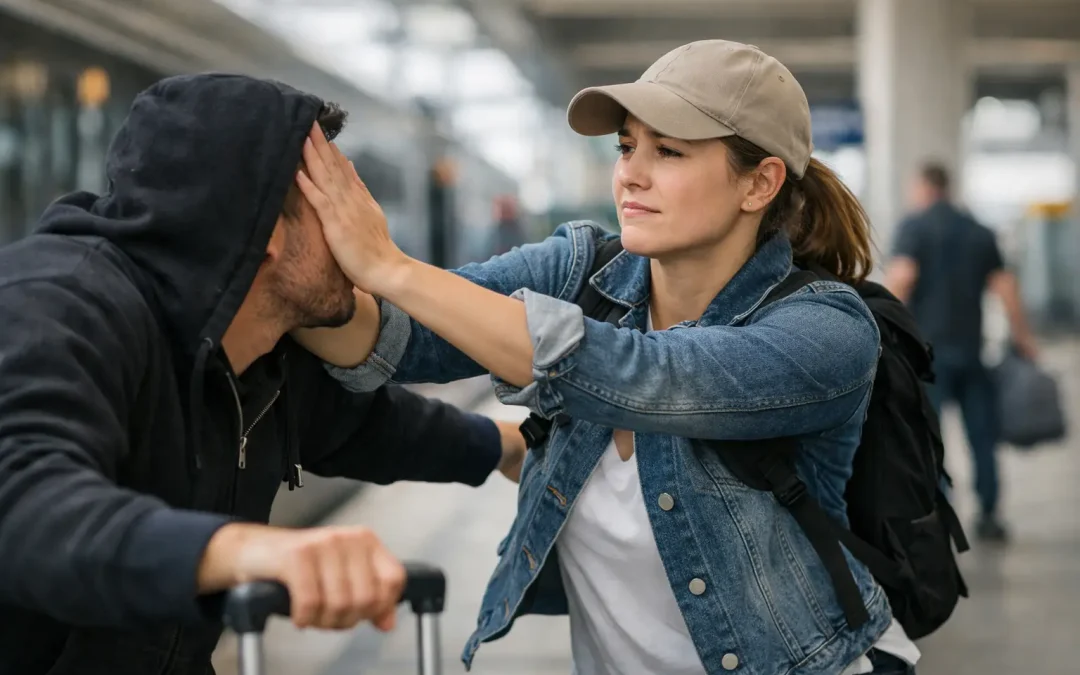
If a person blocks your path or crowds you, put your hands up naturally at chest height, palms outward, as if you are signaling them to stop. This creates a protective barrier without looking like a fighting stance. It also puts your hands in position to move, frame, push away, or protect your head if the situation turns physical.
Create distance whenever possible. Distance gives you time to run, call for help, and see what is happening. Do not let an aggressor pull you into a quiet corner, car, hallway, or private conversation. Their advantage grows when witnesses and escape routes disappear.
If Physical Contact Happens, Keep It Simple
Real violence is fast, ugly, and disorienting. Fine-motor techniques and memorized sequences often disappear when adrenaline hits. That is why practical self-defense favors simple actions that work from natural body positions.
Your first objective is not to win a fight. It is to break contact and escape. Protect your head, stay on your feet if you can, and use direct movement to create an opening. A forceful shove to make space, a strike to a vulnerable target when necessary, or breaking a grip may be enough to let you run toward people and light.
Do not stay to prove a point. Do not chase a thief. Do not argue over property if the person has a weapon or the threat is escalating. Phones, jewelry, and bags can be replaced. You cannot predict whether an attacker has friends nearby, a weapon, or a willingness to keep going.
There are exceptions. If someone is attempting to force you into a vehicle, room, or isolated location, the danger can rise sharply. Resist, make noise, and use immediate, decisive action to prevent being moved. The details depend on the situation, your physical ability, and the space around you, but the principle is clear: do not willingly go to a second location.
Train for Pressure, Not Performance
Watching a short video can introduce an idea. It cannot teach your body to respond when your heart rate spikes and another person is resisting. Under pressure, people fall back on what they have practiced, not what they vaguely remember.
Useful training includes verbal boundary setting, managing distance, escaping common grabs, protecting yourself from strikes, getting up safely, and making decisions in realistic scenarios. It should also include controlled resistance. If every partner freezes in place and lets a technique work, you are rehearsing cooperation, not self-defense.
That does not mean training should be reckless. Good instruction builds pressure gradually and safely. Beginners need simple movements, clear coaching, and repeatable principles before adding speed and resistance. The best system is not the one with the longest list of techniques. It is the one you can remember, apply, and adapt when things go wrong.
Urban Street Defense trains this way: no ceremonial routines, no pauses for a perfect pose, and no false confidence built on compliant partners. The focus is direct action under pressure, because travel does not give you a controlled environment.
A Travel Safety Plan You Will Actually Use
Before each day out, take one minute to decide how you will return, where your safe stops are, and what you will do if your phone battery dies. Keep enough charge for navigation and an emergency call. If you are drinking, set a limit before you start and keep control of your own drink. Impairment makes every other safety habit harder to use.
When traveling with friends, do not assume the group automatically keeps everyone safe. Agree on check-ins, leave together when possible, and take concerns seriously the first time someone voices them. A friend who wants to go home does not need to defend that choice.
Confidence is useful, but awareness is better. You do not need to travel in fear or treat every stranger as a threat. You need to stay present, set boundaries without apology, and act early when a situation begins to shift. Build those habits before your next trip. Then you carry something more reliable than a gadget: the ability to recognize danger, create space, and move with purpose.