
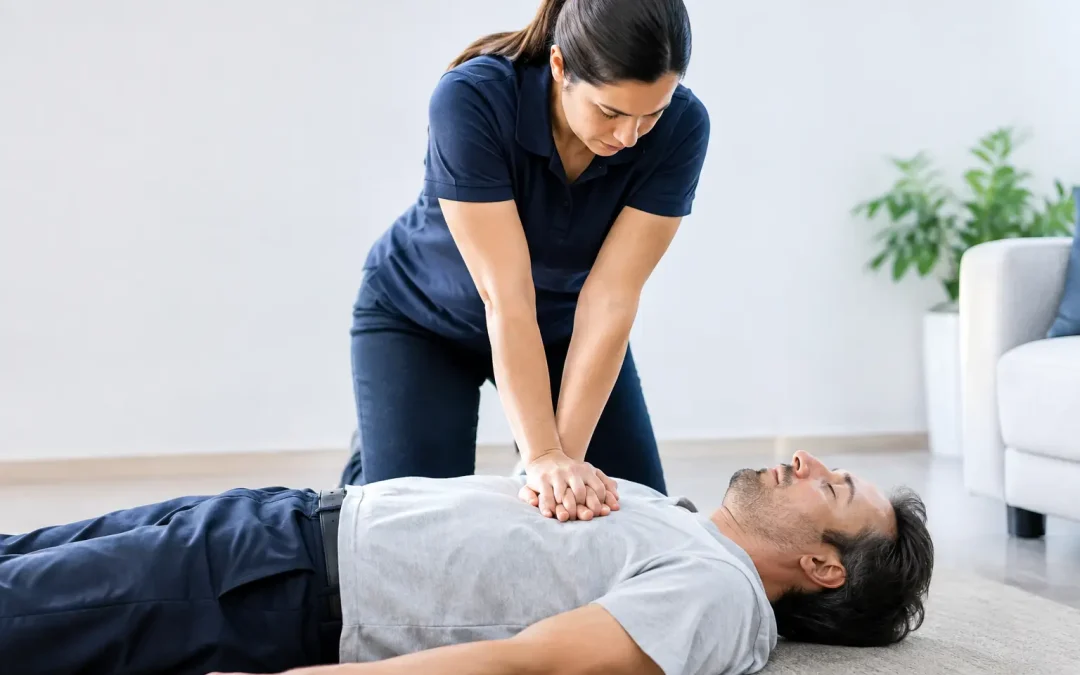
A person collapses at the office, in a gym, on a train platform, or at home. They are unresponsive. Their breathing is absent or irregular. This is not the moment for panic, debate, or fancy moves. CPR gives you a simple, direct action when a heart may have stopped.
No one expects to face a medical emergency. But personal safety is not only about preventing violence or escaping danger. It is also about being capable when someone needs immediate help. The first few minutes after cardiac arrest matter. Fast recognition, hard chest compressions, and early defibrillation can make the difference.
CPR Starts With Recognition
Cardiac arrest is not the same as a heart attack. A heart attack is usually caused by a blockage that reduces blood flow to part of the heart. A person may be awake, talking, and experiencing chest pain. Cardiac arrest means the heart has stopped pumping blood effectively. The person can collapse without warning and become unresponsive within seconds.
Do not wait for certainty. Check whether the person responds by speaking loudly and tapping their shoulder. Look for normal breathing for no more than 10 seconds. Occasional gasps, snorting sounds, or irregular breaths are not normal breathing. They can be a sign of cardiac arrest.
If the person is unresponsive and not breathing normally, call emergency services immediately. If you are in Malaysia, call 999. Put your phone on speaker if possible so the dispatcher can guide you while your hands stay free. If other people are nearby, point to one person and give a clear command: call for help. Point to another: find an AED.
Direct action prevents confusion. A crowd is not a response team until somebody takes charge.
How to Give CPR to an Adult
For an unresponsive adult who is not breathing normally, begin hands-only CPR unless you are trained and willing to provide rescue breaths. Hands-only CPR is better than doing nothing, and it is the right starting point for many adult sudden collapses.
Place the heel of one hand in the center of the chest, on the lower half of the breastbone. Put your other hand on top and interlock your fingers. Keep your arms straight, position your shoulders directly over your hands, and press straight down.
Your goal is simple: push hard and push fast.
Compress the chest at a rate of 100 to 120 compressions per minute. That is faster than many people expect. Press at least 2 inches deep on an adult chest, then allow the chest to fully rise after every compression. Do not lean on the chest between pushes. Full recoil helps the heart refill with blood.
Keep interruptions as short as possible. Do not stop to check whether the person is improving unless they begin to move, open their eyes, speak, or breathe normally. Continue until emergency responders take over, an AED tells you to pause, or you are physically unable to continue.
CPR is physically demanding. If another capable person is there, switch compressors about every two minutes. Make the change quickly. Fatigue makes compressions shallow, and shallow compressions are less effective.
What About Rescue Breaths?
If you are trained in CPR and prepared to give rescue breaths, use a ratio of 30 chest compressions followed by two breaths. Tilt the head back, lift the chin, pinch the nose, and give each breath over about one second. Watch for the chest to rise.
If the chest does not rise, reposition the head and try again. Do not spend a long time struggling with breaths. Chest compressions remain the priority.
For a child, infant, drowning victim, overdose victim, or a person who collapsed because of a breathing emergency, rescue breaths can be especially important. The technique and compression depth differ for children and infants, which is why practical, instructor-led training matters. Do not assume adult CPR is identical for every casualty.
Use an AED the Moment It Arrives
An AED, or automated external defibrillator, is designed for ordinary people to use. It does not require you to diagnose the heart rhythm. The device gives voice instructions and analyzes the person before it advises a shock.
Turn it on as soon as it arrives. Expose the chest, dry it if it is wet, and attach the pads exactly as shown in the diagrams. One pad usually goes on the upper right chest and the other on the lower left side of the chest.
When the AED says it is analyzing, make sure nobody is touching the person. If it advises a shock, loudly tell everyone to stand clear and visually check that no one is in contact. Deliver the shock if prompted, then restart chest compressions immediately.
Do not delay AED use because you are afraid of getting it wrong. The machine will not advise a shock unless it detects a rhythm that may benefit from one. It is a decisive tool, not a medical mystery.
The Mistakes That Waste Critical Time
The biggest mistake is doing nothing because you are unsure. Fear of causing harm stops many bystanders from acting. In a suspected cardiac arrest, the person is already in immediate danger. Starting CPR is the better choice.
Other common mistakes include pressing too gently, pausing too often, checking repeatedly for a pulse, or waiting for a trained professional before beginning. Unless you are specifically trained to assess a pulse, do not lose time searching for one. Check responsiveness and normal breathing, call for help, and start compressions.
Do not move the person unless the area is unsafe. Traffic, fire, electrical hazards, violence, or a collapsing structure change the priority. Your safety comes first. A rescuer who becomes another casualty cannot help anyone.
If an area is safe, stay focused. Ignore spectators, avoid arguments, and follow the dispatcher or AED instructions. Effective emergency response is built on simple actions done without hesitation.
CPR Is a Skill, Not Just Information
Reading the steps is useful. It is not the same as practicing them. Under stress, fine details disappear. People forget hand placement, lose the right pace, or hesitate before touching a stranger. Practical training closes that gap.
A good course lets you use a manikin, feel the required compression depth, practice AED pad placement, and work through realistic scenarios. You learn how hard compressions actually feel, how quickly fatigue arrives, and how to communicate clearly with others around you.
This is where the same principle used in effective self-defense applies: simple actions must be trained until they are available under pressure. You do not need medical jargon. You need a usable response.
For workplaces, CPR and AED readiness should not sit in a policy document waiting for an annual audit. Teams should know where the AED is, who calls emergency services, how to direct responders into the building, and how to take over compressions when a colleague gets tired. A few minutes of confusion can cost a life.
Urban Street Defense teaches people to respond to real pressure, not perform for show. That mindset belongs in emergency first aid as well. Be alert. Make the call. Start the action.
When CPR Ends
Continue CPR until professional help takes over, the person starts breathing normally and shows clear signs of life, the scene becomes unsafe, or you are too exhausted to continue. If the person begins breathing normally but remains unconscious, place them on their side in the recovery position if it is safe to do so, and keep monitoring their breathing.
Afterward, expect an emotional response. Adrenaline can leave you shaking, numb, upset, or unable to replay events clearly. That does not mean you failed. You stepped forward in a moment when action mattered. Speak with emergency responders, trusted people, or a professional if you need support.
The goal is not perfection. It is to recognize a crisis early and give someone a real chance before help arrives. Learn the skill hands-on, know where the nearest AED is, and be the person who acts when every second counts.