
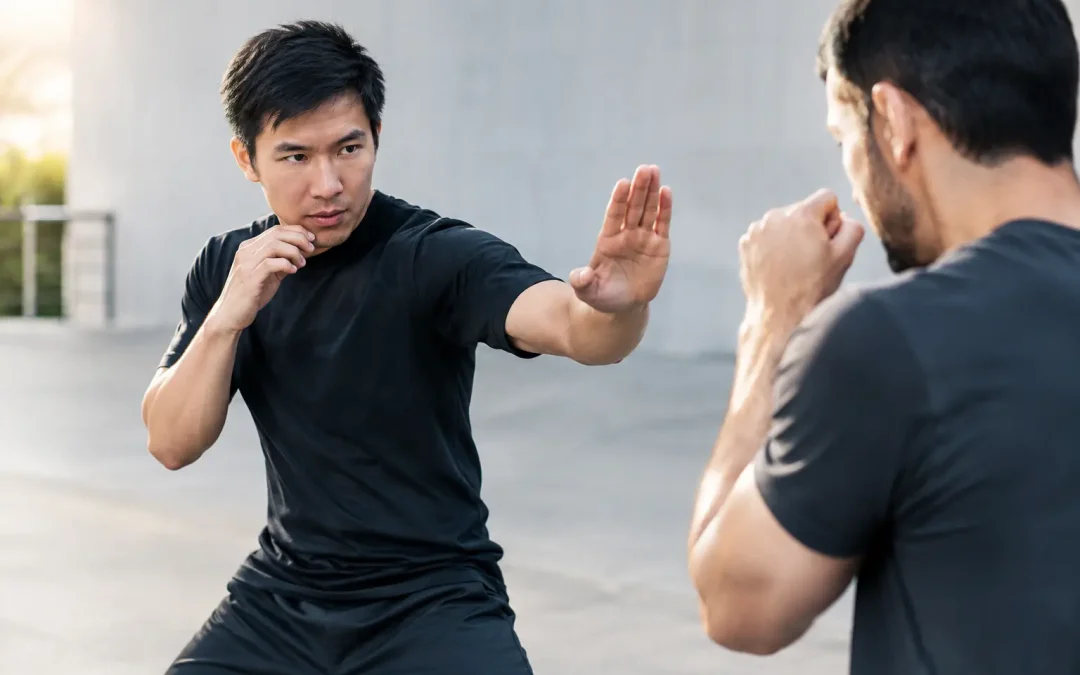
A threat does not wait for you to warm up, remember a sequence, or ask whether you have earned the right belt. Jeet Kune Do for beginners starts with a more useful question: can you recognize danger, create space, act decisively, and get away when your heart is racing?
That is the point of practical self-defense. You are not training to look impressive. You are training to become harder to surprise, harder to control, and more capable of leaving a dangerous situation safely. No fancy moves. No choreography. Just actions you can use under pressure.
What Jeet Kune Do for Beginners Actually Means
Jeet Kune Do, or JKD, is closely associated with Bruce Lee and his later principles of simplicity, directness, adaptability, and using what works. For a beginner, those principles matter more than copying a famous pose or memorizing a traditional syllabus.
A practical JKD-inspired approach does not ask you to become a fighter before you can protect yourself. It gives you a usable foundation: awareness, stance, movement, distance management, simple strikes, defensive reactions, and escape. The goal is not to collect techniques. The goal is to respond when a situation becomes physical.
That distinction matters. Sport fighting has rules, a defined space, a referee, and an opponent who is there to compete. Street violence can involve surprise, confined spaces, uneven ground, multiple people, weapons, or an aggressor who ignores the rules. Training should acknowledge that reality without creating false confidence.
Start With Awareness, Position, and Escape
The best self-defense response often happens before a strike is thrown. Beginners should learn to notice behavior that feels wrong, trust that signal, and create distance early. A person who is crowding you, blocking your path, demanding your attention, or ignoring clear boundaries is giving you information. Take it seriously.
Good training develops what to do with that information. You learn to move toward open space, keep your hands in a natural protective position, use your voice clearly, and avoid being trapped against a wall, vehicle, elevator, or narrow passage. These are not glamorous skills. They are high-value skills.
Escape is the priority whenever it is possible. Physical techniques are for the moment when avoidance, verbal boundaries, and movement are no longer enough. A successful response is not about staying to prove a point. It is about breaking contact and getting to safety.
Build a stable, mobile base
Beginners do not need a complicated stance. They need balance. A usable position lets you move forward, backward, and sideways without crossing your feet or losing control of your body.
Your hands should be ready without looking theatrical. Think protective rather than aggressive: hands up near the upper body, elbows in, chin protected, eyes on the threat. From there, you can move, shield, strike, push away, or run.
Learn distance before power
Many people focus on hitting hard. Power helps, but distance often decides whether you can act at all. If someone is too close, a long punch may not be available. If they are farther away, standing still is a mistake.
Training teaches you to recognize ranges and make quick choices. Step away. Angle out. Use a barrier. Strike only when it creates a chance to escape. The right response depends on where you are, what the aggressor is doing, and whether an exit is open.
Use simple tools you can repeat
Under stress, fine motor skills drop. That is why beginners should start with gross-motor actions that are direct and easy to practice: palm strikes, elbows, knees, low-line kicks, protective covers, pushes, and basic releases from common grabs.
Simple does not mean careless. It means fewer moving parts. A technique should be easy to understand, pressure-test, and apply while you are off-balance, tired, startled, or afraid.
The Skills a Beginner Should Build First
A beginner program should not rush past the basics to chase advanced-looking techniques. Real capability is built through repetition, feedback, and controlled pressure. Focus on these essentials first:
- Situational awareness and recognizing pre-attack behavior.
- A balanced stance, protective guard, and efficient footwork.
- Straight, close-range, and low-line strikes that create an exit.
- Escapes from common grabs, clinches, and attempts to control your movement.
- Verbal boundaries, decision-making, and the ability to disengage fast.
These skills work together. A strong strike means little if you freeze before using it. A good escape from a wrist grab is incomplete if you stay within reach afterward. Training should connect the response from the first warning sign to the moment you reach safety.
Why Pressure Changes Everything
You can understand a technique perfectly and still struggle to use it when someone moves toward you with speed, noise, and resistance. That is not weakness. It is how stress affects the body.
Pressure-oriented training helps close the gap between knowing and doing. It may include controlled sparring, pad work, surprise drills, verbal confrontation scenarios, and resistance from training partners. The intensity should be scaled to your experience level. Beginners need challenge, not chaos.
The trade-off is clear: training that feels more realistic can feel uncomfortable. You may get tired, make mistakes, and discover that a technique you liked in slow practice falls apart when the other person resists. That feedback is valuable. It tells you what needs work.
At Urban Street Defense, the focus is on building instinctive physical and mental responses through scenario-based practice, not ceremonial forms or prearranged routines. Students learn in a supportive environment, but the standard stays practical: can the action work when the situation is messy?
What to Expect at Your First Class
A good beginner class should feel challenging but manageable. You should not be expected to know martial arts terms, perform acrobatic movements, or arrive in peak physical condition. Wear comfortable training clothes, bring water, and be prepared to move.
Expect to practice basic positions, movement, striking on pads, defensive reactions, and partner drills. You may also work through simple scenarios such as being approached in a parking area, dealing with an aggressive grab, or creating an exit from close range. The purpose is not to scare you. It is to make unfamiliar situations more familiar.
You should also expect correction. Practical training requires details: where your feet are, whether your hands are protecting you, whether you are moving after a strike, and whether your response gives you a real route out. Small adjustments can make a major difference.
If you have an old injury, limited mobility, or anxiety about contact drills, say so before class. Effective instructors can scale the intensity while still helping you build useful habits. Self-defense is not one-size-fits-all. Your size, fitness, environment, and likely risks affect what makes sense for you.
Common Beginner Mistakes to Avoid
The first mistake is waiting until you feel fully confident before training under pressure. Confidence is usually the result of practice, not the entry requirement. Start with controlled drills and build from there.
The second is treating every situation as a fight to win. The safest option may be leaving, creating attention, using a barrier, or giving up property rather than risking injury. Your safety matters more than your ego.
The third is believing one class makes you prepared for every threat. A workshop can give you a foundation and sharper awareness. Regular practice builds timing, conditioning, judgment, and the ability to act when your body is under stress.
Finally, do not confuse aggression with readiness. A clear voice, a protective stance, and fast movement can be decisive without escalating a situation unnecessarily. Use only the force needed to protect yourself and escape.
Train for the Moment You Hope Never Comes
Jeet Kune Do for beginners is not about becoming someone else. It is about becoming more alert, more capable, and more difficult to overwhelm. Start with simple actions. Practice them honestly. Test them gradually against pressure.
The goal is not perfection. It is having a response when hesitation could cost you time. Better awareness. Faster action. Stronger choices when they matter.