
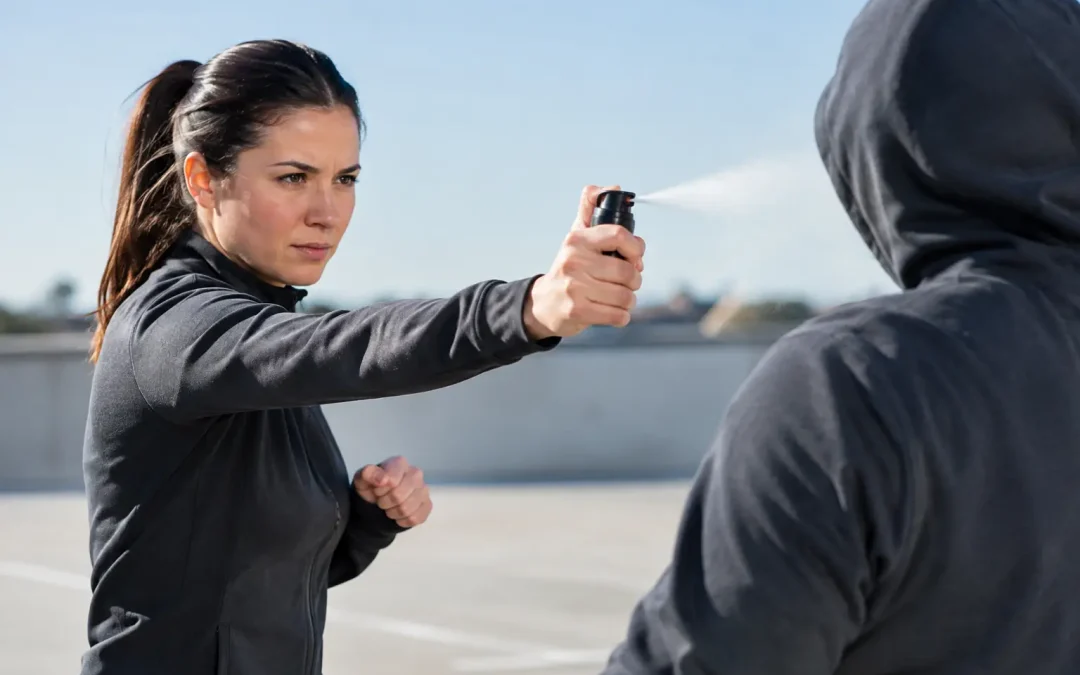
A canister in your bag can feel reassuring. Then the elevator door opens, someone crowds your space, your heart rate spikes, and the moment is already moving faster than your plan. That is where pepper spray versus training becomes the wrong question if you treat either option as a guaranteed answer.
Pepper spray can be a useful personal-safety tool. Practical self-defense training can give you skills no item can provide. But neither one makes you invincible. The stronger approach is to understand what each does well, where each can fail, and how to make decisions under pressure before you are forced to make them in a crisis.
Pepper Spray Versus Training: The Real Difference
Pepper spray is a tool. Training is a capability.
A tool may create distance, interrupt an assault, and give you an opening to escape. Its value is immediate and simple: you do not need size, strength, or years of martial arts experience to carry it. For many people, that matters. A working professional walking from a parking structure, a commuter getting home late, or a traveler in an unfamiliar area may want an option that is compact and easy to access.
But a tool only works when you can get to it, deploy it correctly, and use it at the right moment. Stress can make simple actions difficult. Hands shake. Fine motor control drops. Your bag may be out of reach. You may be pinned, grabbed, distracted, or unable to see clearly. Wind, confined spaces, and close proximity can also create problems. Spray can affect the person carrying it, nearby bystanders, or everyone in a small room.
Training works differently. It does not depend on having one object in one place at one exact moment. It develops awareness, posture, verbal boundaries, movement, decision-making, and simple physical responses. More importantly, it teaches you to act while your body is under stress, not just while you are calm and imagining a threat from the comfort of home.
That does not mean training makes pepper spray unnecessary. It means training gives you a better chance of using any tool with judgment.
Why Confidence From Carrying a Tool Can Be Misleading
The danger is not pepper spray itself. The danger is false confidence.
Many people buy a safety device, put it in a handbag or glove box, and assume they are prepared. They have never checked whether it is legal where they live, whether it is expired, whether they can access it quickly, or whether they can operate it under pressure. They have also never considered what happens if the first attempt does not stop the threat.
Real danger rarely arrives with a warning and plenty of space. It can begin as someone following too closely, blocking your path, refusing to respect a clear no, grabbing your arm, or invading your personal space near a doorway. By the time you recognize the threat, you may need more than a tool. You may need to move, create distance, protect yourself, shout for help, and leave without freezing.
That is why reality-based training does not start with dramatic disarms or complicated sequences. It starts with the moments people actually face: reading behavior, managing distance, setting boundaries, responding to sudden contact, and getting away.
Training Builds the Response Before You Need It
Watching a self-defense video is not training. Memorizing a sequence is not training. Knowing the name of a technique is not training.
Training means practicing a response until it becomes more available under pressure. You learn that an attacker may not stand still. You learn that your own balance, breathing, and decision-making can change when adrenaline hits. You learn to keep your actions simple because complex plans often disappear when fear takes over.
Good training also removes dangerous assumptions. You may be smaller than the aggressor. You may be tired, carrying work materials, wearing restrictive clothing, or dealing with uneven ground. You may have only seconds to react. A practical program prepares for those realities rather than asking you to perform a perfect technique against a cooperative partner.
At Urban Street Defense, that means focusing on direct, adaptable responses instead of ceremonial forms or sport-based routines. The goal is not to look impressive. The goal is to break contact, create a chance to escape, and get home safely.
When Pepper Spray Makes Sense
Pepper spray may be worth carrying when it is legal in your area, you understand the local restrictions, and you are willing to treat it as one layer of a wider safety plan. It can be especially useful when you have enough distance to identify a threat before physical contact begins.
It may help interrupt an attack and buy a few critical seconds. Those seconds are valuable only if you know what they are for: leave, find safety, contact emergency services, and avoid re-engaging. Personal protection is not about winning an argument or proving you can handle someone. It is about getting out.
Responsible ownership matters. Keep the device accessible rather than buried under everyday items. Check its condition and expiration date. Learn its operation according to the manufacturer’s instructions. Most of all, understand the legal rules where you live, work, and travel. Laws on possession and use vary, and a safety tool should never become a legal or physical liability.
When Training Matters More Than a Canister
Training becomes essential when the threat is already close. If someone has grabbed you, blocked your movement, cornered you, or caught you off guard, there may be no clean opportunity to access pepper spray. The same is true in crowded public spaces, vehicles, elevators, or areas where spraying may affect you or others.
This is where body position, balance, voice, awareness, and simple escape-focused movement matter. You need options that work whether you have a tool or not.
Training is also what helps before violence starts. A strong verbal boundary, a better position near an exit, an earlier decision to leave, or the awareness to spot escalating behavior can prevent a situation from becoming physical. These skills are not glamorous. They are highly useful.
For corporate teams, this point is often missed. Workplace safety is not only about responding to an obvious physical attack. Employees benefit from learning situational awareness, boundary setting, travel safety habits, and how to respond when a confrontation becomes unpredictable. A good program gives people practical choices without turning them into fighters.
Do Not Train for a Perfect Scenario
There is no single answer that works in every confrontation. A tool can fail. A technique can fail. A person can freeze. That is why practical self-defense should train adaptable principles, not rehearsed fantasy scenes.
The most useful principles are simple: stay aware, trust early warning signs, create distance when you can, use your voice, protect yourself when contact happens, and escape at the first real opportunity. Under pressure, simple actions are more likely to survive.
Pressure-tested practice matters because it shows where your assumptions break down. You may discover that a move you understood in slow motion is difficult when someone resists. That is not failure. That is valuable feedback. It gives you a chance to build a more honest, effective response in a controlled environment.
The Best Answer Is Layered Preparedness
You do not have to choose between carrying pepper spray and learning self-defense. If pepper spray is lawful and appropriate for you, carry it responsibly. Then build the skills that support it.
Think of personal safety as layers. Your first layer is awareness: noticing risk early and avoiding bad positions when possible. Your next layer is communication: setting clear boundaries and drawing attention when needed. Movement and escape come next. Physical self-defense is for the moment you cannot avoid. A lawful tool can be another layer, not the entire plan.
This approach is more realistic because it accounts for uncertainty. Some days you will not have your bag. Some places will make a spray tool impractical. Some threats will begin too close. Your own body, judgment, and ability to act are the only things you carry everywhere.
Start with what works under pressure, not what looks good in a demonstration. A safety tool may give you an opening. Training helps you recognize it, use it, and leave before the situation takes more from you than it should.