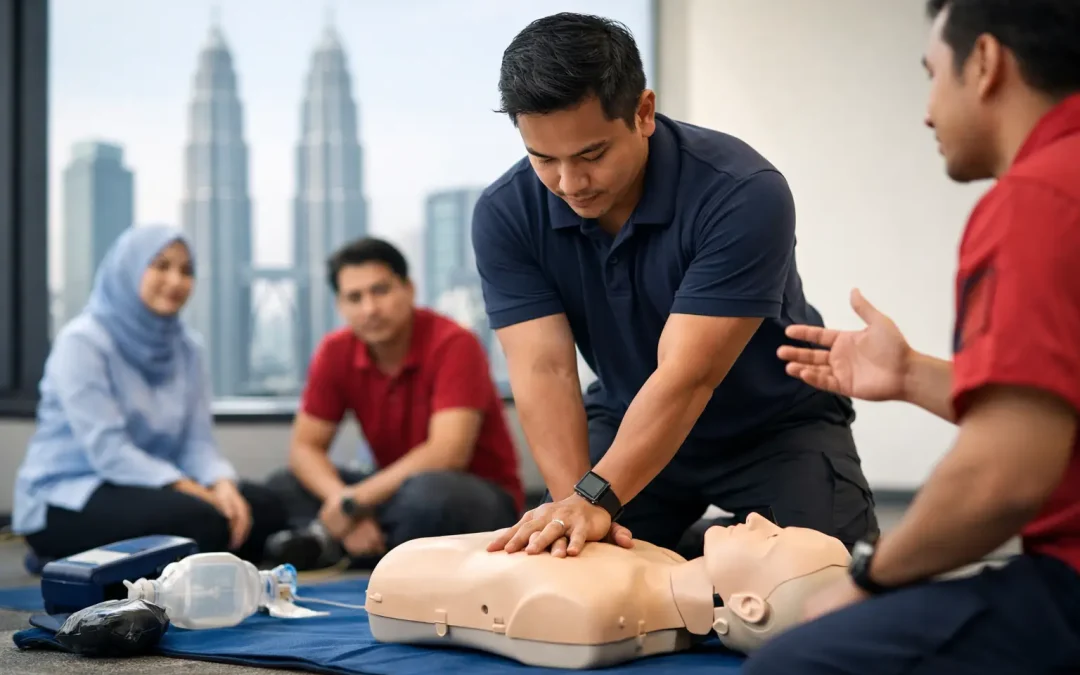
A person collapses at the office, on a train platform, or during a family meal. The room often freezes for a few seconds. Those seconds matter. CPR training in Malaysia is not about collecting a certificate or memorizing medical language. It is about recognizing a life-threatening emergency, taking control of the scene, and starting the right actions before emergency responders arrive.

For people who care about real-world safety, this is a skill worth having. You may never need it. But if cardiac arrest happens in front of you, being ready is far better than wishing you had acted.

Why CPR Training in Malaysia Is a Practical Safety Skill

Cardiac arrest can happen without warning. The person may suddenly collapse, become unresponsive, and stop breathing normally. They may make irregular gasping sounds that do not count as normal breathing. Waiting to see whether they recover wastes valuable time.

CPR keeps blood moving to the brain and vital organs until a defibrillator or professional medical care can take over. It does not guarantee an outcome. No honest instructor should promise that. What it does is give the person a better chance than doing nothing.

That is why practical training matters. A good course teaches you to make decisions under pressure, not merely repeat facts in a classroom. You need to know what an unresponsive person looks like, how to call for help, where to place your hands, how hard and how fast to compress, and how to use an automated external defibrillator, or AED, when one is available.

For working adults, parents, commuters, coaches, security personnel, and team leaders, the value is straightforward: you become someone who can act when others hesitate.

What You Should Learn in a Quality CPR Course

The best CPR courses are hands-on. You should spend meaningful time practicing on a manikin, not just watching a presentation. Chest compressions are physical. Correct hand position, body posture, depth, rate, and full chest recoil are easier to understand when an instructor can correct you in real time.

A capable course should cover how to assess scene safety first. You cannot help anyone if you enter a dangerous area without thinking. Traffic, electrical hazards, fire, violence, unstable structures, and panicked crowds can turn one casualty into two.

From there, training should move through a clear response sequence: check responsiveness, get emergency help moving, begin CPR if the person is unresponsive and not breathing normally, and bring in an AED as quickly as possible. The AED is designed to guide users with voice prompts. Do not be intimidated by it. Early defibrillation can be critical in certain cardiac emergencies.

Choking response is another valuable component. A person who cannot speak, cough, or breathe effectively needs immediate help. Training should teach you how to identify severe choking and when to switch from choking assistance to CPR if the person becomes unresponsive.

Ask whether the program also includes recovery position, bleeding control, and how to communicate clearly with emergency responders. These are not extras. They are part of managing the first minutes of a real emergency.

Certification Matters, but Ability Matters More

A recognized certificate can be useful for workplaces, schools, gyms, childcare settings, and organizations with compliance requirements. It shows that you completed a course and may need periodic renewal. If your employer has a specific requirement, confirm which provider or credential it accepts before you enroll.

But a card in your wallet will not perform compressions. Skill fades when it is not practiced. Someone who trained years ago and never touched a manikin again may struggle to respond with confidence. Refresher training is not a formality. It is how you keep the sequence clear and your movements effective.

When comparing providers, look beyond the certificate. Ask how much practical practice is included, whether AED use is taught, how large the class is, who delivers the instruction, and how often you can refresh your skills. Small-group practice usually gives you more coaching than a crowded lecture room.

There is also a trade-off between speed and depth. A short awareness session may help people understand what CPR is. It may not give them enough repetition to perform well under stress. If you want real readiness, choose a course that gives you time to practice, ask questions, make mistakes, and repeat the process until it feels familiar.

The First Minutes: Simple Actions, No Fancy Moves

Emergency response should be simple because stress makes complicated plans fall apart. If you find an adult who has collapsed, make sure the area is safe, check whether they respond, and call emergency services or direct a specific person to call. If they are not breathing normally, begin CPR and send someone for an AED.

Do not shout vaguely for help. Point to a person and give a direct instruction: Call emergency services now. Bring the AED. Clear the area. Specific commands cut through confusion.

Start firm, continuous chest compressions in the center of the chest, following the method taught in your certified course. Allow the chest to recoil between compressions and minimize interruptions. If you are trained and willing to provide rescue breaths, use the current method your course teaches. If you are not, hands-only CPR is still an immediate action that can make a difference for a collapsed adult until help arrives.

Follow the AED prompts as soon as the device is available. It will tell you when to stop, when to stand clear, and whether a shock is advised. Your job is not to diagnose the heart rhythm. Your job is to keep the response moving.

CPR Is Part of Personal Safety, Not a Replacement for It

Personal safety is not one skill. It is a layered response. Awareness helps you spot danger early. Practical self-defense can help you create space and escape an immediate assault. First aid and CPR prepare you to help when someone is injured or collapses.

These skills overlap in one crucial way: pressure changes people. Fine motor skills degrade. Memory narrows. Panic spreads. Training must build a simple response you can access when your heart rate rises.

That is also why scenario-based learning has value. In a real incident, you may be dealing with noise, a crowd, limited space, a frightened family member, or a person who looks more asleep than seriously ill. Practice that acknowledges those conditions is more useful than polished theory.

Still, know the boundaries. CPR is for a medical emergency, not a way to handle an ongoing violent threat. If the scene is unsafe, create distance and get help. No technique is worth staying in a position where you become the next casualty.

Choosing CPR Training for Your Workplace or Group

CPR training is especially valuable in workplaces because emergencies do not wait for a convenient location. Offices, warehouses, retail spaces, schools, fitness centers, and event venues all have people on site who may be able to respond first.

For employers, the right format depends on the environment. A small office may need a focused session for designated first responders. A larger organization may need broader staff participation, AED familiarization, and regular refresher scheduling. Teams that work with the public, operate machinery, travel, or host customers should consider how quickly emergency help can reach them and where an AED is located.

Private groups can benefit too. Families caring for older relatives, parents of young children, sports communities, and residential groups often have strong reasons to train together. Learning with people you already know can improve communication during an emergency. Assign roles during practice: one person calls, one retrieves the AED, one starts CPR, and another guides responders to the scene.

Do not choose a provider solely because it is cheapest or closest. Convenience matters, especially if it gets people trained. But practical time, competent instruction, current methods, and enough equipment for participants matter more.

Build Readiness Before an Emergency Happens

Training is the start, not the finish. After your course, identify the AEDs in places you use often. Your office, condominium, gym, mall, or transit hub may have one nearby. Learn the emergency contact process where you work. Make sure your family knows your address and can explain it clearly under stress.

Refresh the skill regularly. Practice the decision sequence in your head: safe scene, unresponsive person, call for help, CPR, AED. The goal is not to become a medical professional. The goal is to avoid paralysis when immediate action is needed.

Real safety has no room for ornamental knowledge. Learn the skill, practice it properly, and be prepared to step forward when someone else cannot.

A person collapses at the office, on a train platform, or during a family meal. The room often freezes for a few seconds. Those seconds matter. CPR training in Malaysia is not about collecting a certificate or memorizing medical language. It is about recognizing a life-threatening emergency, taking control of the scene, and starting the right actions before emergency responders arrive.

For people who care about real-world safety, this is a skill worth having. You may never need it. But if cardiac arrest happens in front of you, being ready is far better than wishing you had acted.

Why CPR Training in Malaysia Is a Practical Safety Skill

Cardiac arrest can happen without warning. The person may suddenly collapse, become unresponsive, and stop breathing normally. They may make irregular gasping sounds that do not count as normal breathing. Waiting to see whether they recover wastes valuable time.

CPR keeps blood moving to the brain and vital organs until a defibrillator or professional medical care can take over. It does not guarantee an outcome. No honest instructor should promise that. What it does is give the person a better chance than doing nothing.

That is why practical training matters. A good course teaches you to make decisions under pressure, not merely repeat facts in a classroom. You need to know what an unresponsive person looks like, how to call for help, where to place your hands, how hard and how fast to compress, and how to use an automated external defibrillator, or AED, when one is available.

For working adults, parents, commuters, coaches, security personnel, and team leaders, the value is straightforward: you become someone who can act when others hesitate.

What You Should Learn in a Quality CPR Course

The best CPR courses are hands-on. You should spend meaningful time practicing on a manikin, not just watching a presentation. Chest compressions are physical. Correct hand position, body posture, depth, rate, and full chest recoil are easier to understand when an instructor can correct you in real time.

A capable course should cover how to assess scene safety first. You cannot help anyone if you enter a dangerous area without thinking. Traffic, electrical hazards, fire, violence, unstable structures, and panicked crowds can turn one casualty into two.

From there, training should move through a clear response sequence: check responsiveness, get emergency help moving, begin CPR if the person is unresponsive and not breathing normally, and bring in an AED as quickly as possible. The AED is designed to guide users with voice prompts. Do not be intimidated by it. Early defibrillation can be critical in certain cardiac emergencies.

Choking response is another valuable component. A person who cannot speak, cough, or breathe effectively needs immediate help. Training should teach you how to identify severe choking and when to switch from choking assistance to CPR if the person becomes unresponsive.

Ask whether the program also includes recovery position, bleeding control, and how to communicate clearly with emergency responders. These are not extras. They are part of managing the first minutes of a real emergency.

Certification Matters, but Ability Matters More

A recognized certificate can be useful for workplaces, schools, gyms, childcare settings, and organizations with compliance requirements. It shows that you completed a course and may need periodic renewal. If your employer has a specific requirement, confirm which provider or credential it accepts before you enroll.

But a card in your wallet will not perform compressions. Skill fades when it is not practiced. Someone who trained years ago and never touched a manikin again may struggle to respond with confidence. Refresher training is not a formality. It is how you keep the sequence clear and your movements effective.

When comparing providers, look beyond the certificate. Ask how much practical practice is included, whether AED use is taught, how large the class is, who delivers the instruction, and how often you can refresh your skills. Small-group practice usually gives you more coaching than a crowded lecture room.

There is also a trade-off between speed and depth. A short awareness session may help people understand what CPR is. It may not give them enough repetition to perform well under stress. If you want real readiness, choose a course that gives you time to practice, ask questions, make mistakes, and repeat the process until it feels familiar.

The First Minutes: Simple Actions, No Fancy Moves

Emergency response should be simple because stress makes complicated plans fall apart. If you find an adult who has collapsed, make sure the area is safe, check whether they respond, and call emergency services or direct a specific person to call. If they are not breathing normally, begin CPR and send someone for an AED.

Do not shout vaguely for help. Point to a person and give a direct instruction: Call emergency services now. Bring the AED. Clear the area. Specific commands cut through confusion.

Start firm, continuous chest compressions in the center of the chest, following the method taught in your certified course. Allow the chest to recoil between compressions and minimize interruptions. If you are trained and willing to provide rescue breaths, use the current method your course teaches. If you are not, hands-only CPR is still an immediate action that can make a difference for a collapsed adult until help arrives.

Follow the AED prompts as soon as the device is available. It will tell you when to stop, when to stand clear, and whether a shock is advised. Your job is not to diagnose the heart rhythm. Your job is to keep the response moving.

CPR Is Part of Personal Safety, Not a Replacement for It

Personal safety is not one skill. It is a layered response. Awareness helps you spot danger early. Practical self-defense can help you create space and escape an immediate assault. First aid and CPR prepare you to help when someone is injured or collapses.

These skills overlap in one crucial way: pressure changes people. Fine motor skills degrade. Memory narrows. Panic spreads. Training must build a simple response you can access when your heart rate rises.

That is also why scenario-based learning has value. In a real incident, you may be dealing with noise, a crowd, limited space, a frightened family member, or a person who looks more asleep than seriously ill. Practice that acknowledges those conditions is more useful than polished theory.

Still, know the boundaries. CPR is for a medical emergency, not a way to handle an ongoing violent threat. If the scene is unsafe, create distance and get help. No technique is worth staying in a position where you become the next casualty.

Choosing CPR Training for Your Workplace or Group

CPR training is especially valuable in workplaces because emergencies do not wait for a convenient location. Offices, warehouses, retail spaces, schools, fitness centers, and event venues all have people on site who may be able to respond first.

For employers, the right format depends on the environment. A small office may need a focused session for designated first responders. A larger organization may need broader staff participation, AED familiarization, and regular refresher scheduling. Teams that work with the public, operate machinery, travel, or host customers should consider how quickly emergency help can reach them and where an AED is located.

Private groups can benefit too. Families caring for older relatives, parents of young children, sports communities, and residential groups often have strong reasons to train together. Learning with people you already know can improve communication during an emergency. Assign roles during practice: one person calls, one retrieves the AED, one starts CPR, and another guides responders to the scene.

Do not choose a provider solely because it is cheapest or closest. Convenience matters, especially if it gets people trained. But practical time, competent instruction, current methods, and enough equipment for participants matter more.

Build Readiness Before an Emergency Happens

Training is the start, not the finish. After your course, identify the AEDs in places you use often. Your office, condominium, gym, mall, or transit hub may have one nearby. Learn the emergency contact process where you work. Make sure your family knows your address and can explain it clearly under stress.

Refresh the skill regularly. Practice the decision sequence in your head: safe scene, unresponsive person, call for help, CPR, AED. The goal is not to become a medical professional. The goal is to avoid paralysis when immediate action is needed.

Real safety has no room for ornamental knowledge. Learn the skill, practice it properly, and be prepared to step forward when someone else cannot.