
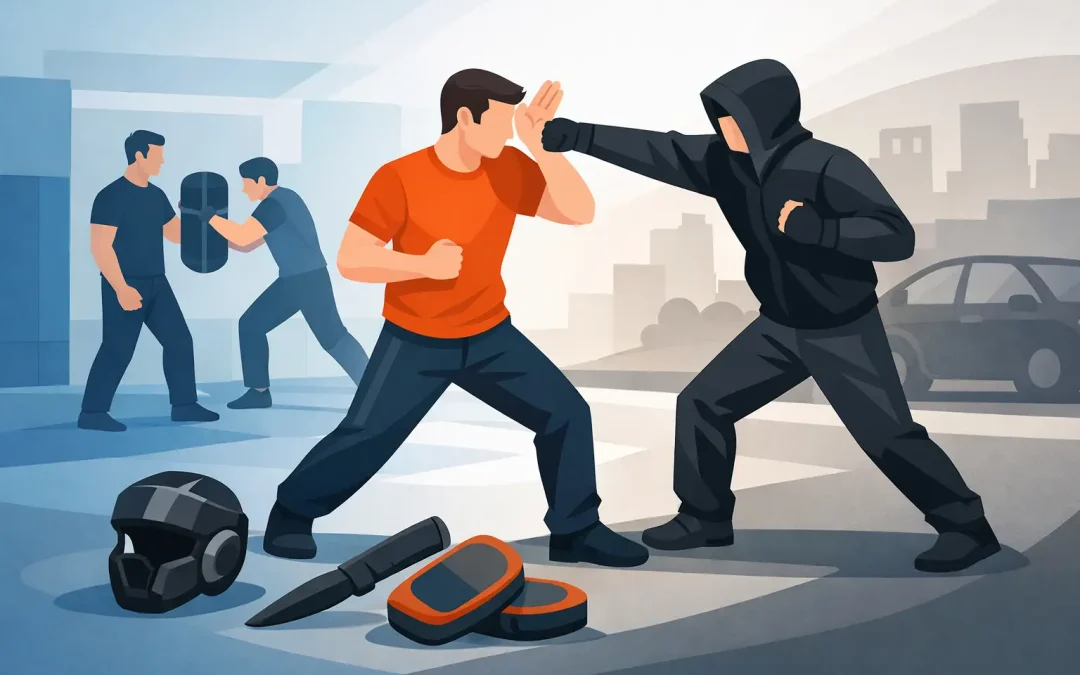
A confrontation rarely announces itself. It may begin in a parking garage, a crowded lift, outside a workplace, or during the walk from public transit to your car. Reality based self defense training prepares you for that uncertainty: the stress, close distance, confusion, and split-second decisions that make real danger very different from a controlled martial arts class.
The goal is not to look skilled. The goal is to recognize danger earlier, create an opportunity to get away, and act decisively when there is no safer option. No fancy moves. No memorized routine that depends on an attacker standing still. Just practical habits that can hold up when your heart rate climbs and your thinking becomes less clear.
What Reality Based Self Defense Training Means
Reality-based training starts with an honest question: what is likely to happen in an urban personal-safety situation? Usually, it is fast, close, awkward, and unexpected. You may be carrying a bag, wearing work clothes, standing in a tight space, or trying to protect a friend or family member. The other person may be bigger, aggressive, intoxicated, or trying to intimidate you before any physical contact begins.
That changes how you should train. A useful program does not build around complicated sequences, ceremonial forms, or techniques that require perfect timing. It builds around simple movement, awareness, verbal boundaries, balance, escape, and direct action under pressure.
This does not mean every situation ends physically. In fact, avoiding a fight is usually the best outcome. Good self-defense training teaches you to spot problems, manage distance, use your voice, leave early, and seek help. Physical skills are there for the moments when avoidance has failed and immediate action is necessary.
Real Pressure Exposes What You Can Use
A technique can feel easy when a partner is cooperative. That is not the test. The test is whether you can access a simple response when someone is moving, resisting, crowding you, and creating stress.
Under pressure, fine motor control drops. People freeze, rush, lose balance, or forget a long sequence of moves. That is why practical training favors gross, natural movements and repeatable principles over a large collection of techniques. You need options that are direct enough to remember and adaptable enough to work from imperfect positions.
Pressure-oriented sparring and scenario work matter because they reveal the gap between knowing and doing. You may understand what to do while watching an instructor, then discover that distance, noise, adrenaline, and surprise change everything. That discovery is valuable. It gives you a chance to build a calmer, faster response in training instead of learning the lesson during a real incident.
The point is not to prove who is toughest in class. It is to practice making decisions when conditions are uncomfortable. Can you keep moving? Can you protect your space? Can you disengage when an opening appears? Can you stop trying to win an exchange and start trying to get home safely?
The Skills That Matter Before Contact
Self-defense begins long before physical action. Awareness is not paranoia. It is noticing your environment well enough to make better choices. Keep your attention off distractions when entering isolated areas. Know where the exits are. Trust behavior that feels wrong, even if you cannot immediately explain why.
Distance is another major advantage. The closer a potential aggressor gets, the fewer options you have. A trained person learns to notice crowding, blocking, unwanted touching, and attempts to isolate them. Clear verbal boundaries can be powerful here. A firm, audible command may attract attention, disrupt an aggressor’s plan, and give you a moment to move.
These skills are especially relevant for commuters, shift workers, students, travelers, and professionals who spend long hours moving through city spaces. They also apply in workplaces. Personal safety is not only about strangers. Boundary violations, intimidation, and conflict can happen around people you know.
Why Simple Beats Impressive
Complicated techniques are often impressive in demonstrations because every movement happens at the right moment. Real situations do not offer that kind of cooperation. Your footing may be poor. Your vision may be blocked. You may be startled or off-balance.
Simplicity is not a lack of skill. It is disciplined selection. You train responses that are direct, efficient, and flexible enough to use when conditions are messy. Jeet Kune Do-inspired principles are useful here: take what is functional, remove what is unnecessary, and adapt to the situation in front of you.
There is a trade-off. Training only a few simple ideas does not make anyone invincible, and no responsible instructor should promise that. But a smaller set of well-practiced responses is more likely to be available under stress than dozens of techniques learned once and never pressure-tested.
A Good Program Trains the Mind Too
Fear changes behavior. Some people freeze. Others become overly aggressive. Both reactions can make a bad situation worse. Reality-based self-defense should help students recognize their stress response and continue making useful decisions anyway.
That includes permission to act. Many people hesitate because they are worried about being rude, making a scene, or misreading someone’s intentions. Training can help you set boundaries earlier and understand that creating distance is not an overreaction when someone ignores a clear request.
It also includes restraint. The purpose of self-defense is safety, not punishment. Once you can leave, leave. Once immediate danger has ended, seek help, contact the relevant authorities, and document what you can safely remember. Good judgment is part of capability.
What to Look for in Reality-Based Self Defense Training
Choose training that respects beginners without treating them as fragile. You should be able to start with no martial arts background, learn in a controlled environment, and progress at a pace that develops confidence rather than false bravado.
Look for instructors who explain why a drill matters and who allow students to experience realistic resistance gradually. Ask whether the class addresses verbal boundaries, awareness, escape, and decision-making, not just physical techniques. Small class sizes and private coaching can be especially useful if you want more feedback or have specific concerns about commuting, travel, workplace safety, or a past experience.
Be cautious of programs that make guarantees, rely only on choreography, or present every threat as a fight to be won. Safety training should make you more aware, more prepared, and more capable of leaving danger. It should not encourage reckless confidence.
For organizations, the same standard applies. Corporate personal-safety training should be practical, inclusive, and relevant to the environments employees actually use. A useful session gives people clear actions they can remember after the workshop, whether they commute late, travel for work, meet clients, or work in public-facing roles.
Train for the Life You Actually Live
The best self-defense training fits real schedules and real concerns. A busy professional may need focused sessions that build core skills quickly. A private group may want training tailored to the places and situations they share. Women-focused courses can address common boundary and personal-safety concerns without assuming women need a separate set of rules for becoming capable.
Urban Street Defense approaches training with this standard: build functional responses through scenario-based practice, direct movement, and pressure-tested learning. The aim is not to collect techniques. It is to become harder to intimidate, harder to isolate, and better able to act when a situation turns wrong.
You do not need to wait for a frightening experience to take your safety seriously. Start with awareness. Practice clear boundaries. Put yourself in a training environment that challenges you safely. Confidence is not pretending danger will never happen. It is knowing you have prepared to respond when it does.